Linguistics
Reasearch and Ideas on the breakdown of Languages, Scripts, and Tribal Families.
Note: ADD proper names and cross-internal links.
Note: ADD list of "special" details to add the various details for extras, ie. saltmarshes of Vashel, under Tamsen Forest.
Note: Text Highlight and Background Colour: Kandáy, Réthem, Thârda, Káldôr, Mèlderýn, Chybísa, Orbáal, Ázadmêre, Eváel.
Note: Green = I Have, Red = Don't Have, Orange = Old Scan, Blue = Misc, Black = ALL Base (Template)
Note: Colour Highlights: Yellow
Colour LINK Text: Possible Link NAME
Note: Hidden comments <!-- TEXT HERE WILL NOT BE DISPLAYED -->
Note: Anchor Points - Section linking WITHIN pages USE [[Help:Section#Section_linking|Section linking]] or To link to a section in the same page you can use [[#section name|displayed text]], and to link to a section in another page [[page name#section name|displayed text]].
Note: Section linking with arbitrary id USE <span id="anchor_name"></span>. Be sure to use a name that is not likely to be duplicated. One way to do this is to incorporate the titles of the higher-level sections, at least in abbreviated form, e.g., Ontario-Natural_features for the "Natural features" subsection of the "Ontario" section of an article about the provinces of Canada.
ADD inside Table Caption/Heaer Text
Contents
- 1 Linguistics
- 2 Language/Linguistic Research
- 3 A
- 4 Kèthîra Languages
- 5 Venârivè: Northwestern Lýthia
- 6 Missing Languages
- 7 A
- 8 A
- 9 A
- 10 A
- 11 Family Tree Ideas
- 12 Name & Dates List
- 13 Notes
Linguistics
ADD Family Tree Styled Linguistics Tree Diagram for all Languages.
Replace “ ” with "
Replace ‘ ’ with '
Possible Link
INSERT TABLE
{{Smallcaps|tr}} or {{Smallcaps|bt}}
 |
Language/Linguistic Research
Here we shall list all links to references to Linguistics and the construction of a Family Tree of Languages
Note: ADD ColourBoxes and sub colour box colours from wikipedia
North Germanic
West Germanic
 North Sea Germanic
 Weser-Rhine Germanic
 Elbe Germanic
East Germanic
East Germanic
Background colors used on Wikipedia
- Background colors used on Wikipedia for various language families and groups
MAKE nested tables?
| Background colors used on Wikipedia for various language families and groups | ||||||
|---|---|---|---|---|---|---|
| Afro-Asiatic | Nilo-Saharan? | Niger–Congo | Khoisan (areal) | |||
| Indo-European | Caucasian (areal) | Uralic | Dravidian | Altaic (areal) | Paleosiberian (areal) | |
| Sino-Tibetan | Hmong–Mien | Kra–Dai | Austroasiatic | Austronesian | Papuan (areal) | Australian (areal) |
| Eskimo–Aleut | Na-Dené (and Dené–Yeniseian) | American (areal) | ||||
| Creole/Pidgin/Mixed | language isolate | sign language | constructed language | unclassified | ||
Background colors used on Wikipedia
Note: ADD and CREATE a table like this for all the Languages & Tribes plus TimeLine
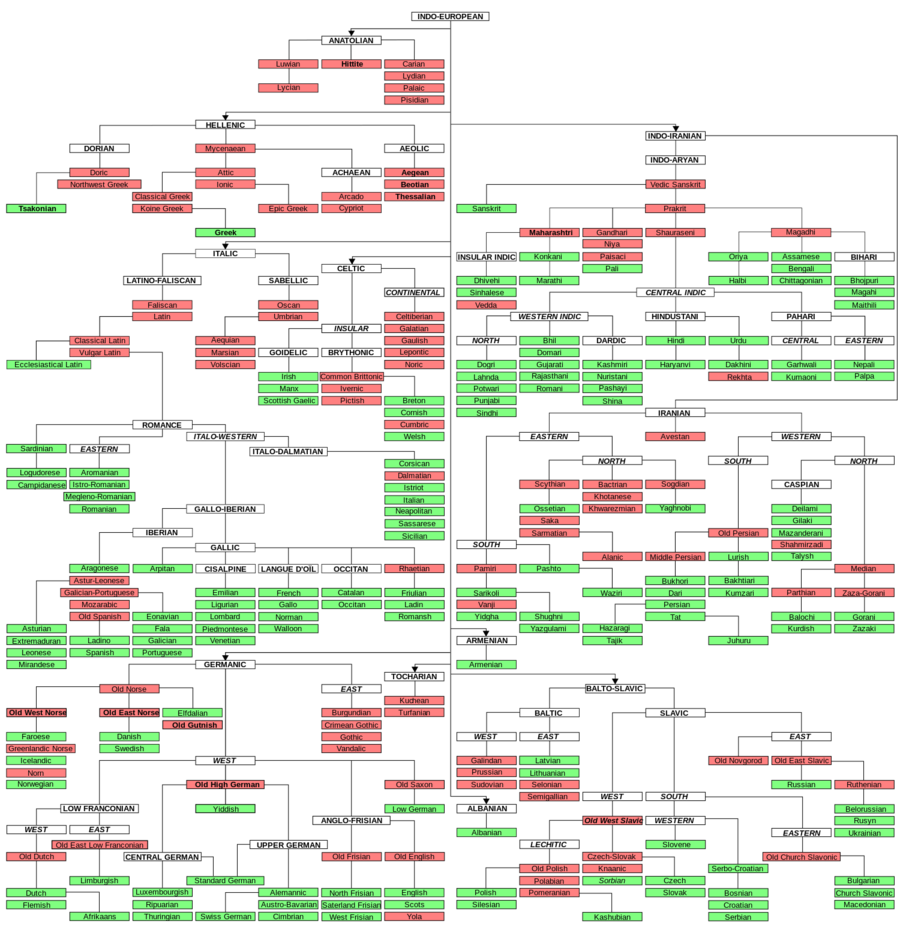
The table below shows the succession of the significant historical stages of each language (horizontally) and their approximate groupings in subfamilies (vertically). Vertical sequence within each group does not imply a measure of greater or lesser similarity.
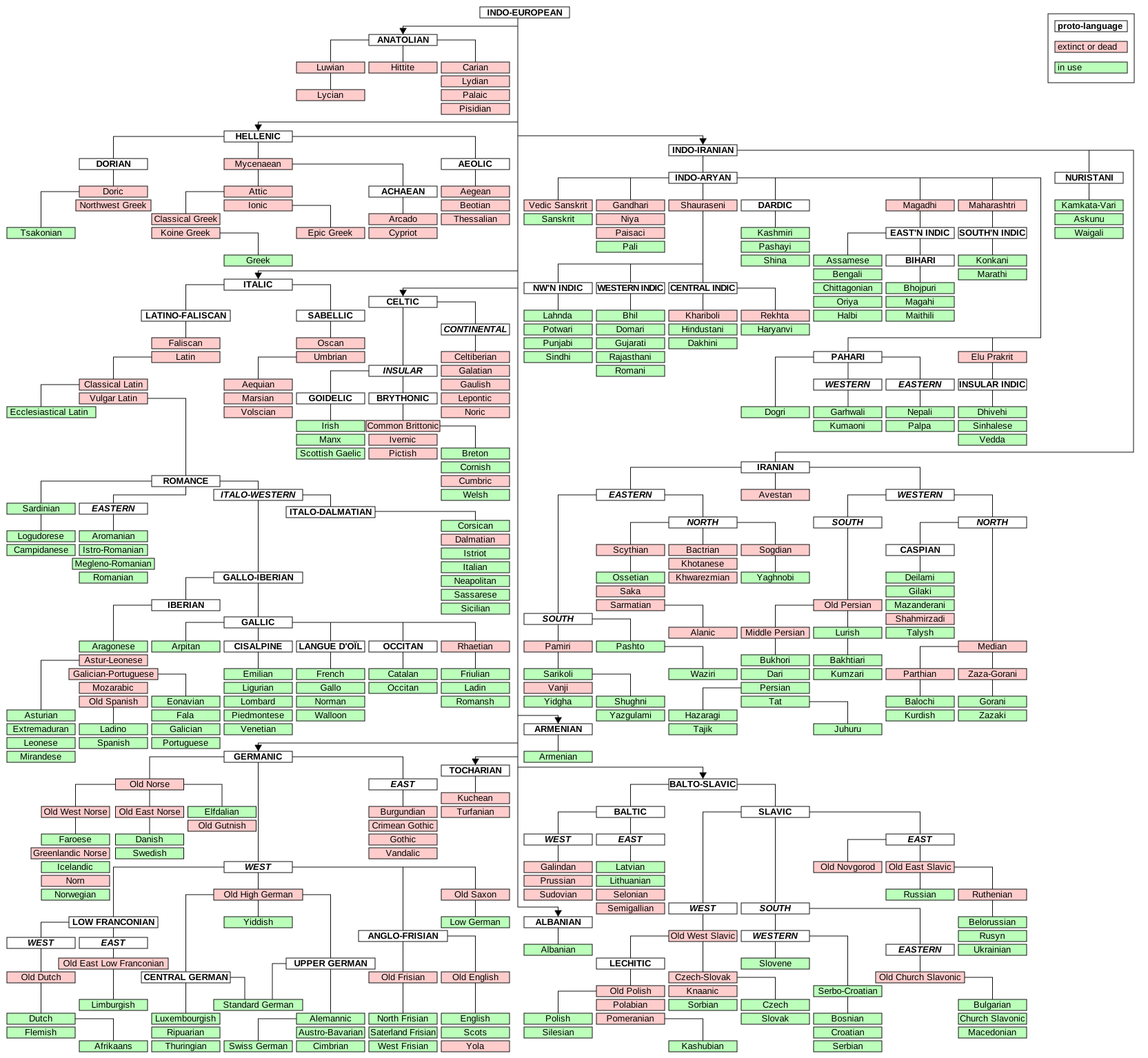
IndoEuropean Tree Graph
Proto-Indo-European language Historical and geographical setting
 |
Other References
- Hydronym
- A hydronym is a proper name of a body of water. Hydronymy, a subset of toponymy, the taxonomic study of place-names, is the study of the names of bodies of water, the origins of those names, and how they are transmitted through history. Hydronyms may include the names of rivers (potamonyms), lakes, and even oceanic elements.
Compared to most other toponyms, hydronyms are very conservative linguistically, and people who move to an area often retain the existing name of a body of water rather than rename it in their own language. For example, the Rhine in Germany bears a Celtic name, not a German name. The Mississippi River in the United States bears an Anishinaabe name, not a French or English one. The names of large rivers are even more conservative than the local names of small streams.
Therefore, hydronomy may be a tool used to reconstruct past cultural interactions, population movements, religious conversions, or older languages. For example, history professor Kenneth H. Jackson identified a river-name pattern against which to fit the story of the Anglo-Saxon invasion of Britain and pockets of surviving native British culture. His river map of Britain divided the island into three principal areas of English settlement: the river valleys draining eastward in which surviving British names are limited to the largest rivers and Saxon settlement was early and dense; the highland spine; and a third region whose British hydronyms apply even to the smaller streams.
Often a given body of water will have several entirely different names given to it by different peoples living along its shores. For example, Tibetan: ་, Wylie: rDza chu, ZYPY: Za qu and Thai: แม่น้ำโขง are the Tibetan and Thai names, respectively, for the same river, the Mekong in southeast Asia. And the Tibetan term Za Qu (rdza chu) refers to three other rivers as well.
Hydronyms from various languages may all share a common etymology. For example, the Danube, Don, Dniester, Dnieper, and Donets rivers all contain the Scythian name for "river" (cf. don, "river, water" in modern Ossetic). A similar suggestion is that the Yarden, Yarkon, and Yarmouk (and possibly, with distortion, Yabbok and/or Arnon) rivers in the Israel/Jordan area contain the Egyptian word for river (itrw, transliterated in the Bible as ye'or).
It is also possible for a toponym to become a hydronym: for example, the River Liffey takes its name from the plain on which it stands, called Liphe or Life; the river originally was called An Ruirthech. An unusual example is the River Cam, which originally was called the Granta, but when the town of Grantebrycge became Cambridge, the river's name changed to match the toponym.
- Toponymy
- Toponymy is the study of place names (toponyms), their origins, meanings, use, and typology. Toponym is the general name for any place or geographical entity.
- Demonym
- A demonym is a word that identifies residents or natives of a particular place, which is derived from the name of that particular place.
- [A|A]
- A
- [A|A]
- A
- [A|A]
- A
A
- A
- A
Kèthîra Languages
MOVE all related research and linked information to Linguistics.
Map of Language Families
Language is a product of common historical and geographical experience over time, a vital element of culture and ethnicity. The people of Kèthîra speak more than 100 languages in 11 families. Family members share root words and sounds, but are still distinct tongues. The existence of a language family implies a common root from which all modern members are descended.
Járind Family
The Járind ethnic area included much of northwest Lýthia until migrations of eastern peoples displaced Járind culture north and west. Járind languages are characterised by a singsong lilt with occasional gutturals. Járind have fair to medium complexions, light brown or red wavy hair, and brown eyes.
- The Járind Family includes;
- Áltish
- Eméla
- Hârnic
- Jàrinése
- Yaríli
INSERT TABLE
Phâric Family
The Phâric peoples originated in Reksýna but were driven west into the Járind ethnic area by Ketâri tribes. Phâric tongues are characterised by rising-falling tones, compound nouns, and regular grammar. These rules are frequently broken; Phâric tongues have been strongly influenced by languages of other families. Phâric peoples are tall, with light straight hair, fair complexions, and blue-grey eyes.
- The Phâric Family includes;
- Hârbáaler/Chéler
- Ivínian
- Pálithàner
- Quârph
- Shôrka
- Tríerzi
INSERT TABLE
Azéri (or Venârian) Family
Azéri tongues are spoken around the Venârian Sea. Most tongues have extensive vocabularies and complex grammar, and are characterized by rising tones. Azéri have medium to swarthy complexion, and dark hair and eyes.
- The Azéri Family (or Venârian Family) includes;
- Àzeryáni (High & Low)
- Býrian
- Elbýthian
- Karéjian
- Ûrméch
INSERT TABLE
Anzélan Family
Anzélan tongues are spoken in Anzelôria. The original language spread from the south, dividing into Panhaónic in the north and Wernái in the south. Anzelôrian tongues are characterised by compounds of short, sharp syllables. The length of time that a vowel sound is voiced has meaning. Grammar and rhythm tend to be regular. Anzelôrians have dark to black complexions, dark curly hair and eyes.
- The Anzélan Family includes;
- Chogôri
- Geláphic
- Neshái
- Pèchalâri
- Thónian
- Túvarese
- Wernái
INSERT TABLE
Mafáni Family
Mafáni tongues are spoken around the Gulf of Mafán and Shéntu Sea. Mafáni languages are characterised by compound words, regular grammar, and short, precise rhythm; they have a clicking sound. The ancient Máfanese were far ranging people. They planted colonies around the Shéntu Sea and beyond. It is hard to identify a Máfanese ethnic type, since in most regions they have merged into native populations.
- The Mafáni Family includes;
- Máfanese
- Molnásian
- Shénti
- Thóta
INSERT TABLE
Molkûran Family
Molkûran languages are spoken in southeastern Lýthia. The family is derived from Molkûri, the language of the ancient Ziggurat Culture. Languages of this family have complex, precise grammar, and by variations in pitch and tone to convey rich meaning. The typical Molkûran has a dark to swarthy complexion, dark hair and eyes, and tends to be a little shorter than average.
- The Molkûran Family includes;
- Chomsúni
- Homôri
- Kánic
- Lashói
- Melûrian
- Mólken
- Mêrna-Mólken
- Pechósi
INSERT TABLE
Reshéni Family
Reshéni tongues are descended from Reshéni, the principal language of the Ch’mísa Empire. The Reshéni typically have dark complexions, dark hair and eyes, and tend to be shorter than average.
- The Reshéni Family includes;
- Argólan
- Jankôran
- Mengólan
- Shóji
INSERT TABLE
Ketâric Family
Ketâric languages are descended from Ancient Kétar, the language of the Ketârh barbarians who conquered much of central and eastern Lýthia between 1750-500 bt. Ketâri languages and peoples are diverse, strongly influenced by the indigenous tongues and cultures of the conquered regions.
- The Ketâric Family includes;
- Ánil-Ketâri
- Bésha
- Dálken
- Diramése
- Ketâri
- Kyâman
- Reksýni
INSERT TABLE
Númec Family
Númec tongues are descended from Hepéka. Númec peoples tend to be shorter than average and dark in colouring. The Kôrlic group tends to be lighter due to mixing with northern peoples. The Faláni are darker. Númec languages are characterised by long vowel sounds and guttural stops.
- The Númec Family includes;
- Faláni
- Kôrlic
- Númer
INSERT TABLE
Kámadh Family
The languages of Kámerand have developed largely in isolation, although Ínan seems to have some words contributed by Járind tongues and Ivínian.
- The Kámadh Family includes;
- Neránadher
- Ínan
- Hârazai
- Rakáma
- Erènakáma
- Yêrazh
- Hôro
INSERT TABLE
Mêrnáti Family
Except for limited influences from Molkûran and Kámadh tongues, the languages of Mêrnat have developed in isolation. The peoples who speak Mêrnáti tongues are swarthy to black. There are thousands of mutually intelligible dialects.
- The Mêrnáti Family includes;
- Mêrna
- Tían
- Dâdèn
- Kolôtis
INSERT TABLE
Venârivè: Northwestern Lýthia
Note: ADD colour boxes from Families ABOVE
Note: ADD colour for name of Language (including Dialect(s) colours from History Harn PDF) and another for Script. Put into a Language Table. Link to History of Hârn PDF.
Note: ADD Maps from P4, 5, 7, 8, 9, & 20 into A4 Booklet with each on a separate layer for printing.
Note: ADD Region & Map References to each.
- from Venârivè: Northwestern Lýthia P19 & 183
Possible Link
INSERT TABLE
{{Smallcaps|tr}} {{Smallcaps|bt}}
Culture and Language
Note: Make Alphabetical Listed
Note: ADD Link Highlights for Dialects
Note: ADD Link Highlights for Tribal Dialects from Barbarians COL 4761 (ie. P13); Barbarians
The Solori speak a language that is part of the Azeri language family.
The Kamaki speak Kamakin, which has elements of both Jarin and Anzelan languages.
Venârivè is a region where many cultural and linguistic groups have developed and interacted, forming a complex tapestry of social organisation, realms and peoples.
The major human cultural and linguistic groups of Venârivè are:
- Járind, including the Járin, Eméla, Yaríli, and Alti (Áltic), as well as Hârnians;
- Phâric, including the Ivinians and their colonies, Quarph, Shorka, and Trierzi; ~ Note: Phâric (Atáni)
- Azeri, including the Azeryani, Karejians, Ûmélrians, Elbythians, and Byrians;
- Ketari, including the Ketaric and Besha nomads, the Hacherim, and the Dalken;
- Mafani, including the Chogori and Shenti;
- Anzelôrians, including the Pechalari, Tuvarans, and Thonians;
- Hepekerians, including the Korlic, Dalani, Dalazeri, and Numec peoples.
In addition there are a number of non-human species and cultures, and a several religious languages. All of these are written in a range of different scripts.
Cultural and Linguistic Groups
Jarind
The Jarind are believed to have originated in the area now known as Ûmélria, and were the first known people to reach the western shores of Lýthia, around tr3000. They dominated the regions now known as Shôrkýnè and Trierzon for over a millennia. Jarind peoples also reached Ivinia and Hepekeria.
Emela is the most ‘pure’ of the Jarind languages, and is spoken principally by the inhabitants of Emélrenè, as well as the Émhlè peoples of western Venârivè.
- History: (Kingdom of Emélrenè P17) bt1450-1340 Conflict between Emélrenè and the Uphâri in Álagon and the Jerinálian Mountains.
- c. bt1400 Uphâri conquer much of Álagon, drive back Emélan allies.
- bt1340 Emélan Confederation defeat Uphâri in Álagon. ‘Closing of Emélrenè’, as Eméla leave Álaghan Alliance in control of Álagon.
Jarin is the language of the Jarind people of Hârn. It is spoken by tribal peoples and by the oppressed majority of the region of Orbáal. Jarin was much influenced by its interaction with the elder folk of Hârn.
Yarili is the language of the tribal Jarind people of Hârbáal and Ivinia. There are subtle differences between the peoples of the two regions;
- in Hârbáal. they are called Yarla.
Áltic is the language of the Álti, the Jarind people of the far northern regions of Lýthia. Their culture is now much influenced by the Ivinians.
Hârnians are a mixed people, whose complex social and cultural history includes influences from the Jarind and Phâri. ‘Civilised’ Hârnians speak a range of mutually comprehensible dialects, but the island’s many tribal groups speak dialects of varying intelligibility.
- Note: It is possible that the Uméni language of the tribal people of Ûmélria is an ancient Jarind tongue.
Phâri
The Phâri are a very broad cultural and linguistic group, said to have originated in north-central Lýthia. Their migrations westward around tr1700 caused significant cultural disruption, and led to the formation of new social and cultural groupings. The Ivinians and the Trierzi have had wide-ranging impact on the history of Venârivè.
Quarphic is the language of the Quarph, the people of Quârphor, distantly related to the Shorka and Trierzi. The Quarph have a variety of lifestyles, from nomadic to settled agrarian societies.
- There are four distinct dialects of Quarphic: western, southern, eastern and northern.
Hurisean is the language and culture of the settled people of the western part of Quârphor known as Hurisea, influenced by many surrounding cultures.
Ivinian is possibly the most wide-spread language of Venârivè. The Ivinians developed their culture in the far north on the island of Ivae, but have since spread colonies across many areas of Venârivè.
Hârbáaler and Chéler are two languages closely related to Ivinian, spoken in lands settled or conquered by Ivinians to the south.
- Note: Both have assimilated significant elements of other languages.
Pálithàner is a relatively young language developed from Ivinian, and spoken in coastal regions of the Ivinian colony-kingdom of Palíthanè.
Shorka is the name of a group of dialects spoken in the Kingdom of Shôrkýnè.
- Note: It is related to both Quarph and Trierzi, but has been significantly influenced by local Jarind tongues.
- Dialects include Qualren (the ‘official’ dialect), Melodan, Pelodan, Loalan, Fedin, Kolaren, Sabes, Enseler, Nistalen, and Jandi.
- History;
- (Kingdom of Emélrenè P17) bt1650 Phâric (Uphâri) people invade Shôrkýnè.
- (Venârivè P14) c. bt1650 Uphâri reach eastern Lówalys (Shôrkýnè)
- bt1280-1200 Wars in Álagon between Uphâri and Álagyn tribes; Uphâri eventually ‘defeated’.
- c.bt400 Sôrki (Shôrka) tribes reach Álagon
- bt1307 Uphâri defeat Shóna Alliance, take Plain of Káretan
- History;
Trierzi is the language of the region once known as Thanema and Zonara, now dominated by the Kingdom of Trierzon. It is also spoken in much of Palíthanè.
- Its many dialects can be mutually unintelligible; they include Liguno-Athaman, Senedar, Stalfi, Melsa-faldon, Alonadi, Areshymen, Cherykan, Zanori, and Tengalin.
Trade Ivínian (or Kántâl)
Trade Ivínian (or Kántâl) is the ‘lingua franca’ of trade across northwest Venârivè. Like Chéler and Hârbáaler (to which it is closely related), it is a polyglot dialect, which has adopted many terms and words from other languages, and is kept unified by the mobility of traders and seamen. Almost all sailors and traders in the region, irrespective of their own language and culture, have some facility with this language.
- Note: Polyglot means ‘ability to speak many languages’
- Need to figure out which languages are used within this group of traders before delving into the history and connected Dialects.
Azeri
The Azeri peoples are as diverse as the Phâri. Scholars claim to be able to trace their ancestry back to the Vénic Island culture which began on the eastern Venârian shore.
The Àzeryáni have had a major impact on Venârivè through the spread of their culture associated with the Empire of Ázeryàn. They evolved principally on the eastern regions of the Ázeryàn Peninsula, and came to dominate much of the region. While somewhat in decline in recent centuries, theirs is one of the most vibrant cultures of the region.
- The Àzeryáni speak two languages: Low Àzeryáni (Nâsik Azéri), which is highly differentiated by region, and High Àzeryáni (Zâkimladal), which is a highly uniform language of the upper classes, and of the government and bureaucracy.
- Dialects of Nâsik Azéri spoken within the Empire of Ázeryàn include: western, northern, central, southern, prime, eastern, and island.
- Dialects spoken in regions which were once part of the empire include: Lánkori (in Lánkor), Terâzin (in eastern Tríerzòn), Górik (in Gôris), Kôlvisar (in Menêma), and Dálazeri (in Vítho and Xêrium).
Karéjian is the language of most of the islands of the Venârian Sea and some areas of the eastern coast.
- It is the direct descendant of Kàruía, the language of the Kàruía people who were dominant traders across the region until the rise of Ázeryàn.
Urmech is a language related to both Àzeryáni and Karéjian, with local influences. It is spoken in inland regions of Ûmélria.
Elbythian is a language spoke in the inland regions of the eastern Venârian coast.
- It is related to Karéjian, with significant influence from Bésha, Hácherian, and Àzeryáni.
Býrian is the language of the Empire of Býria on the northern Anzelôrian coast.
- It is a mixture of Àzeryáni, Kàruía, Târgan, and northern Tuvâran.
Ketâri
The Ketâric peoples of central Lýthia have had a major impact on surrounding peoples, despite their relatively lower levels of cultural development. As the first people to domesticate the horse, they inflicted defeats on a number of ‘civilisations’ millennia ago, and continue to threaten agrarian cultures to this day. Most Ketâri have a nomadic lifestyle, although significant exceptions exist.
The Reksýni dominate the northern plains of Venârivè, having pushed the Quârph westward and inflicting a crushing defeat on the Empire of Ázeryàn in the middle of last century. They are a powerful confederation of tribes, but nowhere near as unified as they were at their height.
- Note: related to Rekâri? that became Reksýni?
- (see Venârivè P164) Gósan Réka-ul-Sýna – founding prophet of the ‘Reksýni’ religion, the faith that unified the Rekâri tribes into one of the most fearsome forces of Venârivè.
- (see also Venârivè P15, 16, & 18)
- c. bt800 Soquâr Phâri come to dominate in southern Quârphor.
- tr601 Pôrna River massacre, thousands of Rekâri tribes folk slaughtered by Quârph.
- c. bt600 Rekâri tribes begin to pressure Soquâr, leading to eventual split of Sôrki and Quâr.
- tr1 Rekâri tribes push into northeast Quârphor.
- c. tr200 Quârphic resurgence pushes back Rekâri tribes.
- (Summa Venâriva P99) Between tr360 and tr370 the (Ázeryàn?) legions methodically pushed the Rekâri tribes out of Úlga plain.
- (Summa Venâriva P50 & 59) The Àzeryáni explorer Hlárakor el Téldranèsen, who wrote about his discoveries in Shôrkýnè and other northern regions in tr325...the memoirs of his adventure were the first thorough portrait of the Shôrka. He was the first writer to describe the Áltic peoples in any detail, and he was the first to realize that the Rekâri tribes were the same people described as the Arek Ketâri in Lánukros’ works.
- ...popularity of the writings of the Kàruían merchant-adventurer, c. tr210 travels of Lánukros el Hroánes to eastern Lýthia (to c. 240) (Kàruían merchant-adventurer)
The Ketâri are the dominant people of the central Lýthian plateau, and have had an enormous influence on the history of Lýthia, east and west, including the destruction of the empires of Mafán and Ch’mísa. The westernmost branch of this horse people are the Ánil Ketâri (West Ketâri), who live on the plains east of the Ûmélrian and Hakhârlis mountains.
The Bésha nomads control the Béshakan Desert, and have also had a significant influence in Venârian history from time to time. Together with the Pèchalâri and other tribal groups, they were responsible for the destruction of the Târgan Empire over seven centuries ago. Today they are relatively disunited and provide mercenary forces for the civilised realms around the desert, including both Dalkésh and Hácherdad.
The Namârdim dwell in the Namârdhez and Mafanìlâr mountains. They are ethnically and culturally mixed, speaking a language related to that of the Bésha, but influenced by ancient Mafâsh.
Hácherian is the language of the Hácherim, a people related to the Bésha, who settled in the Hakhârlis Mountains many centuries ago.
Dálken is the language of the Empire of Dalkésh. While related to Bésha, it has been significantly influenced by Pèchalâri and by Târgan, the language of the Târgan Empire.
- The Dalkéshi are of mixed Bésha, Pèchalâri, Târgan, and even Kàruían ancestry, but paradoxically have developed notions of racial ‘purity’ similar to those of the ancient Târgans – despite those very traits having led to the Târgan Genocide of tr7.
Mafáni
The Mafáni are a diverse cultural group who can trace their ancestry and culture back to the almost near legendary Empire of Mafán.
Mafáni is spoken all around the Gulf of Mafán. Despite their cultural diversity, the Mafáni have maintained a relatively high level of linguistic consistency due to high levels of literacy and vibrant trade networks. Over the last century there has been something of a revival in Mafáni culture, after almost uncounted years of gradual decline.
Shénti is the Mafáni language of the eastern coast of Anzelôria, a mixture of Mafáni and local Anzelôrian languages.
Anzelôrian
The Anzelôrian language group is relatively diverse. It has two large sub-groups – the northern Panhaónic group and the southern Wernai group.
Chogôri is the language of the people of Chogôro. It is an Anzelôrian language much influenced by Mafáni. The Chogôri are much under cultural pressure from a resurgent Mafáni and migrating Pèchalâri.
Pèchalâri is the language of Péchalâr, a tribal people who have in recent centuries been pushed southwards by the expansion of Dalkésh. A small number of Péchalâr have begun to form petty-states in response.
Tuvâran peoples are a broad group, with several distinct dialects known as eastern, southern, western, and Elánasi. Northern Tuvâran is largely extinct, but had an important impact on the development of Býrian. Some scholars also consider the language of the Búqdin of Xêria to be related to Tuvâran, but this is disputed.
Neshái is a central Anzelôrian language, which is spoken by only a few tribes who live north enough to consider being part of Venârivè.
Thónian is the broad language group of the westernmost Anzelôrians, who live in the varied region defined largely by the Thónian Alps.
- This has created several ‘dialects’ which are in fact largely separate language groups: Hérei, Laker, mountain, inner, southern, northern, west.
Hèpekérian
The island continent of Hèpekér is home to a diverse set of language groups and influences. The dominant group is that of the central desert nomads, but other language groups have made their mark.
Númer is the language of the Númec people of central Hèpekéria. While not the most numerous people of the region, they are culturally dominant and influential, controlling cross-regional trade and exercising military supremacy.
Kôrlic is the language of the people of northern Hèpekéria. It evolved from Númer, heavily influenced successively by Dálani, Kàruía, Azéri and finally Ivínian.
Dálani is the language of the people of the Dalánya Mountains; related to Númer but also to the ancient Járind tongue of the people of that region.
Faláni is the language of the southern peoples of Hèpekéria. It is closely related to Númer, but with significant influence from Thónian tongues.
- Note: As noted previously, Búqdin is considered by some to be an Anzelôrian language, but clearly also influenced from Númer and other sources.
Other peoples
The Mengólans are the westernmost of the Reshenic peoples. Only a relatively small number of these people live within Venârivè. They speak Mengólan, which has been affected by Reksýni to the south.
Elder Folk and Non-Humans
Humans are not the only intelligent, cultured beings of Venârivè and Kèthîra, although they are by far the most populous and dominate most regions.
Sinái
Scholars consider the ‘elven’ folk to be the most ancient of all of Kèthîra. The best known are the Sinái of Hârn. Legends tell of a time when the Sinái ruled all of Hârn, by they are now largely confined to the forest of Shâva. Their language is known as Sináin, and they have their own script, Selénian, which may have influenced the development of Lakíse.
Legends also tell of other kinds of ‘elves’, including the Sidhé (‘high elves’), the Morsinái (‘dark elves’), the Hwæthârwyn (‘snow elves’) of Áltôr, and finally the Naêri (‘southern elves’) of Anzelôria.
Kúzhai
The Kúzhai, or ‘dwarves’, are known to dwell on Hârn, but legends also tell of seven tribes and seven kingdoms, believed to be located in Ivínia and central Lýthia. It is said the ancient Kúzhan city of Mêrdáin was influential in the rise of the Narmâr River culture.
- See also: , ("Kúzhai emerged to found their various realms – initially Mêrdáin (founded bt7190), Êrdar (see Summa Venâriva P5), and Lârhakul in central Lýthia (great Ketârh plateau)")
The Kúzhan language appears to be relatively undifferentiated. The Kúzhai apparently invented the Khrúni script, from which Runic has evolved.
Chostôri
There are other tales of ‘deep-dwarves’ or Chostôri, said to be a darker, less cultured group of beings. Some say that the Chostôri and Kúzhai were at war for generations before the Age of Men. The Chostôri apparently have their own tongue, but use a script similar to Khrúni.
Gârgún
The Gârgún of Hârn can scarcely be classified as elder folk, since they only appeared on Kèthîra around tr100, apparently brought to this world by the mage Lóthrim. Their unique biology strongly suggests they are not originally from Kèthîra.
There are five sub-species of gârgún: Gargu Arak (small or streaked), Hyeka (common or brown), Khanu (great or black), Kyani (white), and Viasal (red).
Ílmè
The Ílmè or ‘mere dragons’ dwell in a few isolated, mainly swampy locations not favoured by humans. They are a secretive folk, with strong gender differentiation. Stories of the Ílmè indicate they can be found on Hârn, Ivínia, Quârphor and other locations such as Thónia.
Nâdi
The Nâdi, also known as the Mizúni, are the indigenous inhabitants of the Nadámi Mountains, which are named for them. Few in this region have ever met them; they trade only with a select few humans whom they trust. They speak their own tongue, which they do not share. Legends of the land of the ‘dog-men’ are widespread across Venârivè. Most peasants ‘know’ that they exist, and that they live ‘a long way away’.
Centaurin
The Centaurin are the horse-folk of the great central plains of Lýthia. They are not numerous, but do live in groups of up to thirty individuals. Some appear to have developed agricultural techniques. They tend to speak the languages of those around them. The Reksýni consider them sacred.
- Centaurin of Ivínia (Northern Centaurin or Ivinian centaurin)
- Centaurin of Áltôr (Áltic Centaurin)
- Centaurin of Reksýna (Reksýni Centaurin)
Nâblúgi
The Nâblúgi are the ‘small-folk’ said to live in the Luíndè and Ûmélrian mountains and valleys. Whether they are related to the Kúzhai, or indeed whether they are anything other than humans of short stature, is open to debate.
Ándanùji
The Ándanùji or ‘mountain-folk’ of the Thónian Alps are strange, extremely tall beings said to live in high towers, to have unearthly calls, and to be fickle in their dealings with men.
Scripts
Most of the people of Venârivè cannot read or write, even in their own tongue. Those that can are usually in specialist positions such as traders, heralds, clerics, scholars, and government officials.
A range of scripts are used across the region; many are used to write more than one language.
Selenian
The script of the Sinái, or elves, invented millennia ago. Highly cursive, it is best suited to a quill pen or paint brush.
Lakise
The script of western Venârivè, it is principally used in the feudal kingdoms, but increasingly spreading to other regions. It was apparently invented on Melderyn around bt600, and is related to Selenian.
Khruni
The angular script of the Kúzhai, it is best suited for carving on wood or stone.
Runic
Runic originated in northern Venârivè, and is used by the Ivinians and others of the north. A simplified form of Khruni (although Ivinians believe that they invented it), it is widespread across Venârivè due to the influence of Ivinians on trade.
Milanta
A cursive script of the Karuian traders, Milanta is an evolution of the ancient Alanta and Tianta scripts. It is now only used by a small number of scholars in Karejia.
Ayâran
The script of the Azeri, Karejians, Elbythians, Ûmélrians, and Býrians. It is relatively angular in form, and evolved from the Zérin script of the ancient Zéran and Azeri settlers on the Azeryan peninsula.
Neramic
The script of Dalkesh and the Beshakan, Neramic was used by the Târgan Empire, and evolved from the ancient Anzelôrian script known as Neri, but adopted elements from Sheni and Kono. It has both angular and cursive elements and forms.
Kono
The very ancient script of the Mafani Empire, Kono was very angular, and was well suited for carving in stone and wood. Some argue it is related to Khruni, but other scholars consider this to be far-fetched.
Tankono
The script of the Mafani peoples, Tankono evolved from the very ancient Kono script of the Empire of Mafan, with influences from the Miluan script of Molkûra, as well as Neramic. It is thus a highly complex script, with a variety of registers and forms, and with both angular and cursive options.
Hekori
Hekori is the script of the Hepekerians, derived from Tianta, but much evolved. It is used principally by the Numec and Falani.
Shenya
The modern script of the Reksyni, Shenya apparently evolved from the ancient script of the Ketari, Sheni. Both Shenya and Sheni are generally painted on fabrics with brushes, and are thus highly cursive.
See: Appendix VI for a list of the languages and scripts used by different cultures across Venârivè.
Numerals
Almost all Venârian scripts have symbols for numbers. While originally different cultures used different counting systems, most now make use of the decimal system, first developed in ancient Mafan and retained by the Karuia and Karejians. The Mangai have been strong supporters of the spread of decimal counting.
Religious Languages
Some religious groups make use of their own languages. Most of these are otherwise ‘dead’ ancient languages preserved in liturgical form, but some are apparently unique.
Ormauk is the secret language of the Morgathan church, apparently divinely inspired. It has its own unique script, Nuvesarl.
The Agrikan church, in addition to using Azeryani, has a secret ‘temple-tongue’ known as Surikal.
Finally, the Ilviran church makes use of a language known as Ivashi. This is apparently the language spoken by the god Ilvir and his servants and creatures, the Ivashu.
Appendix VI: Languages and Scripts
- from Venârivè: Northwestern Lýthia P183
Note: ADD Link Highlights for Dialects
Note: Make Alphabetical Listed
Note: ADD Colour Highlights: Ancient, Middle, Modern, old language, etc. of each Language and Dialects. Then ADD Table with each, separate them into which is oldest to newest, then ADD timeline column. Pinpoint changes from one to another.
As noted in Culture and Languages, a wide variety of languages and dialects are in use across Venârivè, and an equally wide range of scripts are used to write them.
Elder
- Sináin – language of Elves,
- written in Selénian.
- Kúzhan – language of Dwarves,
- Khrúni script.
Járind Family
- Járind – ancient language group of Járind people.
- Émhlè – ancient language of the Eméla,
- written in Khrúni.
- Eméla – middle and modern language of the Eméla,
- written in Khrúni and Lakíse.
- Zónawè – ancient language of the Járind of Zonâra;
- Khrúni script.
- Zonâran – middle language of Zonâra;
- Zérin script.
- Old Járin – middle language of the Járin of Hârn.
- Járin – modern language of the Járin of Hârn. There are a number of dialects spoken by the tribal Járind peoples of Hârn.
- Yaríli – modern language of the Yaríli of Iváe.
- Yârla – modern language of the Yârla of Hârbáal.
- Old Áltic – middle language of the Áltwè.
- Áltic – modern language of the Álti;
- there are a number of regional dialects, broadly grouped as Western and Eastern.
- Runic script.
- Uméni – modern language of the tribal Uméni of Ûmélria; influenced by Azéri, Quâr and Kétar.
- Hârnic – language of Hârn; there are a number of regional, local and tribal dialects.
- Runic and Lakíse scripts.
Ancient
- a
Middle
- a
Modern
- a
Phâric Family
- Phâri – ancient language group of the Phâric peoples.
- Quâr – ancient language of the Quâr.
- Quârphic – modern language of Quârphor;
- dialects include Huriséan, Western, Northern, Southern and Eastern.
- Runic script.
- Shôrki – old language of the Sôrki.
- Khrúni script.
- Shôrka – modern language of Shôrkýnè;
- dialects include Melódan, Pelódan, Loálan, Quálren, Stálfi, Fédin, Kolâren, Sábes, Énseler, Jándi and Nístalen.
- Lakíse script.
- Old Tríerzi – middle language of the Tríerzi.
- Tháneman – middle language of the Thánemi.
- Tríerzi – modern language of Tríerzòn;
- has many dialects, including Ligúno-Áthaman, Sénedar, Stálfi, Mélsa-fáldon, Alonádi, Areshýmen, Cherýkan, Zánori, and Tengálin.
- Lakíse script.
- Ivíni – old language of Ivínia.
- Khrúni script.
- Ivínian – modern language of Ivínians.
- dialects include Târkáiner (see: Venârivè P124 & 175) Tarkain has a mixed Trierzi, Azeri, and Ivinian culture; Tarkainer is a dialect of Ivinian with heavy influence from those languages. (Good example of a hidden and not listed Dialect)
- Runic script.
- Orbáaler – dialect of Ivínian spoken in Orbáal, Hârn. Orbáalese is part of both the Jarind and Pharic language families. (See: Jarinese for Orbaalese characters. - HârnForum )
- Runic and Lakíse script.
- Hârbáaler – modern language of Hârbáalers, considered by some a dialect of Ivínian.
- Runic and Lakíse script.
- Chéler – modern language of the inhabitants of Chélemby; viewed by some as a dialect of Hârbáaler with a considerable number of foreign terms.
- Runic and Lakíse script.
- ‘Trade Ivínian’ – (Kántâl) the lingua-franca of trade in much of northwestern Venârivè; very similar to Chéler, but with an even greater number of foreign terms and idioms.
- Runic and Lakíse scripts.
- Pálithàner – modern language of Palíthanè.
- Runic and Lakíse scripts.
Azéri Family (or Venârian Family)
- Azéri – ancient language group of the Azéri peoples.
- Written in both Alánta and Tiánta scripts.
- Àzeryáni – language of Azéri settlers of Ázeryàn.
- Zérin script.
- Zâkimladal (High Àzeryáni) – modern language of high-class Àzeryáni.
- Ayâran Script.
- Nâsik Azéri (Low Àzeryáni) – modern language of lower-class / common Àzeryáni.
- There are several recognised dialects within the Empire including: Prime, Central, Northern, Western, Southern, Island and Eastern.
- In addition, there are several dialects of low Àzeryáni spoken outside the Empire, principally: Lánkori, Terâzin, Górik, Kôlvisar, Dálazeri.
- Ayâran and Lakíse scripts.
- Vénic – ancient language of Vénic island culture.
- Written in both Alánta and Tiánta scripts.
- Kàruía – language of Kàruía islands culture.
- Written in both Milánta and Zérin scripts.
- Karéjian – language of Karéjia;
- uses the Ayâran and Lakíse scripts.
- Ûrméch – language of Ûmélria; influenced by Uméni.
- Ayâran script.
- Elbýthian – language of eastern Venârian.
- Ayâran and Nerámic scripts.
- Býrian – language of Býria.
- Ayâran and Lakíse scripts.
Ketâric Family
- Kétar – original language of the people of the central plateau.
- Màfakéta – language of Ketâric nomads who conquered Mafáni empire.
- Shéni script.
- Old Ketâri – middle language of central Ketârh.
- Ketâri – modern language of Ketâri nomads.
- Ánil Ketâri – language of western Ketâri.
- Reksýni – modern language of Reksýna.
- Shénya script.
- Bésha – language of Béshakan nomads.
- Nerámic script.
- Hácherian – language of the Hácherim.
- Nerámic script.
- Namârdi – language of the Namârdim.
- Nerámic script.
- Dálken – language of Dalkésh.
- Nerámic script.
Mafáni Family
- Old Mafáni – ancient language of the Empire of Mafáni.
- Kóno script.
- Mafâsh – middle language of the Mafáni.
- Tankóno and Nerámic scripts.
- Mafáni – modern language of the Mafáni.
- Tankóno script.
- Shénti – modern language of the eastern coast of Anzelôria, a mixture of Anzelôrian and Mafáni.
- Tankóno script.
modern Mafáni is influenced by Mólken, the language of Molkûra. The script of Molkûra (Milúan) also influenced Kóno, and together with influence from Nerámic, this led to the development of Tankóno.
Anzélan Family
aka Anzelôrian
- Anzéla – ancient language group of Anzelôria.
- Néri script.
- Panhaónic – northern Anzelôrian language group.
- Nerámic script.
- Târgan – extinct language of the Târga River valley; replaced by Dálken.
- Nerámic script.
- Neshái – modern language of the Neshái tribes.
- Chogôri – modern language of Chogôro.
- Tankóno script.
- Pèchalâri – modern language of Pèchalâri.
- Nerámic script.
- Tuvâran – modern language group of Tuvârans;
- Dialects includes numerous sub-languages and dialects grouped as Eastern, Southern and Western.
- Thónian – modern language group of Thónians;
- Dialects includes a number of sub-languages and dialects grouped as Mountain, Laker, Inner, Northern, Western, and Southern.
- Hérei – Thónian language of the indigenous people of Árlanto.
- Elánasi – a Tuvâran language, spoken in western Árlanto.
- Búqdin – a Thónian language of Hèpekéria.
Númec Family
- Hepéka – ancient language group of Hèpekéria.
- Tiánta script.
- Old Númec – middle language of the Númec.
- Hekôri script.
- Númer – modern language of Númec.
- Hekôri script.
- Kôrlic – modern language of the Kôrlic peoples, descended from old Númec, but heavily influenced by Azéri, Ivínian and Kàruía.
- Hekôri, Runic and Ayâran scripts.
- Dálani – the mixed Járind/Númec language of the tribal people of Dalánya.
- Faláni – modern language of the Faláni, descended from old Númec.
- Hekôri script.
Lakíse Numerals
ADD LakiseQuill, Harn Lakise, Harn Runic Fonts
| 0 | 0 |
| 1 | 1 |
| 2 | 2 |
| 3 | 3 |
| 4 | 4 |
| 5 | 5 |
| 6 | 6 |
| 7 | 7 |
| 8 | 8 |
| 9 | 9 |
Language Table
- A
Missing Languages
ADD
bt
tr
From Page 14 Venârivè: Northwestern Lýthia
- Járind
- emerge from Caves in Mountains of the Moon (Ûmélria)
- Yârhin - Settle in Quârphor and Lánkor (P29 Emélrenè: ‘Yarhín’ or ‘People of the Moon’)
- Zéran (P29 Emélrenè: the Zéran who settled ‘Zêrhanor’ (the Ázeryàn Peninsula))
- Émhlè (P29 Emélrenè: ‘Yarhín’ or ‘People of the Moon’ for the tribes included, of whom the Émhlè were just a part.)
- Yârhlè (P29 Emélrenè: ancestors of the Yaríli of Hârbáal and Ivínia)
- Zónawè (P29 Emélrenè: Zónawè who settled Zonâra (now Tríerzòn))
- Hôrzili
- Yârynè
- Uphâri
- Yaríli
- Áltiwè (P29 Emélrenè: ancestors of the Áltic peoples)
- Tonát (P29 Emélrenè: encounters between the Émhlè and other peoples such as the Tonát of the Tonátris Mountains)
- Agénzi (seperate Tribe?) (P29 Emélrenè: and the Agénzi of the southern Àzeryán Peninsula.)
- Yaríli (P29 Emélrenè: Yârhlè descedants)
Note: (p5 Venârivè): Around bt1750 the Ketari of central Lýthia... The peoples pushed westward by the Ketari were collectively referred to as the Phari. They were pushed into Quârphor, northern Zêrhanor (P29 Emélrenè: the Zéran who settled ‘Zêrhanor’ (the Ázeryàn Peninsula)), and Lankor, and reached the region known as Lowalys (now called Shôrkýnè) around bt1650.
They crushed many Járind tribes, prompting the formation of a number of Járind confederations – the most prominent of these were the Shatrah (Yârhin refuge), Shona, Lýthwys and Emelan confederations. These managed to slow the advance of the Phari, who, in turn, formed their own inter-tribal alliances. The first of these emerged in the region then known as Tochémi, now called Palíthanè.
Other Járind sought to escape by migrating themselves. A people now known as the Yaríli migrated to Ivinia in this period. They were followed later by a Pharic people known as the Ivini, ancestors of today’s Ivinians. Others escaped to small islands in the Gulf of Eder, leading to such short-lived realms as that on the Wynedhrhin islands, the kingdom of Wynedor.
(P 10) ~ The last great Járind realm on the Hârbáaler mainland, Lýthwys (Lyth), fell in tr322, but others, such as at Dínibôr (p14 bt6870 Chostôren emerge at Dínibôr (Chel). See also P18 Emelrene: {{Smallcaps|tr}496 Sack of Dínibôr by Ivínian raiders), Calamísa, Shátrah, and Trepûra survived until the late fifth and early sixth century.
- Ketâri
- a
- Phâric
- a
- Uphâri
- a
- a
- a
A
- A
- A
A
- A
- A
A
- A
- A
A
- A
- A
Family Tree Ideas
Note: ADD Pages code here for Family Tree examples
Templates for Family Tree ~ Template:Family tree/doc which is deprecated and being replaced with Template:Chart, however it uses a Module:TreeChart LUA Module.
Family Tree Timeline Seperators
A tree example with seperators for each Era/Period Change.
Note: that the monarchs of England are in the middle column, with the years of their reigns.
- Non-monarchs are only added to show relationships between monarchs.
| Normans | |||||||||||||||||||||||||||||
| William I 1066–1087 | |||||||||||||||||||||||||||||
| William II 1087–1100 | |||||||||||||||||||||||||||||
| Adela of Normandy | Henry I 1100–1135 | ||||||||||||||||||||||||||||
| Stephen 1135–1154 | Matilda | ||||||||||||||||||||||||||||
| Plantagenets | |||||||||||||||||||||||||||||
| Henry II 1154–1189 | |||||||||||||||||||||||||||||
| Richard I 1189–1199 | |||||||||||||||||||||||||||||
| John 1199–1216 | |||||||||||||||||||||||||||||
| Henry III 1216–1272 | |||||||||||||||||||||||||||||
| Edward I 1272–1307 | |||||||||||||||||||||||||||||
| Edward II 1307–1327 | |||||||||||||||||||||||||||||
| Edward, the Black Prince | Edward III 1327–1377 | ||||||||||||||||||||||||||||
| Richard II 1377–1399 | John of Gaunt | ||||||||||||||||||||||||||||
| Henry IV 1399–1413 | Edmund of Langley | ||||||||||||||||||||||||||||
| Henry V 1413–1422 | Richard of Conisburgh | ||||||||||||||||||||||||||||
| Henry VI 1422–1461, 1470–1471 | Richard of York | ||||||||||||||||||||||||||||
| Edward IV 1461–1470, 1471–1483 | |||||||||||||||||||||||||||||
| Edward V 1483 | |||||||||||||||||||||||||||||
| Richard III 1483–1485 | |||||||||||||||||||||||||||||
| Tudors | |||||||||||||||||||||||||||||
| Elizabeth of York | Henry VII 1485–1509 | Catherine of Aragon | |||||||||||||||||||||||||||
| Margaret Tudor | Henry VIII 1509–1547 | Anne Boleyn | |||||||||||||||||||||||||||
| James IV of Scotland | Edward VI 1547–1553 | Jane Seymour | |||||||||||||||||||||||||||
| James V of Scotland | Mary I of England 1553–1558 | ||||||||||||||||||||||||||||
| Mary, Queen of Scots | Elizabeth I 1558–1603 | ||||||||||||||||||||||||||||
| Stuarts | |||||||||||||||||||||||||||||
| James VI and I 1603–1625 | |||||||||||||||||||||||||||||
| Monarchs of Britain | |||||||||||||||||||||||||||||
Family Tree Chart Parts
Various Colours Styles and Chain links that are possible.
A
| Gladys | Sydney | ||||||||||||||||||||||||
| Mom | Dad | Aunt Daisy | |||||||||||||||||||||||
| My brother Joe | Me! | My little sister | |||||||||||||||||||||||
A
| White box | |||||||||||||||||||||
| Red box | Green box | Blue box | |||||||||||||||||||
A
| Box 1 | Box 2 | ||||||||||||||||
| Box 3 | Box 4 | ||||||||||||||||
Family Tree more detail
A more details, upclose tree for details.
| Llywelyn the Great 1173-1195-1240 | |||||||||||||||||||||||||||||||||||||
| Gruffudd ap Llywelyn 1198-1244 | Dafydd ap Llywelyn 1212-1240-1246 | ||||||||||||||||||||||||||||||||||||
| Owain Goch ap Gruffudd d. 1282 | Llywelyn ap Gruffudd 1223-1246-1282 | Dafydd ap Gruffudd 1238-1282-1283 | Rhodri ap Gruffudd 1230-1315 | ||||||||||||||||||||||||||||||||||
| Gwenllian of Wales 1282-1337 | Llywelyn ap Dafydd 1267-1283-1287 | Owain ap Dafydd 1275-1287-1325 | Tomas ap Rhodri 1300-1325-1363 | ||||||||||||||||||||||||||||||||||
| Owain Lawgoch 1330-1378 | |||||||||||||||||||||||||||||||||||||
Name & Dates List
Note: ADD a proper/seperate page for this all as a table. Once broken down into the Book Style like Kanday's split page style, can then add Category for each section part so that a complete list then gets made for all the pages for "said name". The once this is done, can then add this comprehensive list to "that" Index Section for "Category". In the end the aim is to create a complete "Name & Dates List/Index" so all the LINKS for names can then not only be categorised, but also interlinked between ALL articles and books, especially for DATES as this will be required to create a comprehensive Chronology Timeline and quick inter-referencing of the subject link(s).
Note: ADD links to each Name & Date within the Tabled Index, these should also include Eras & Periods for dates.
Note: INCLUDE all these into the Template (Sidebars & other data) Tables and so on.
Note: Example: Mercenary Companies would not only have a template for the Company, but be interlinked with that Type as a Category reflecting and showing Country, Shire, Hundred, Leader, Associated to/Sponsor, Location/Region and all other manner of data links within the design of the template and interact automatically with other templates, catergories, and index link lists.
Note: Example: A river would have a sidebar template that includes it's source length and so on, but also show not only the Catergories & Names, but be reflected within each of those Categories & Names Listed together. Basically internested Data, Links, Catergories, and so on to save redoing all links again with new pages or modifications, it automatically gets updated once interconnected correctly.
Notes
- A
- A