Difference between revisions of "Linguistics"
m (→Background colors used on Wikipedia) |
m (→IndoEuropean Tree Graph) |
||
| Line 250: | Line 250: | ||
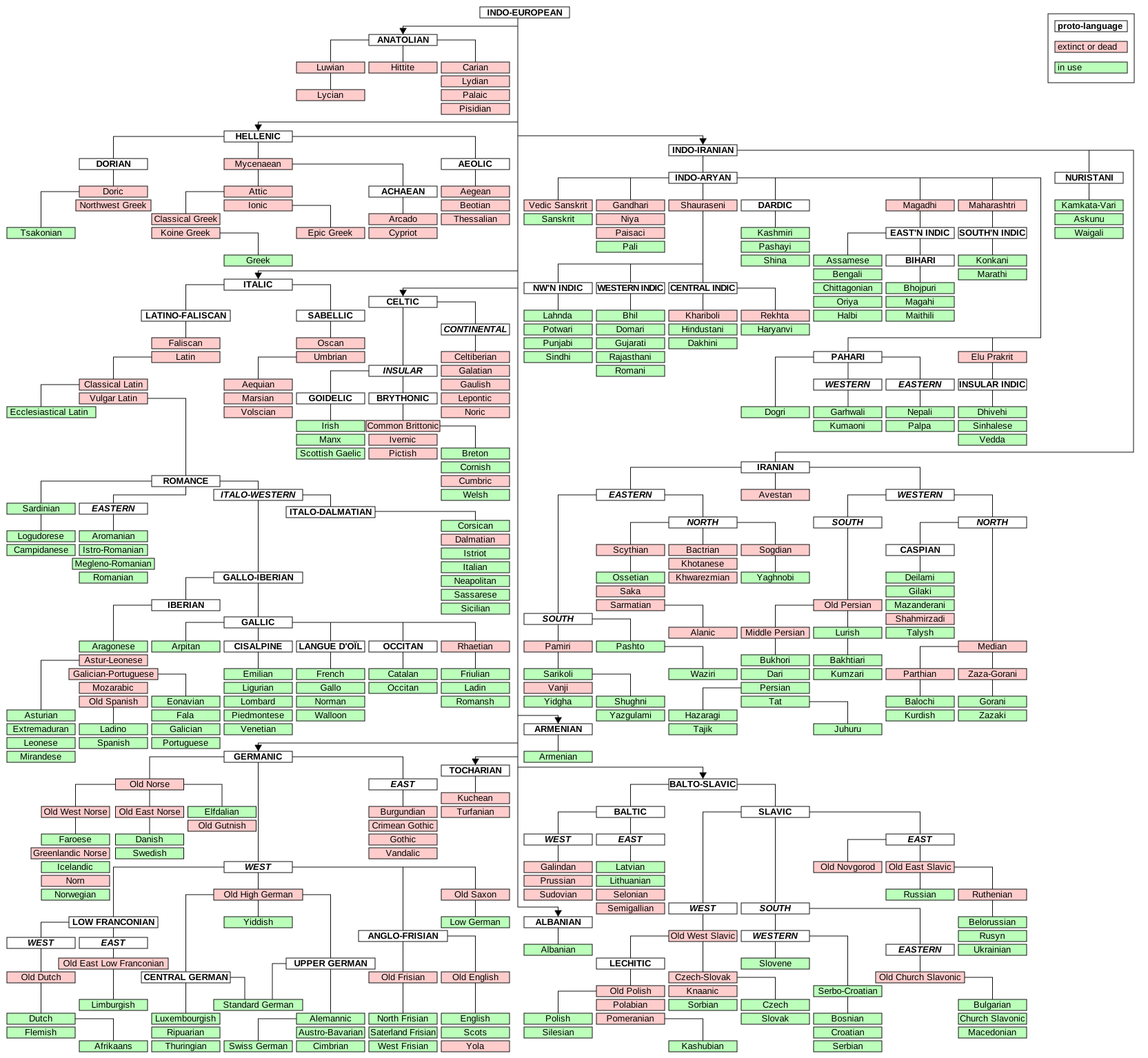
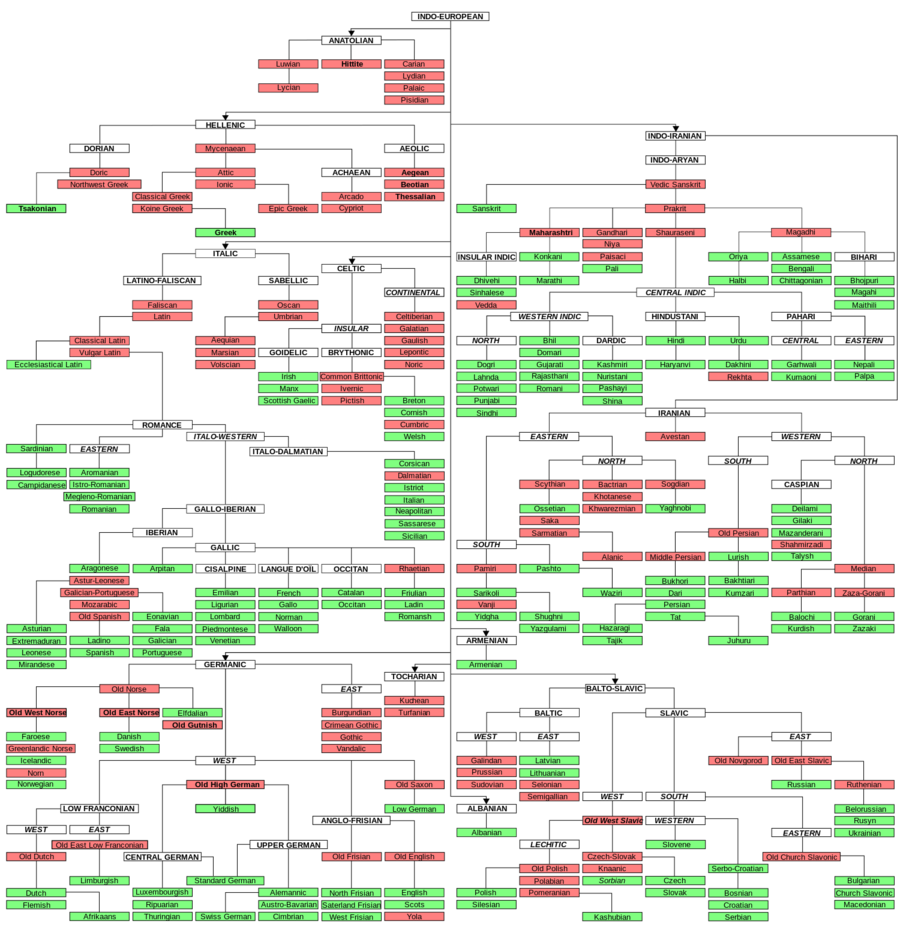
[https://upload.wikimedia.org/wikipedia/commons/4/4f/IndoEuropeanTree.svg IndoEuropeanTree] | [https://upload.wikimedia.org/wikipedia/commons/4/4f/IndoEuropeanTree.svg IndoEuropeanTree] | ||
| + | |||
| + | <center> | ||
| + | {| | ||
| + | |+ style="caption-side:bottom; color:#000000;"|'''IndoEuropean Tree Graph''' | ||
| + | | [[File:IndoEuropeanTree.svg|900px|center|link= ]] | ||
| + | |} | ||
| + | </center> | ||
=== Other References === | === Other References === | ||
Revision as of 04:19, 30 August 2018
Reasearch and Ideas on the breakdown of Languages, Scripts, and Tribal Families.
Note: ADD proper names and cross-internal links.
Note: ADD list of "special" details to add the various details for extras, ie. saltmarshes of Vashel, under Tamsen Forest.
Note: Text Highlight and Background Colour: Kandáy, Réthem, Thârda, Káldôr, Mèlderýn, Chybísa, Orbáal, Ázadmêre, Eváel.
Note: Green = I Have, Red = Don't Have, Orange = Old Scan, Blue = Misc, Black = ALL Base (Template)
Note: Colour Highlights: Yellow
Colour LINK Text: Possible Link NAME
Note: Hidden comments <!-- TEXT HERE WILL NOT BE DISPLAYED -->
Note: Anchor Points - Section linking WITHIN pages USE [[Help:Section#Section_linking|Section linking]] or To link to a section in the same page you can use [[#section name|displayed text]], and to link to a section in another page [[page name#section name|displayed text]].
Note: Section linking with arbitrary id USE <span id="anchor_name"></span>. Be sure to use a name that is not likely to be duplicated. One way to do this is to incorporate the titles of the higher-level sections, at least in abbreviated form, e.g., Ontario-Natural_features for the "Natural features" subsection of the "Ontario" section of an article about the provinces of Canada.
ADD inside Table Caption/Heaer Text
Contents
Linguistics
Replace “ ” with "
Replace ‘ ’ with '
Possible Link
INSERT TABLE
Language/Linguistic Research
Here we shall list all links to references to Linguistics and the construction of a Family Tree of Languages
Note: ADD ColourBoxes and sub colour box colours from wikipedia
North Germanic
West Germanic
 North Sea Germanic
 Weser-Rhine Germanic
 Elbe Germanic
East Germanic
East Germanic
Background colors used on Wikipedia
- Background colors used on Wikipedia for various language families and groups
MAKE nested tables?
| Background colors used on Wikipedia for various language families and groups | ||||||
|---|---|---|---|---|---|---|
| Afro-Asiatic | Nilo-Saharan? | Niger–Congo | Khoisan (areal) | |||
| Indo-European | Caucasian (areal) | Uralic | Dravidian | Altaic (areal) | Paleosiberian (areal) | |
| Sino-Tibetan | Hmong–Mien | Kra–Dai | Austroasiatic | Austronesian | Papuan (areal) | Australian (areal) |
| Eskimo–Aleut | Na-Dené (and Dené–Yeniseian) | American (areal) | ||||
| Creole/Pidgin/Mixed | language isolate | sign language | constructed language | unclassified | ||
Background colors used on Wikipedia
Note: ADD and CREATE a table like this for all the Languages & Tribes plus TimeLine
The table below shows the succession of the significant historical stages of each language (horizontally) and their approximate groupings in subfamilies (vertically). Vertical sequence within each group does not imply a measure of greater or lesser similarity.
IndoEuropean Tree Graph
 |
Other References
- Hydronym
- A hydronym is a proper name of a body of water. Hydronymy, a subset of toponymy, the taxonomic study of place-names, is the study of the names of bodies of water, the origins of those names, and how they are transmitted through history. Hydronyms may include the names of rivers (potamonyms), lakes, and even oceanic elements.
Compared to most other toponyms, hydronyms are very conservative linguistically, and people who move to an area often retain the existing name of a body of water rather than rename it in their own language. For example, the Rhine in Germany bears a Celtic name, not a German name. The Mississippi River in the United States bears an Anishinaabe name, not a French or English one. The names of large rivers are even more conservative than the local names of small streams.
Therefore, hydronomy may be a tool used to reconstruct past cultural interactions, population movements, religious conversions, or older languages. For example, history professor Kenneth H. Jackson identified a river-name pattern against which to fit the story of the Anglo-Saxon invasion of Britain and pockets of surviving native British culture. His river map of Britain divided the island into three principal areas of English settlement: the river valleys draining eastward in which surviving British names are limited to the largest rivers and Saxon settlement was early and dense; the highland spine; and a third region whose British hydronyms apply even to the smaller streams.
Often a given body of water will have several entirely different names given to it by different peoples living along its shores. For example, Tibetan: ་, Wylie: rDza chu, ZYPY: Za qu and Thai: แม่น้ำโขง are the Tibetan and Thai names, respectively, for the same river, the Mekong in southeast Asia. And the Tibetan term Za Qu (rdza chu) refers to three other rivers as well.
Hydronyms from various languages may all share a common etymology. For example, the Danube, Don, Dniester, Dnieper, and Donets rivers all contain the Scythian name for "river" (cf. don, "river, water" in modern Ossetic). A similar suggestion is that the Yarden, Yarkon, and Yarmouk (and possibly, with distortion, Yabbok and/or Arnon) rivers in the Israel/Jordan area contain the Egyptian word for river (itrw, transliterated in the Bible as ye'or).
It is also possible for a toponym to become a hydronym: for example, the River Liffey takes its name from the plain on which it stands, called Liphe or Life; the river originally was called An Ruirthech. An unusual example is the River Cam, which originally was called the Granta, but when the town of Grantebrycge became Cambridge, the river's name changed to match the toponym.
- Toponymy
- Toponymy is the study of place names (toponyms), their origins, meanings, use, and typology. Toponym is the general name for any place or geographical entity.
- Demonym
- A demonym is a word that identifies residents or natives of a particular place, which is derived from the name of that particular place.
- [A|A]
- A
- [A|A]
- A
- [A|A]
- A
A
- A
- A
Kèthîra Languages
MOVE all related research and linked information to Linguistics.
Map of Language Families
Language is a product of common historical and geographical experience over time, a vital element of culture and ethnicity. The people of Kèthîra speak more than 100 languages in 11 families. Family members share root words and sounds, but are still distinct tongues. The existence of a language family implies a common root from which all modern members are descended.
Járind Family
The Járind ethnic area included much of northwest Lýthia until migrations of eastern peoples displaced Járind culture north and west. Járind languages are characterised by a singsong lilt with occasional gutturals. Járind have fair to medium complexions, light brown or red wavy hair, and brown eyes.
- The Járind Family includes;
- Áltish, Eméla, Hârnic, Jàrinése and Yaríli.
INSERT TABLE
Phâric Family
The Phâric peoples originated in Reksýna but were driven west into the Járind ethnic area by Ketâri tribes. Phâric tongues are characterised by rising-falling tones, compound nouns, and regular grammar. These rules are frequently broken; Phâric tongues have been strongly influenced by languages of other families. Phâric peoples are tall, with light straight hair, fair complexions, and blue-grey eyes.
- The Phâric Family includes;
- Hârbáaler/Chéler, Ivínian, Pálithàner, Quârph, Shôrka and Tríerzi.
INSERT TABLE
Azéri (or Venârian) Family
Azéri tongues are spoken around the Venârian Sea. Most tongues have extensive vocabularies and complex grammar, and are characterized by rising tones. Azéri have medium to swarthy complexion, and dark hair and eyes.
- The Azéri Family (or Venârian Family) includes;
- Àzeryáni (High & Low), Býrian, Elbýthian, Karéjian, and Ûrméch.
INSERT TABLE
Anzélan Family
Anzélan tongues are spoken in Anzelôria. The original language spread from the south, dividing into Panhaónic in the north and Wernái in the south. Anzelôrian tongues are characterised by compounds of short, sharp syllables. The length of time that a vowel sound is voiced has meaning. Grammar and rhythm tend to be regular. Anzelôrians have dark to black complexions, dark curly hair and eyes.
- The Anzélan Family includes;
- Chogôri, Geláphic, Neshái, Pèchalâri, Thónian, Túvarese and Wernái.
INSERT TABLE
Mafáni Family
Mafáni tongues are spoken around the Gulf of Mafán and Shéntu Sea. Mafáni languages are characterised by compound words, regular grammar, and short, precise rhythm; they have a clicking sound. The ancient Máfanese were far ranging people. They planted colonies around the Shéntu Sea and beyond. It is hard to identify a Máfanese ethnic type, since in most regions they have merged into native populations.
- The Mafáni Family includes;
- Máfanese, Molnásian, Shénti, and Thóta.
INSERT TABLE
Molkûran Family
Molkûran languages are spoken in southeastern Lýthia. The family is derived from Molkûri, the language of the ancient Ziggurat Culture. Languages of this family have complex, precise grammar, and by variations in pitch and tone to convey rich meaning. The typical Molkûran has a dark to swarthy complexion, dark hair and eyes, and tends to be a little shorter than average.
- The Molkûran Family includes;
- Chomsúni, Homôri, Kánic, Lashói, Melûrian, Mólken, Mêrna-Mólken and Pechósi.
INSERT TABLE
Reshéni Family
Reshéni tongues are descended from Reshéni, the principal language of the Ch’mísa Empire. The Reshéni typically have dark complexions, dark hair and eyes, and tend to be shorter than average.
- The Reshéni Family includes;
- Argólan, Jankôran, Mengólan, and Shóji.
INSERT TABLE
Ketâric Family
Ketâric languages are descended from Ancient Kétar, the language of the Ketârh barbarians who conquered much of central and eastern Lýthia between 1750-500 BT. Ketâri languages and peoples are diverse, strongly influenced by the indigenous tongues and cultures of the conquered regions.
- The Ketâric Family includes;
- Ánil-Ketâri, Bésha, Dálken, Diramése, Ketâri, Kyâman and Reksýni.
INSERT TABLE
Númec Family
Númec tongues are descended from Hepéka. Númec peoples tend to be shorter than average and dark in colouring. The Kôrlic group tends to be lighter due to mixing with northern peoples. The Faláni are darker. Númec languages are characterised by long vowel sounds and guttural stops.
- The Númec Family includes;
- Faláni, Kôrlic and Númer.
INSERT TABLE
Kámadh Family
The languages of Kámerand have developed largely in isolation, although Ínan seems to have some words contributed by Járind tongues and Ivínian.
- The Kámadh Family includes;
- Neránadher, Ínan, Hârazai, Rakáma, Erènakáma, Yêrazh and Hôro.
INSERT TABLE
Mêrnáti Family
Except for limited influences from Molkûran and Kámadh tongues, the languages of Mêrnat have developed in isolation. The peoples who speak Mêrnáti tongues are swarthy to black. There are thousands of mutually intelligible dialects.
- The Mêrnáti Family includes;
- Mêrna, Tían, Dâdèn and Kolôtis.
INSERT TABLE
Venârivè: Northwestern Lýthia
Note: ADD colour boxes from Families ABOVE
Note: ADD colour for name of Language (including Dialect(s) colours from History Harn PDF) and another for Script. Put into a Language Table. Link to History of Hârn PDF.
- from Venârivè: Northwestern Lýthia P183
Possible Link
INSERT TABLE
Appendix VI: Languages and Scripts
Note: Make Alphabetical Listed
As noted in Culture and Languages, a wide variety of languages and dialects are in use across Venârivè, and an equally wide range of scripts are used to write them.
Elder
- Sináin – language of Elves,
- written in Selénian.
- Kúzhan – language of Dwarves,
- Khrúni script.
Járind Family
- Járind – ancient language group of Járind people.
- Émhlè – ancient language of the Eméla,
- written in Khrúni.
- Eméla – middle and modern language of the Eméla,
- written in Khrúni and Lakíse.
- Zónawè – ancient language of the Járind of Zonâra;
- Khrúni script.
- Zonâran – middle language of Zonâra;
- Zérin script.
- Old Járin – middle language of the Járin of Hârn.
- Járin – modern language of the Járin of Hârn. There are a number of dialects spoken by the tribal Járind peoples of Hârn.
- Yaríli – modern language of the Yaríli of Iváe.
- Yârla – modern language of the Yârla of Hârbáal.
- Old Áltic – middle language of the Áltwè.
- Áltic – modern language of the Álti; there are a number of regional dialects, broadly grouped as Western and Eastern.
- Runic script.
- Uméni – modern language of the tribal Uméni of Ûmélria; influenced by Azéri, Quâr and Kétar.
- Hârnic – language of Hârn; there are a number of regional, local and tribal dialects.
- Runic and Lakíse scripts.
Phâric Family
- Phâri – ancient language group of the Phâric peoples.
- Quâr – ancient language of the Quâr.
- Quârphic – modern language of Quârphor; dialects include Huriséan, Western, Northern, Southern and Eastern.
- Runic script.
- Shôrki – old language of the Sôrki.
- Khrúni script.
- Shôrka – modern language of Shôrkýnè; dialects include Melódan, Pelódan, Loálan, Quálren, Stálfi, Fédin, Kolâren, Sábes, Énseler, Jándi and Nístalen.
- Lakíse script.
- Old Tríerzi – middle language of the Tríerzi.
- Tháneman – middle language of the Thánemi.
- Tríerzi – modern language of Tríerzòn; has many dialects, including Ligúno-Áthaman, Sénedar, Stálfi, Mélsa-fáldon, Alonádi, Areshýmen, Cherýkan, Zánori, and Tengálin.
- Lakíse script.
- Ivíni – old language of Ivínia.
- Khrúni script.
- Ivínian – modern language of Ivínians.
- Runic script.
- Orbáaler – dialect of Ivínian spoken in Orbáal, Hârn.
- Runic and Lakíse script.
- Hârbáaler – modern language of Hârbáalers, considered by some a dialect of Ivínian.
- Runic and Lakíse script.
- Chéler – modern language of the inhabitants of Chélemby; viewed by some as a dialect of Hârbáaler with a considerable number of foreign terms.
- Runic and Lakíse script.
- ‘Trade Ivínian’ – (Kántâl) the lingua-franca of trade in much of northwestern Venârivè; very similar to Chéler, but with an even greater number of foreign terms and idioms.
- Runic and Lakíse scripts.
- Pálithàner – modern language of Palíthanè.
- Runic and Lakíse scripts.
Azéri Family (or Venârian Family)
- Azéri – ancient language group of the Azéri peoples.
- Written in both Alánta and Tiánta scripts.
- Àzeryáni – language of Azéri settlers of Ázeryàn.
- Zérin script.
- Zâkimladal (High Àzeryáni) – modern language of high-class Àzeryáni.
- Ayâran Script.
- Nâsik Azéri (Low Àzeryáni) – modern language of lower-class / common Àzeryáni.
- There are several recognised dialects within the Empire including: Prime, Central, Northern, Western, Southern, Island and Eastern.
- In addition, there are several dialects of low Àzeryáni spoken outside the Empire, principally: Lánkori, Terâzin, Górik, Kôlvisar, Dálazeri.
- Ayâran and Lakíse scripts.
- Vénic – ancient language of Vénic island culture.
- Written in both Alánta and Tiánta scripts.
- Kàruía – language of Kàruía islands culture.
- Written in both Milánta and Zérin scripts.
- Karéjian – language of Karéjia;
- uses the Ayâran and Lakíse scripts.
- Ûrméch – language of Ûmélria; influenced by Uméni.
- Ayâran script.
- Elbýthian – language of eastern Venârian.
- Ayâran and Nerámic scripts.
- Býrian – language of Býria.
- Ayâran and Lakíse scripts.
Ketâric Family
- Kétar – original language of the people of the central plateau.
- Màfakéta – language of Ketâric nomads who conquered Mafáni empire.
- Shéni script.
- Old Ketâri – middle language of central Ketârh.
- Ketâri – modern language of Ketâri nomads.
- Ánil Ketâri – language of western Ketâri.
- Reksýni – modern language of Reksýna.
- Shénya script.
- Bésha – language of Béshakan nomads.
- Nerámic script.
- Hácherian – language of the Hácherim.
- Nerámic script.
- Namârdi – language of the Namârdim.
- Nerámic script.
- Dálken – language of Dalkésh.
- Nerámic script.
Mafáni Family
- Old Mafáni – ancient language of the Empire of Mafáni.
- Kóno script.
- Mafâsh – middle language of the Mafáni.
- Tankóno and Nerámic scripts.
- Mafáni – modern language of the Mafáni.
- Tankóno script.
- Shénti – modern language of the eastern coast of Anzelôria, a mixture of Anzelôrian and Mafáni.
- Tankóno script.
Modern Mafáni is influenced by Mólken, the language of Molkûra. The script of Molkûra (Milúan) also influenced Kóno, and together with influence from Nerámic, this led to the development of Tankóno.
Anzélan Family
aka Anzelôrian
- Anzéla – ancient language group of Anzelôria.
- Néri script.
- Panhaónic – northern Anzelôrian language group.
- Nerámic script.
- Târgan – extinct language of the Târga River valley; replaced by Dálken.
- Nerámic script.
- Neshái – modern language of the Neshái tribes.
- Chogôri – modern language of Chogôro.
- Tankóno script.
- Pèchalâri – modern language of Pèchalâri.
- Nerámic script.
- Tuvâran – modern language group of Tuvârans; includes numerous sub-languages and dialects grouped as Eastern, Southern and Western.
- Thónian – modern language group of Thónians; includes a number of sub-languages and dialects grouped as Mountain, Laker, Inner, Northern, Western, and Southern.
- Hérei – Thónian language of the indigenous people of Árlanto.
- Elánasi – a Tuvâran language, spoken in western Árlanto.
- Búqdin – a Thónian language of Hèpekéria.
Númec Family
- Hepéka – ancient language group of Hèpekéria.
- Tiánta script.
- Old Númec – middle language of the Númec.
- Hekôri script.
- Númer – modern language of Númec.
- Hekôri script.
- Kôrlic – modern language of the Kôrlic peoples, descended from old Númec, but heavily influenced by Azéri, Ivínian and Kàruía.
- Hekôri, Runic and Ayâran scripts.
- Dálani – the mixed Járind/Númec language of the tribal people of Dalánya.
- Faláni – modern language of the Faláni, descended from old Númec.
- Hekôri script.
Lakíse Numerals
ADD LakiseQuill, Harn Lakise, Harn Runic Fonts
| 0 | 0 |
| 1 | 1 |
| 2 | 2 |
| 3 | 3 |
| 4 | 4 |
| 5 | 5 |
| 6 | 6 |
| 7 | 7 |
| 8 | 8 |
| 9 | 9 |
Language Table
- A
A
- A
- A
A
- A
- A
A
- A
- A
A
- A
- A
A
- A
- A
A
- A
- A
Name & Dates List
Note: ADD a proper/seperate page for this all as a table. Once broken down into the Book Style like Kanday's split page style, can then add Category for each section part so that a complete list then gets made for all the pages for "said name". The once this is done, can then add this comprehensive list to "that" Index Section for "Category". In the end the aim is to create a complete "Name & Dates List/Index" so all the LINKS for names can then not only be categorised, but also interlinked between ALL articles and books, especially for DATES as this will be required to create a comprehensive Chronology Timeline and quick inter-referencing of the subject link(s).
Note: ADD links to each Name & Date within the Tabled Index, these should also include Eras & Periods for dates.
Note: INCLUDE all these into the Template (Sidebars & other data) Tables and so on.
Note: Example: Mercenary Companies would not only have a template for the Company, but be interlinked with that Type as a Category reflecting and showing Country, Shire, Hundred, Leader, Associated to/Sponsor, Location/Region and all other manner of data links within the design of the template and interact automatically with other templates, catergories, and index link lists.
Note: Example: A river would have a sidebar template that includes it's source length and so on, but also show not only the Catergories & Names, but be reflected within each of those Categories & Names Listed together. Basically internested Data, Links, Catergories, and so on to save redoing all links again with new pages or modifications, it automatically gets updated once interconnected correctly.
Notes
- A
- A