Hârn History Chronology
Hârn History Chronology is a list of all the histories
Note: ADD proper names and cross-internal links.
Note: ADD list of "special" details to add the various details for extras, ie. saltmarshes of Vashel, under Tamsen Forest.
Note: Text Highlight and Background Colour: Kandáy, Réthem, Thârda, Káldôr, Mèlderýn, Chybísa, Orbáal, Ázadmêre, Eváel.
Note: Green = I Have, Red = Don't Have, Orange = Old Scan, Blue = Misc, Black = ALL Base (Template)
Note: Colour Highlights: Yellow
Colour LINK Text: Possible Link NAME
Note: Hidden comments <!-- TEXT HERE WILL NOT BE DISPLAYED -->
Note: Anchor Points - Section linking WITHIN pages USE [[Help:Section#Section_linking|Section linking]] or To link to a section in the same page you can use [[#section name|displayed text]], and to link to a section in another page [[page name#section name|displayed text]].
Note: Section linking with arbitrary id USE <span id="anchor_name"></span>. Be sure to use a name that is not likely to be duplicated. One way to do this is to incorporate the titles of the higher-level sections, at least in abbreviated form, e.g., Ontario-Natural_features for the "Natural features" subsection of the "Ontario" section of an article about the provinces of Canada.
ADD inside Table Caption/Heaer Text
Contents
Chronology (Timeline)
Replace “ ” with "
Replace ‘ ’ with '
Possible Link
INSERT TABLE
 |
Note: ADD Chronology (Timeline) of Kandáy within each Manor, then create a table of Dates, listing Events and the various campaigns, old Petty Kingdoms, Wars, etc.
Note: ADD relavent timeline information from Summa_Venariva & Venarive with Hârnic references.
Venârivè Chronology
All year numbers are given in Túzyn Reckoning (TR) or Before Túzyn Reckoning (BT). Throughout this publication, it is assumed throughout that the current date is the first day of the first month of tr720.
- Page 23: (Before bt300) - The Beginnings of Venârivè
- Page 37: (bt300 - tr1) - The Summer of the Classic Age
- Page 47: (tr1-tr150) - Crisis and Depression
- Page 59-60: (tr150-tr450) - The Imperial Age
- Page 73: Religious Chronology (tr1-tr450) - The Imperial Cults
- Page 80: (tr450-tr550) - The Imperial Autumn
- Page 88: (tr550-tr600) - The Red Death
- Page 110-111: (tr600 to tr720) - The Modern Age
Breakdown of Regions & Timelines
- Summa_Venariva.pdf ~ A Social History of Venârivè
- Pronunciation and Accents: page ii
- Hârn (region) 1, 2, 14, 19, 20, 23, 25, 26, 28, 31, 37, 47, 55, 56, 59, 60, 63, 66, 70, 73, 77, 79, 80, 82, 84, 88, 93, 96, 107, 108, 110, 111.
- Venarive_102.pdf
- Venarive_Index_102.pdf
- Hârn — Island 1, Region 110, Hârnic — Language 19, 110, 183, Pantheon 85, Religious Peculiarity 85, Tribes 112
- Kandáy, Kingdom of (Realm) 111
- Venarive_Index_102.pdf
Venârivè Eras & Periods
History
Venârivè P03
There are a variety of systems for counting the years in Venârivè. These are discussed in detail in Daily Life. This section follows the most widely used system, the Tuzyn Reckoning. Tuzyn Reckoning uses the foundation of the Kingdom of Mèlderýn as its starting point. All dates after that point are identified by tr; all dates prior are identified as Before Tuzyn or bt. The current date in this system is tr720.
Most historians of Venârivè divide the history of the region into a number of eras and periods. The simplest divisions are the ‘eras’:
- Ælder / Heroic Era – before bt1300
- Ancient / Classical Era – bt1300 to bt300
- Middle Era – bt300 to tr500
- Modern Era – tr500 to present (tr720)
A more detailed division is by ‘periods’, which overlap:
- Legendary Period – pre bt3000
- Megalith Period – bt3000 to bt1600
- Migrations Period – bt1600 to bt680
- Foundations Period – bt680 to tr1
- Early States Period – tr1 to tr300
- Imperial Period – tr200 to tr500
- Viking Period – tr250 to tr550
- Modern Kingdoms Period – tr500 to present
See Folk of Venârivè (P161) for a list of notable personalities of from the history Venârivè.
Note: ADD History section of Venârivè (P3-18)
Venârivè Timeline
Note: ADD additions for the TimeLine image to be rendered, see Timeline of architectural styles: 6000 BC–present
- 8000 years - The last 1000 years (fine grid) is expanded in the timeline above
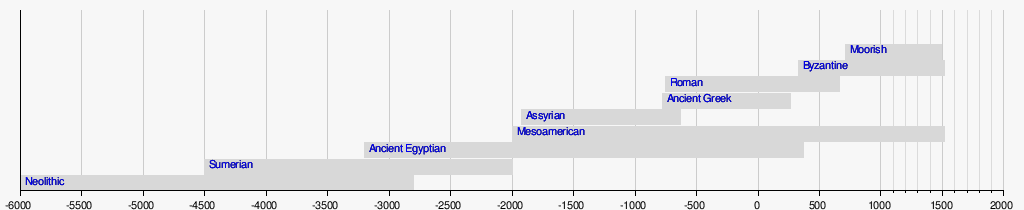 |
<timeline> DateFormat = yyyy ImageSize = width:1024 height:auto barincrement:18 PlotArea = left:20 right:20 bottom:20 top:10 Colors = id:noir value:black id:canvas value:rgb(0.97,0.97,0.97) id:egypt value:rgb(1,1,0.6) id:gris value:gray(0.85) id:gris2 value:gray(0.70) id:grilleMajor value:rgb(0.80,0.80,0.80) id:bleuclair value:rgb(0.56,0.56,0.86) id:rouge value:red id:rougeclair value:rgb(0.86,0.56,0.56) id:bleuclair value:rgb(0.76,0.76,0.96) id:grilleMinor value:rgb(0.86,0.86,0.86) Period = from:-6000 till:2000 TimeAxis = orientation:horizontal format:yyyy AlignBars = justify ScaleMinor = unit:year increment:100 start:1000 gridcolor:grilleMinor ScaleMajor = unit:year increment:500 start:-6000 gridcolor:grilleMajor BackgroundColors = canvas:canvas bars:canvas BarData= bar:epoque barset:evennement PlotData= barset:evennement color:rouge shift:(2,0) width:15 at:550 #blank line #at:800 text:"[[Carolingian architecture|Carolingian]]" #france and [[Northern Europe|northern europe]] from:711 till:1492 text:"[[Moorish architecture|Moorish]]" shift:(5,-2) color:gris anchor:from #Spain, Portugal, North Africa from:330 till:1520 text:"[[Byzantine architecture|Byzantine]]" shift:(5,-2) color:gris anchor:from from:-753 till:663 text:"[[Roman architecture|Roman]]" shift:(5,-2) color:gris anchor:from from:-776 till:265 text:"[[Ancient Greek architecture|Ancient Greek]]" shift:(5,-2) color:gris anchor:from from:-1920 till:-630 text:"[[Architecture of Mesopotamia|Assyrian]]" shift:(5,-2) color:gris anchor:from from:-2000 till:1519 text:"[[Mesoamerican architecture|Mesoamerican]]" shift:(5,-2) color:gris anchor:from from:-3200 till:373 text:"[[Ancient Egyptian architecture|Ancient Egyptian]]" shift:(5,-2) color:gris anchor:from from:-4500 till:-2000 text:"[[Architecture of Mesopotamia|Sumerian]]" shift:(5,-2) color:gris anchor:from from:-6000 till:-2800 text:"[[Neolithic architecture|Neolithic]]" shift:(5,-2) color:gris anchor:from #To start the indentation on top again #barset:break #at:1919 #blank line </timeline>
Venârivè Timeline Clade
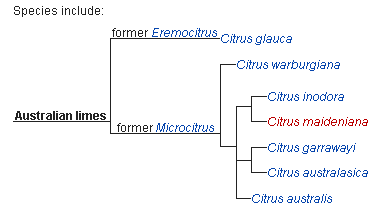
Note: ADD Clade tree (see Template:Clade and Template:Cladogram)
Example: Australian lime
 |
Tribes, Kingdoms & Linguistics
CREATE a hierarchy for all the Clans over time and who died out, when, and which merged with each other.
Note: ADD a new style for referencing language (Linguistics) and family groups (Tribes).
See: Linguistics, Dendrogram, Tree Model, Linkage (linguistics), Genetic relationship (linguistics), Language isolate, Language family, Indo-European languages, English language, Linguistic maps, etc. for Breaking it all down.
Note: ADD Style like Swabian German See Image: Alemannic-Dialects-Map & Family tree of the German monarchs to the Template Style
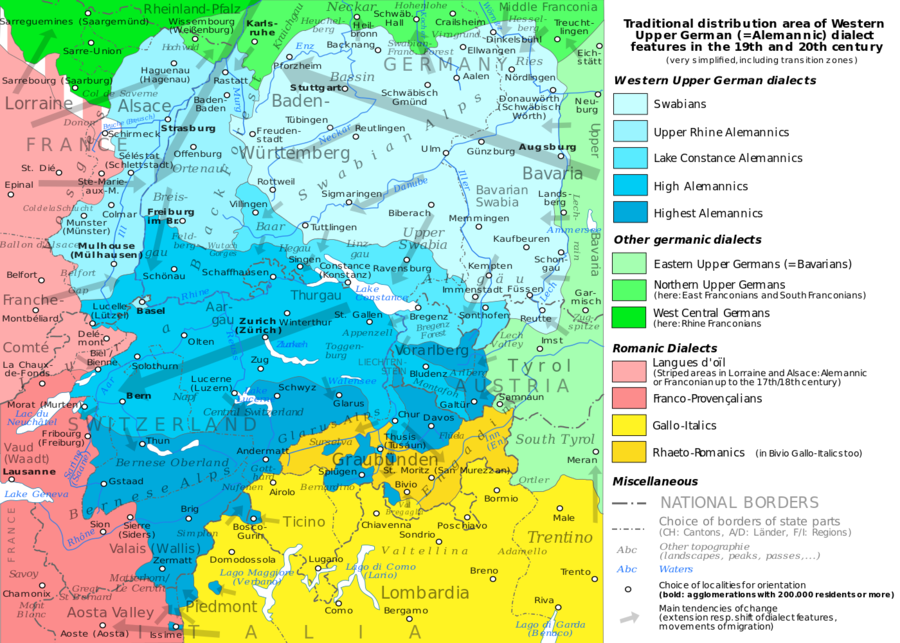 |
Crossover with Linguistics
Note: ADD This too the style in which we can separate Tribes & Linguistics Languages and Dialects over time. This option can use not only a code, but also show the Language Family, Dialect, and map the area covered.
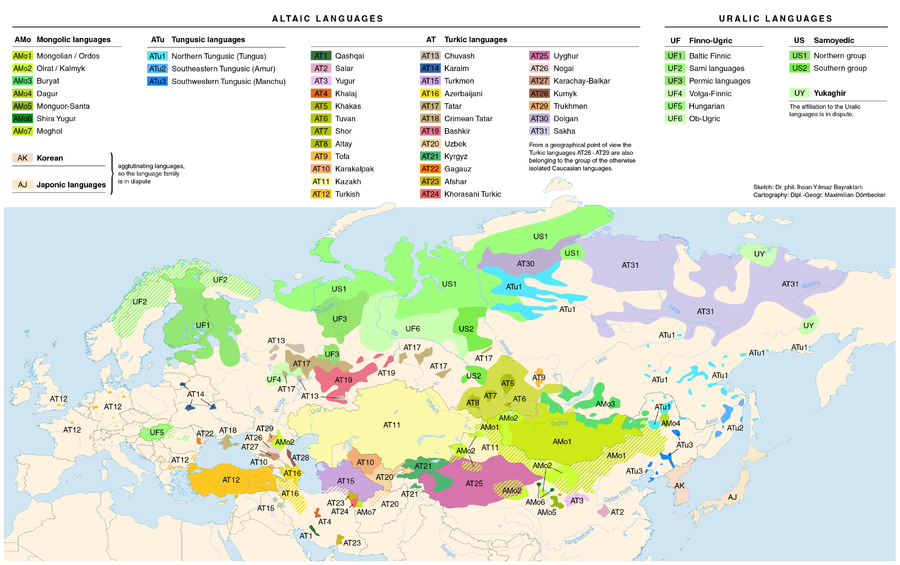 |
See Also: Linguistic Groups
Note: ADD these;
- The Making of Modern English ~ How to break down the growth and change of a language with influences and social changes
- Alemany ~ Two images, first showing the Area a tribe and language group grows, with pinpoint dots for dates/years appeared in that area. GREAT way to show the advance of Phâric Family as it spread west. The second shows the various tribes. The first is the best example to show the years in which the "layer" tribe/language spread in stages and the colour changes.
- Periodisation of the History of the English Language ~ Good way to "Excel" the various stages, start and end of a period, subdivisions, and so on.
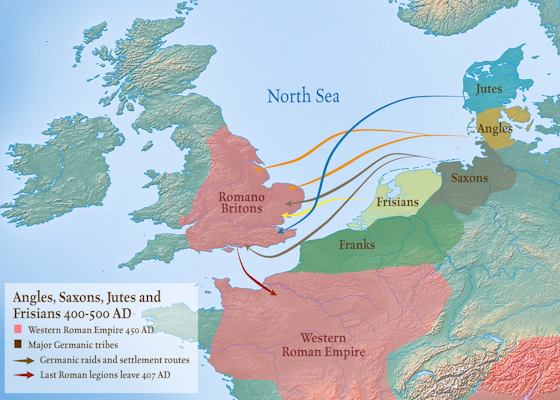
- Spread of Angles, Saxons, Jutes and Frisians ~ Pointer diagram map showing a new stage of change in a Period shift and the new languages being mixed into an area.
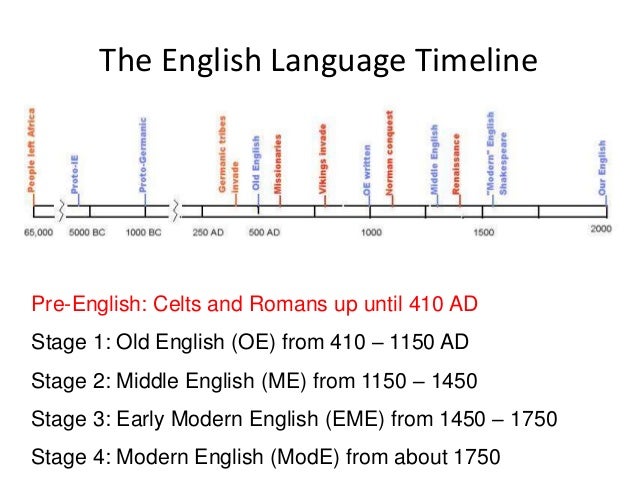
- The English Language Timeline ~ Picture to show the whole Timeline, an example using the English Language from Pre-English, Old English, Middle English, Early Modern English, and Modern English that can be used as a way each new language splits, blends, or overwrites another language through time.
- The History of English ~ Diagram showing a clearer way of the influencers to a language shift occurring (ie. Angles/Saxons/Jutes shift from Old Frisian to Old English, then Normans/French change to Middle English) from one language to another.
- How the English language went from an obscure Germanic dialect to a global language
- Delves into the how and what's changed not only the language but hints at the dialects as well.
- How the English language went from an obscure Germanic dialect to a global language
- Scots Language Chart ~ How Middle English split from Old English into two branches that become known as Scots & Modern English.
Note: Create a way to show movement, spread, and change of a language group by using pint points (time) and colour (Main into sub/crossovers), ie. Red, Blue, Green can be used to show Main Family Group and then modify the overlay with each colour changing to Yellow (Red + Green), Magenta (Red + Blue), Cyan (Blue + Green) and so on. Dialects can also use the same style of system clearly showing which group is influenced by which Language Family. Some can become extinct but still influence another such as "Northern Tuvaran is largely extinct, but had an important impact on the development of Byrian."
Note: Split into Ancient (Pre), Old, Middle, Early Modern, Modern styled evolution's of each phase. ie. Émhlè – ancient language of the Eméla; Eméla – middle and modern language of the Eméla. With the Pre being Járind, and Eméla being the modern (current) form of the language.
Note: Multi-Influences Such as Shôrka (modern language of Shôrkýnè), can influence or join with another (such as Quarph), even though starting as another, Ûmélria (possible origin of Járind), even related (to both Quarph and Trierzi) influenced by local (Járind) tongues.
Note: Hârn Languages & Tree will show a good set of change, merging, and dialects that will be the most complex, especially when including the local Barbarian Dialects and given the merging of all the tribes and disappearance of some such as the Shira being wiped out, yet others merge such as the Aleta, Erynyn/Kandellyn, Corani, etc.
MOVE to Linguistics
Then Di-sect into the various stages of the language.
- Make a list of each Family Group
- Sub Groups
- Crossovers
- Influence on another
- Influenced by another
- Sub Groups
And so on until we have a language map
Template:Legend
Note: ADD Template:Legend Template:Legend
- ie. {{#if:|{{{text}}}| }} Swabian
{{legend|color|label|outline=outline color|border=css border}}
Language Family
Table Box
Colour Sample Template
{{Color sample|#00FF00|description=green}}
Language family: Indo-European
- Germanic
- West Germanic
- High German
- Alemannic
- Swabian
- Alemannic
- High German
- West Germanic
NOTE: ADD Colour Boxes just as Indo-European does.
Templates: Template:Infobox language/family-color, Template:Language families
See: Indo-European family tree in order of first attestation
Appendix VI: Languages and Scripts
As noted in Culture and Languages, a wide variety of languages and dialects are in use across Venârivè, and an equally wide range of scripts are used to write them.
ADD colour for name of Language (including Dialect(s) colours from History Harn PDF) and another for Script. Put into a Language Table. Link to History of Hârn PDF.
- from Venârivè: Northwestern Lýthia P183
- See Languages and Scripts
Kèthîra Languages
As noted in Culture and Languages, a wide variety of languages and dialects are in use across Venârivè, and an equally wide range of scripts are used to write them.
ADD colour for name of Language (including Dialect(s) colours from History Harn PDF) and another for Script. Put into a Language Table. Link to History of Hârn PDF.
- See under Hârnic Regions Kèthîra P43 (PDF p46/47)
Tribes & Kingdoms of Hârn
ADD new article data from harn-history - Tribes & Kingdoms of Western Harn (TR300-453).pdf
Linguistic Dialects & Languages of Hârn
ADD new article data from harn-history - Tribes & Kingdoms of Western Harn (TR300-453).pdf
- Linguistics ~ Breakdown into DIALECT GROUPS and colour code. Could also add as sub section of Side Bar Template Entries
- Chronology (Timeline) of Kandáy
Ideas
Note: ADD a list of ideas and how & what Templates can create a good timeline to cross reference the various topics needed.
Using both Historic interaction and contact with another tribe, with that in mind, use both Linguistics and Historic influences to build a timetable for various events, blending (social/tribal, technology, etc.) them all together to fill in a clearer picture of the peoples, settlements, a create a "local" sense of their world for that particular region, but more so for creating atmosphere to each and every Manor, rural village, and further enhance a sense of a living world.
There would have been many changes over the course of time for any Culture that comes into contact with one another. Be it from assimilation, merging, annihilation, etc. This can mean certain cultural affects, technology changes, right through to shifts in language, architecture, and right down to social influences.
Painting a picture of where a people have come from (ancestors relocating) to how they've been influenced (contact with others) by one another to form a unique society of the now.
Using all this we can create a better reflection of why a building looks the way it is in a certain Kingdom, to why a military acts the way it does and why it has a certain piece of technology, and so on.
A
- A
- A
A
- A
- A
A
- A
- A
A
- A
- A
A
- A
- A
Name & Dates List
Note: ADD a proper/seperate page for this all as a table. Once broken down into the Book Style like Kanday's split page style, can then add Category for each section part so that a complete list then gets made for all the pages for "said name". The once this is done, can then add this comprehensive list to "that" Index Section for "Category". In the end the aim is to create a complete "Name & Dates List/Index" so all the LINKS for names can then not only be categorised, but also interlinked between ALL articles and books, especially for DATES as this will be required to create a comprehensive Chronology Timeline and quick inter-referencing of the subject link(s).
Note: ADD links to each Name & Date within the Tabled Index, these should also include Eras & Periods for dates.
Note: INCLUDE all these into the Template (Sidebars & other data) Tables and so on.
Note: Example: Mercenary Companies would not only have a template for the Company, but be interlinked with that Type as a Category reflecting and showing Country, Shire, Hundred, Leader, Associated to/Sponsor, Location/Region and all other manner of data links within the design of the template and interact automatically with other templates, catergories, and index link lists.
Note: Example: A river would have a sidebar template that includes it's source length and so on, but also show not only the Catergories & Names, but be reflected within each of those Categories & Names Listed together. Basically internested Data, Links, Catergories, and so on to save redoing all links again with new pages or modifications, it automatically gets updated once interconnected correctly.
Notes
- A
- A