Hârn Manor Land Use Terms
Note: Green = I Have, Red = Don't Have, Orange = Old Scan, Blue = Misc, Black = ALL Base (Template)
Note: ADD Link Colour for Text: CREATE LINKED Page
Land Use Terms
Note: CREATE an image of Land Use terms, ie. an ACRE and it's components, plus surrounding parts.
Note: REMOVE ALL Listings not related to Land Use Terms.
List
- See;
- A, A, A for an example.
ACRE
The basic unit of area measurement. The customary size of an acre may vary from one part of Lythia to another, but these rules assume a standard measure. An acre is roughly 200 feet square, or 20mm × 20mm on a local map.
BALK
A narrow strip of turf left unplowed to establish a boundary between selions.
FURLONG
(Furrow-Long) A group of selions (strips) in an open field.
- Furrow: noun: a long, narrow trench made in the ground by a plough, especially for planting seeds or irrigation. "regular furrows in a ploughed field". verb:make a rut, groove, or trail in (the ground or the surface of something). "gorges furrowing the deep-sea floor"
GORE
An odd-shaped piece of land. Gores may be left uncultivated or worked with hand tools.
HEADLAND
Wasteland at the ends of selions where the plow is turned.
HEDGEROW
A dense line of cultivated trees (hawthorn is most common) that are the preferred method for dividing fields. Hedgerows make a vital and complex contribution to the agricultural ecology.
HIDE
An area of land, traditionally four yards. This averages 120 acres but varies from one district to another based on land quality and imprecision in measurement.
SELION
A half-acre strip of land in one of the arable fields (or meadows). Each selion is held by one tenant household, which usually holds multiple selions scattered throughout the fields. Selions are grouped in furlongs, each of which may be planted in a different crop.
VIRGATE
Another name for a Yard, or 30 acres. It is the traditional holding of a Villein, who is sometimes called a Virgater.
WASTE
Land that is "wasted." This is not useless land, it is land that, for one reason or another, is currently unused. Insufficient labor or seed, crop disease, or military factors may be responsible.
YARD
Thirty acres (or 60 selions) of cleared land suitable for cropland and pasture. The actual amount varies according to the productivity of the land and other factors and can range from 20 to 40 acres.
- Note: ADD references from Wikipedia: Open-field system, Ridge and furrow, |Selion, etc. as extras elements for the above entries.
Parts of a Manor
ASSART
The process of clearing woodland or draining marshland, undertaken to increase the amount of cleared land. Assarting is often undertaken by freemen in exchange for three to five years of free rent, the origin of the term "free holder."
COMMON
A portion of the manorial village where any resident may graze livestock.
CROFT
The garden surrounding a peasant's cottage. While it is usually less than an acre, the croft is a vital source of fruit/vegetables.
DEMESNE
Manor land that the lord keeps for himself. The demesne is worked by unfree tenants who owe labor in exchange for their land. Some manors do not have demesne, a few are entirely demesne.
FARM
Legal term for a lease or grant for consideration, usually money. Some manors are farmed to a bailiff. Manorial lords farm to freeholders in exchange for fixed rent.
GLEBE
Land on a manor to support the local temple or chapel. The land is cultivated by local clerics and by adherents "working their tithe" or is farmed out for Rent. See Manor 14.
HEUSHIRE
Rent paid on a house or cottage, generally fixed by custom or by farm contract.
HUNDRED
A district, an administrative division of the shire. The chief crown representative is the Bailiff of the Hundred.
KNIGHT'S FEE
Sufficient land/resources to support a fully equipped cavalryman (knight). Traditionally, this is 10 Hides, or 1200 Acres.
MANOR
An estate consisting of tenant holdings and/or a lord's demesne. Theoretically, a manor has the amount of land required to support one knight.
MANORHOUSE
The residence of the lord and his family and household.
MEADOW
The part of the manor where grass is grown for winter fodder. The meadow is often the best land in the fief.
MOOT
A village meeting and/or the place where it is held (mootplace). The reeve presides and all aspects of village life and bylaws are debated. See also, Hallmoot.
PARISH
A religious district of a church that contains at least one temple and a variable number of smaller chapels. In the feudal kingdoms of Hârn, where the Church of Peoni dominates peasant worship, there tends to be one chapel to Peoni per manor. Other faiths have far fewer, but larger, parishes.
PASTURE
Land used for grazing livestock. This is mostly the cleared land left fallow each year, but some areas of permanent pasture may exist, such as hilly areas too steep for plow oxen to work.
PUNFOLD
An enclosure wherein the lord keeps stray animals until their fines are paid. The punfold is generally managed by the beadle.
TOFT
A peasant's cottage. Also see, Croft.
Additional Information
Historic Farm-derived units of measurement
- Note: ADD missing elements;
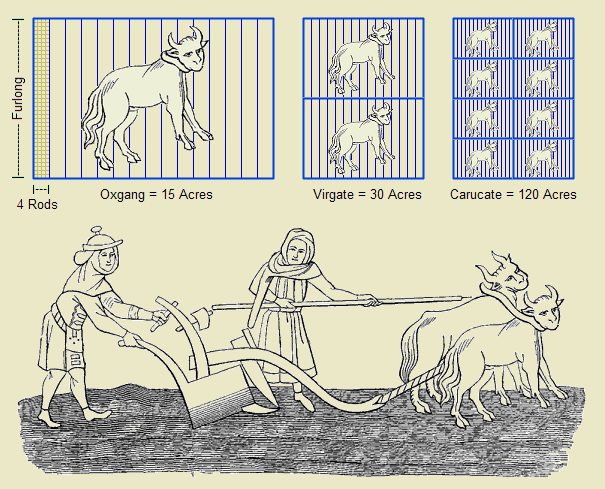 |
- The rod is a historical unit of length equal to 5½ yards. It may have originated from the typical length of a mediaeval ox-goad. There are 4 rods in one chain.
- The furlong (meaning furrow length) was the distance a team of oxen could plough without resting. This was standardised to be exactly 40 rods or 10 chains.
- An acre was the amount of land tillable by one man behind one ox in one day. Traditional acres were long and narrow due to the difficulty in turning the plough and the value of river front access.
- An oxgang was the amount of land tillable by one ox in a ploughing season. This could vary from village to village, but was typically around 15 acres.
- A virgate was the amount of land tillable by two oxen in a ploughing season.
- A carucate was the amount of land tillable by a team of eight oxen in a ploughing season. This was equal to 8 oxgangs or 4 virgates.
Open-field System etc.
- Note: ADD references from Wikipedia: Open-field system, Ridge and furrow, Selion, etc. as extras elements for the above entries.
Notes
- A
- A
