Hârn HârnMaster Barbarians
Note: ADD proper names and cross-internal links.
Note: ADD list of "special" details to add the various details for extras, ie. saltmarshes of Vashel, under Tamsen Forest.
Note: Text Highlight and Background Colour: Kandáy, Réthem, Thârda, Káldôr, Mèlderýn, Chybísa, Orbáal, Ázadmêre, Eváel.
Note: Green = I Have, Red = Don't Have, Orange = Old Scan, Blue = Misc, Black = ALL Base (Template)
Note: Colour Highlights: Yellow
Colour LINK Text: Possible Link NAME
Note: Hidden comments <!-- TEXT HERE WILL NOT BE DISPLAYED -->
Note: Anchor Points - Section linking WITHIN pages USE [[Help:Section#Section_linking|Section linking]] or To link to a section in the same page you can use [[#section name|displayed text]], and to link to a section in another page [[page name#section name|displayed text]].
Note: Section linking with arbitrary id USE <span id="anchor_name"></span>. Be sure to use a name that is not likely to be duplicated. One way to do this is to incorporate the titles of the higher-level sections, at least in abbreviated form, e.g., Ontario-Natural_features for the "Natural features" subsection of the "Ontario" section of an article about the provinces of Canada.
ADD inside Table Caption/Heaer Text
Contents
- 1 HârnMaster Barbarians COL 4761
- 2 TRIBAL LIFE
- 2.1 TRIBAL ECONOMICS
- 2.2 TRIBES OF HÂRN
- 2.3 TRIBAL OCCUPATIONS
- 2.4 Tribal Nations Map
- 2.5 TRIBAL WARFARE
- 2.6 TRIBAL LAW
- 2.7 HUNTING
- 2.8 TRACKING TABLE
- 2.9 HUNTING TABLE
- 2.10 APPROACH TABLE
- 2.11 TRAPPING
- 2.12 TRIBAL RELIGION
- 2.13 TRIBAL RITUAL SKILL
- 2.14 SHAMANS
- 2.15 SHAMAN SKILLS & PIETY
- 2.16 TRIBAL INVOCATIONS
- 2.17 TRIBAL CAMPAIGNS
- 3 BARBARIAN CHARACTERS
- 4 ADAENUM
- 5 ANOA
- 6 Bujoc
- 7 Chelni
- 8 Equani
- 9 Chymak
- 10 Gozyda
- 11 Hodiri
- 12 Kabloqui
- 13 Kamaki
- 14 Kath
- 15 Kubora
- 16 Pagaelin
- 17 Solori
- 18 Taelda
- 19 Tulwyn
- 20 Urdu
- 21 Ymodi
- 22 Back Cover
- 23 A
- 24 A
- 25 A
- 26 A
- 27 A
- 28 Notes
HârnMaster Barbarians COL 4761
Possible Link
 |
A
TRIBAL LIFE
- Barbarians 1
The deep forests of Hârn are home to 18 tribal nations whose total population exceeds 100,000. Each nation has a fairly well-defined homeland indicated on the Tribal Nations map (p3) and detailed in each tribe’s article. The tribal nations are of the same Jarin and Pharic racial stock as civilized human cultures but have remained barbaric or semi-civilized.
Although civilized Hârnians look down on them as backward, most tribesmen have more freedom and leisure time than manorial peasants who spend virtually their entire day in the fields. However, much of that spare time must be spent sharpening spears and fletching arrows because the wilderness is a significantly more dangerous environ than the manor.
TRIBAL ECONOMICS
All Hârnic tribes are hunter-gatherers or fisher-gatherers although a few practice rudimentary herding and agriculture. The tribes are nomadic or seminomadic, meaning they tend to move from one location to another within their territory seasonally or every few years. Hence, they have no permanent homes and instead use portable tents or temporary huts as needed. Because wilderness areas are sparsely populated, tribal villages can be widely spaced.
Trade with Civilization
Hârnic tribes are usually able to find enough food and other essentials to survive. However, trade with civilized mercantylers is common for tribes on the edges of civilization or those located along established trade routes like the Salt Route or Fur Road. The tribes trade furs, wild beasts for the arena, slaves, and rare herbs and minerals like amber and jade, in exchange for metal tools and weapons, woven textiles, jewelry, and most other specialized products of civilized technology.
Mining and Metals
Tribes mine and smelt only small amounts of metal; their artifacts are primarily made of stone, horn, wood, and leather. Metal acquired in trade or looted from civilized settlements or caravans is used for making axeheads, arrowheads, spearheads, and daggers. Larger weapons such as swords or battleaxes, however obtained, are status symbols. A few tribes trade with local gargun for metal goods.
The Kubora, Urdu, and Equani are unusual in that they use significant quantities of metal and even know how to make iron. This was one of the factors that enabled Arlun’s hordes to conquer Rethem.
Some tribes gather copper and tin ore from surface deposits and know how to smelt it to produce bronze tools and weapons. These have the same statistics as their iron equivalents except Weapon Quality is −1.
TRIBES OF HÂRN
Note: ADD links to each tribe page.
Ten tribal nations are descended from early Jarin colonists and six from the later Pharic invaders. Two are of hybrid origin.
JARIN TRIBES
Adaenum
Fisherfolk of Anfla Island off the southwest coast of Hârn.
Anoa
Nomadic hunters of the Anoth River valley in southern Orbaal.
Bujoc
Nation of shy, superstitious, forest nomads with a strong matrilineal culture.
Chymak
Famed sea-folk of Belna Island. They range the Gulf of Ederwyn in large sea-going canoes, and are much valued as seamen on merchant ships.
Equani
Warrior tribesmen of Equeth, noted for their elaborate facial scars and tattoos and their merciless treatment of intruders.
Kabloqui
Degenerate cannibals from the north shore of Lake Benath. They are related to the Equani, who detest them. Their gargun neighbors may destroy them, if their own treachery doesn’t first.
Kubora
Powerful warrior nation of Peran. They once united under Arlun the Barbarian and conquered Rethem. They export wild beasts for the Pamesani Games.
Taelda
Nomadic hunter-gatherers who inhabit the vast forests of southern Nuthela. The Taelda are renowned healers and woodsmen.
Urdu
Nomadic hunters who inhabit the range between the Chetul and Pemetta rivers in northwestern Hârn.
Ymodi
Wild forest tribesmen of Himod in northern Hârn. Beleaguered by the Equani to the west, Anoa to the east, and gargun to the north and south, they survive because of their impressive skill with the bow and spear.
TRIBAL OCCUPATIONS
- Barbarians 2
Hârnic tribes have few speciality craftsmen. Tribesmen help in the production of tools, weapons, pottery, clothing, and other artifacts. Some occupations might be reserved for one clan, and some are often restricted to men or women. Tribesmen mostly improve their quality of life by trading the bounty of nature for the manufactured products of the civilized world.
Compared to their civilized cousins, tribesmen have fewer occupations. The descriptions below are general. Occupations vary among the tribes. Refer to the Occupation Table for each tribe to identify specific occupations and skills.
Hunter: The default occupation for men in most tribal cultures. The hunter is an expert at wilderness survival and is often highly skilled with a bow and javelin/spear, which are used regularly to hunt. The enhanced Eyesight, Hearing, and Smell that tribal characters possess give them an edge in such useful wilderness skills as Awareness, Stealth, Tracking, and Survival. Some tribes, such as the Tulwyn and Equani, have a class of elite warriors. These are just hunters who are particularly skilled at combat.
Fisherman: Most coastal tribes survive on fish and favor marine skills over hunting and fur-trapping skills. Tribal fisherman have higher weapon skills than most seafarers because they, like hunters, are the primary defensive manpower. Some Chymak seamen serve in the Seamen’s Guild.
Herder: Some tribes herd goats, cattle, horses, and other animals. This occupation is sometimes handled by children and young adults.
Grower: A few tribes grow crops to supplement their gathering. This role is usually filled by women and slaves.
Slave: Warrior tribesmen much prefer to have slaves perform hideworking and other unclean work. Slaves number as much as ten percent of some tribal populations. It is a custom encouraged by Hârnic slavers, who offer valuable trade goods in exchange for human goods. Slaves are generally well treated but are forbidden to carry weapons and cannot normally leave the tribal camp without an escort. Unruly or inefficient slaves are typically sold to a slaver.
Shaman: Most tribes have shamans or similar holy men. There are many different religions among the tribal peoples of Hârn. See Barbarians 8 for full information on shaman characters.
Chieftain: The traditions of leadership vary widely between tribal nations. A few nations lack the occupation of “chieftain,” usually because shamans fill that role.
PHARIC TRIBES
Chelni
A loose federation of 30 tribes, ranging in size from 60 to 200, who occupy the Chelna Gap and surrounding hills. The Chelni breed ponies that are traded for civilized goods.
Gozyda
Forest tribesmen who control the Mimea Hills in western Hârn. Organized into bands of 60 or less, the Gozyda include some outlaws from Tharda and Kanday. This has brought them new blood and technology.
Hodiri
Proud nomadic horsemen of Horadir. The Hodiri are extremely fierce warriors. There are about 80 tribes, 60 to 300 strong.
Kath
A loose federation of wild and primitive tribes inhabiting the Kathela Hills in eastern Hârn. There are about 60 bands, few of which exceed 30 in number. Kath women are known for their beauty.
Pagaelin
The violent, vicious tribal nation dwelling roughly between the Osel River and Setha Heath. There are approximately 120 tribes of 60–240 members. They are under the influence of a heretical Navehan sect.
Tulwyn
Merciless barbarians who inhabit the wilderness of Athul. They are divided into some 90 tribes, of 60–150 members. The Tulwyn use weapons and tools taken from traders along the Salt Route.
OTHER TRIBES
Kamaki
The herdsmen of the island of Kamace off southwestern Hârn. There are fourteen tribes, few exceeding 100 in number.
Solori
A primitive and wild nation in southeastern Hârn. There are about 30 tribes, each of 40–150 people. The Solori are slowly being exterminated in a genocidal crusade waged by the knights of the Order of the Lady of Paladins.
Tribal Nations Map
- Barbarians 3
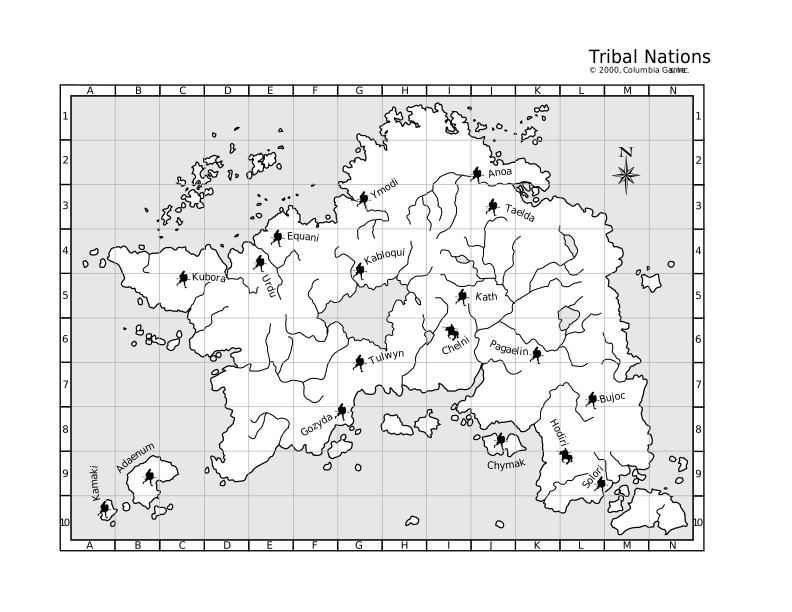 |
TRIBAL WARFARE
- Barbarians 4
Most tribes are perpetually at war with the gargun although a few, notably the Tulwyn, trade with the orcs for their much superior metalwork and weapons. Before the gargun appeared on Hârn some six centuries ago, tribal folk shared the wilderness only with a few bothersome predators and Ivashu and numbered two or three times their present population. The gargun proved to be vastly more fertile and aggressive rivals for wilderness domination. They initially forced many tribes to flee into civilized parts, creating a period of unrest known as the Migration Wars that lasted from 178 to 235. By the year 250, the struggle stabilized at its present situation; roughly 50,000 gargun dominate the alpine and highland wilderness and double that number of tribesmen control the lowland forests.
Tribesmen prefer to fight lightly encumbered. They rarely wear metal armour, although it is common to loot mail and plate from fallen foes and convert it into more useful artifacts or trade it to civilized mercantylers. Tribal warriors prefer leather, although thick furs (treat as Quilt) are used in cold weather conditions. Most tribes can white-taw hides, creating a tough leather that retains the fur (treat as Leather+Quilt). Some tribes, especially sea-faring peoples, never use armour.
Warring tribes rarely engage in pitched battles. Ambush or surprise raids are the preferred tactics, and bloodshed is kept to a minimum. Tribesmen much prefer to take captives than scalps, for prisoners can be exchanged, ransomed, or kept as slaves. In a meeting engagement between warring tribes, it is customary for one side to retire after suffering just one or two casualties; battles to defend a camp are usually more brutal and tend to be avoided.
TRIBAL LAW
A major difference between the barbarian peoples of Hârn and their civilized cousins is their respective freedom. The feudal order is based upon a social contract that requires peasants to sacrifice legal freedom in exchange for security. The vast majority of Hârnic folk are born into a feudal culture and lead a relatively peaceful but unfree life.
All barbarians are freemen. They are not bound by law to their tribes, only by bonds of blood and friendship, and need not fear the retribution of an armed and annoyed overlord should they desire to leave. Of course the dangers lurking in their surrounding wilderness tends to keep tribesmen close to home, as leaving it is often fatal.
Law is established by tribal custom and handed down by the chieftain. Judgements can be harsh, but a cruel or unjust chieftain is easier to depose than a knight or baron.
SPIRIT MARKERS
Spirit markers define territory and convey information. They normally take the physical form of a stick to which objects have been tied, typically feathers, scraps of fur, bones, and carved wood. Sometimes the markers are attached to branches or carved into trees. Spirit markers are imbued with spirit magic during their fabrication. This makes them visible to the ethereal world.
Markers are unique, but can be grouped into four broad classifications:
[1] Camp Markers indicate a clan camp is being approached. Those wishing to enter the camp should wait beside the marker until they are approached and given permission to proceed. Levels I to III.
[2] Curse Markers warn that trespassers will suffer some form of bad luck until they are ritually purified. Levels II to V.
[3] Pestilence Markers are warnings to indicate that the area they enclose is populated with evil spirits. Levels IV to VI. Those with an Aura of 13+ who touch the marker may be able to see the spirits.
[4] Death Markers are a more powerful form of the first three. They summon a tribal spirit who enters into Mental Conflict with anyone who attempts to violate the marker or its message. Levels V to VII.
Spirit Markers have a rated level as with invocations or spells. The level depends on the skill of the shaman during fabrication and the effect or intent. Higher level markers are easier to detect by sensitivity skills and talents.
HUNTING
- Barbarians 5
Hunting (or fishing) accounts for 40–60% of the tribal diet. Obtaining meat is primarily a male role, partly because of the danger and weapons employed, partly to ensure and maintain male dominance.
Tracking Animals
Most hunters do not track live prey; too much energy is consumed in the process to justify the return. Animals have habits, and good hunters know the spots frequented by game or use information gleaned from trails to determine where to lie in wait for prey.
Skilled trackers make deductions about the species, size, weight, and age of an animal by examining its footprints. Some clues are the depth of the prints and their spacing. If leaves or twigs have fallen in the print or insect tracks cross it, the hunter can surmise the age of the trail. The time of day the creature passed is also discernable from the path of the trail, particularly in open or sparsely treed ground. If the tracks meander from tree to tree, the animal likely passed at midday when the sun’s heat encouraged it to seek shade. Whether the tracks pass to the east or west of a tree indicates the time of day as well; morning shade is cast to the west and afternoon shade to the east. When combined with knowledge of local weather and an animal’s habits, the best hunters can determine the age of a trail to within fifteen minutes.
Tracking skill is used to determine the frequency of animal encounters. Roll on the Tracking Table modified at GM discretion for current weather and local abundance of game. Heavy rain or snow would justify a penalty of 10–60 to Tracking skill. The result determines the number of animals encountered. Species and food value can be generated on the Hunting Table.
Approaching Animals
Refer to the Missile Data T able in HârnMaster core rules. The prey can be attacked from Extreme, Long, Medium, or Short range. Animals are usually sighted at Extreme range. The hunter may attack immediately or attempt to close. A Stealth Roll is made on the Approach Table to determine if the animal is alerted during each attempt to close. Modify the roll according to terrain (GM discretion). At each Range Class, the hunter may attack (fire/throw a missile weapon) or attempt to move closer.
Downing Animals
The attack may be resolved with the Hârnmaster (combat 16) rules. Animal defense on the first shot is probably Ignore, then Dodge or Charge (Counterstrike) on later shots if any. If a strike is made, determine injury. If the animal fails a Shock Roll, it is downed and helpless. A wounded beast may flee, or attack the hunter. If the attack misses, animals will generally flee, but some may charge the hunter.
TRACKING TABLE
| CS: | 1d3 animals sighted. |
| MS: | One animal sighted. |
| MF: | Animal sighted, but flees. |
| CF: | Animal charges hunter if applicable, or flees. |
HUNTING TABLE
| 1d100 | Type | Food1 |
|---|---|---|
| 01–05 | Black Bear | 75 |
| 06–08 | Beaver/Otter | 10 |
| 09–21 | Boar | 25 |
| 22–25 | Cougar | 15 |
| 26–45 | Deer | 75 |
| 46–50 | Fox/Weasel | 10 |
| 51–55 | Moose/Elk | 300 |
| 56–65 | Rabbit/Hare | 2 |
| 66–75 | Sheep/Goat | 20 |
| 76–80 | Wolf | 20 |
| 81–85 | Gargun | Inedible |
| 86–95 | Human | 40 |
| 96–00 | GM Discretion | –– |
| 1 Man-days of meat. Assumes 50% of animal weight is meat, and two pounds (1KG) of meat per day. Randomize values plus or minus 20% if desired. | ||
APPROACH TABLE
| CS: | Close two Range Classes. |
| MS: | Close one Range Class. |
| MF: | Range same. Animal makes Awareness Roll and flees if it detects hunter. |
| CF: | Hunter stumbles. Prey flees. |
Releasing the Spirit
When a tribal hunter makes a kill, the invocation Spirit Release is performed over the corpse. This prayer is known by all hunters from an early age.
In some tribes, the head is mounted on a stick or buried. Most believe that when an animal’s skull has been cleaned of flesh by scavengers, the animal has been reborn in a new body.
TRAPPING
- Barbarians 6
Many tribes rely on tools, weapons, clothing, and other manufactured goods paid for with pelts they trap and harvest. The fur trade is particularly lucrative in Orbaal, Nuthela, Equeth, Himod, and Peran, as well as the remoter reaches of the Sorkin and Rayesha Mountains. Some fur-bearing animals change the colors of their fur to white in the winter, and then back to a deep brown or black in the summer. Each hue enjoys a special status, but the lighter colors are generally more valuable.
Trapping Animals
Trapping is the skill of snaring a useful fur-bearing animal, protecting the trapped animal from predators, skinning the creature without damaging the pelt, and cleaning it and transporting it to a buyer. Trapping (a new HârnMaster skill) is described in the sidebar.
The Fur Trade
Nobles buy furs as trim and accessories, and even as whole coats and cloaks. They are willing to pay handsomely to be seen in rich garb and this supports a thriving Hârnic fur trade.
Some civilized mercantylers specialize in the fur trade. They typically journey to traditional trading posts in the early to late spring to acquire pelts trapped throughout the winter. Payment is never in coin, for which tribesmen have little use, but rather in metal weapons and tools, woven cloth and dyes, and shiny but inexpensive jewelry. Although values can vary dramatically, pelts can generally be obtained for about 10% of their retail value and then transported and sold to a furrier or hideworker for about 50% of their retail value. The trader must then deal with the settlement’s guards, hawking tax, and other bureaucratic hallmarks of civilization.
TRAPPING SKILL
INSERT HEADER TABLE
AGL DEX EYE Ula/Ara +2 SB2
Used to set traps and check them. Traps are suitable for small mammals (not larger than a fox or badger). It takes one daylight watch to deploy/harvest a onemile trapline.
The trapper sets out a trapline and then checks it every few days.
CS: 1d6 pelts per mile of trapline.
MS: 1d2 pelts per mile of trapline.
MF: No Pelts.
CF: Traps destroyed by animals, gargun, or rivals.
For every day that a trapline goes unchecked, there is a 20% chance that local predators will get to trapped animals fi
Overhunting
Hunting/Trapping reduces the amount of game in an area. Drives reduce the available game to sparse; other methods reduce abundance according to their success at GM discretion. It is not possible to hunt an area repeatedly and still find plenty of game.
Fishing & Foraging for Food
See HârnMaster core rules, Skills 16.
Fur/Hide Prices (retail)
| Fur/Hide | Price (retail) |
|---|---|
| Bear | 18d |
| Beaver | 20d |
| Boar/Pig | 5d |
| Cattle/Ox | 12d |
| Cougar | 6d |
| Deer | 6d |
| Elk | 10d |
| Ermine/Sable | 30d |
| Fox | 18d |
| Goat | 4d |
| Horse | 10d |
| Lamb | 3d |
| Moose | 12d |
| Otter | 24d |
| Rabbit/Hare | 1d |
| Seal | 24d |
| Weasel | 24d |
| Wolf | 8d |
TRIBAL RELIGION
- Barbarians 7
An important feature of most Hârnic tribal societies is their extreme superstition. Most folk on Hârn are superstitious to some degree but tribal societies have more rules about taboo activities, plants, and animals. Although tribal religions are not overly concerned with proselytizing nor with complex theology, they are defining features of the society.
While some tribal deities are independent demigods, several are really aspects of the gods worshiped by civilized folk. However, since the needs of a tribal community are different, deities known to civilized folk usually appear in different guises to their tribal worshippers. Although Ilvir and K’orr are one and the same, shamans of the Anoa tribal nation are unaware of this fact.
The Spirit World
Most tribes believe that everything in nature has a spirit, not only all living creatures, but also such things as rocks, trees, rivers, winds, and mountains. For some tribes, there is no such thing as an inanimate object. Differences in the natural world of a tribe are reflected in its spirit world. Forest spirits do not exist in the spirit world of a desert tribe. Sea creatures are not often found in the spirit world of an inland tribe although, in some cases, corruptions do exist because the tribe migrated from a coastal region in the distant past. Most spirits are benign but there are always evil spirits to be overcome.
Because tribal cultures interact closely with nature, almost any activity is likely to disturb a spirit or two. Hence, the spirit world is never far from the natural world. Pursuits such as hunting, fishing, or gathering herbs are accompanied by rituals to ward off the displeasure of spirits affected. If not properly appeased, hazards visited upon the tribe or individual by evil or angry spirits can be dire indeed. The shaman is the tribe’s intermediary with the spirit world. Attitudes toward them vary from honor to distrust.
TRIBAL RELIGIONS
| TRIBE | CHIEF DEITY | Identity/Supporter/Afterlife | TITLE | Morality | Intervention1 |
|---|---|---|---|---|---|
| Adaenum | Manaclir | Eder/Totem/Reincarnation | Olna2 | 05–16 | <16/61+/81+ |
| Anoa | K’orr | Ilvir/Spirits/Reincarnation | Shaman | 05–16 | <11/51+/76+ |
| Bujoc | (Animist) | None/Totem/Reincarnation | Sha Woman | 05–16 | <21/41+/81+ |
| Chelni | (Animist) | None/Spirits/Yashain | Shaman | 05–16 | <21/41+/81+ |
| Chymak | Kualthurlu | Eder/Demigod/Reincarnation | Sarfaeda | 05–16 | <16/61+/81+ |
| Equani | Kemlar | Demigod/Spirits/Yashain | Shaman | 05–10 | <11/51+/86+ |
| Gozyda | Oyinath | None/Reincarnation | Shaman | 03–10 | <21/41+/81+ |
| Hodiri | — | None//None/Other | n/a | 05–16 | <21/41+/81+ |
| Kamaki | Shadet-Etu | Eder/Demigods/Yashain | Shaman | 08–16 | <16/61+/81+ |
| Kabloqui | (Animist) | None/Ancestor/Yashain | Shaman | 03–10 | <21/41+/81+ |
| Kath | (Animist) | None/Totem/Yashain | Shaman | 05–13 | <21/41+/81+ |
| Kubora | Kemlar | None/Demigod/Yashain | Shaman | 05–13 | <11/51+/86+ |
| Pagaelin | Saraen | Sarajin/Demigods/Yashain | Shaman | 05–16 | <16/41+/81+ |
| Solori | Matasum | Demigod/Ancestor/Other | Clanhead3 | 05–13 | <11/51+/86+ |
| Taelda | Cothllynn | Siem/Spirits/Reincarnation | Tuathar | 08–18 | <16/41+/91+ |
| Tulwyn | Kekamar | Demigod/Spirits/Yashain | Priest2 | 05–13 | <16/41+/81+ |
| Urdu | Kemlar | Demigod/Spirits/Yashain | Shaman | 05–13 | <11/51+/86+ |
| Ymodi | Wajok | Demigod/Totem/Reincarnation | Shaman | 05–16 | <16/61+/91+ |
| 1Intervention/Conditions/Retribution | 2 Have some form of clerical rank | 3 Not a true shaman, but has some religious functions | |||
Eder
During the Natal Wars, many Lesser Gods were slain or imprisoned in the struggle for divine dominance. Eder was a god expelled from the “high forest of the undamned” and imprisoned in a huge cave beneath the ocean. The Gulf of Ederwyn, lying to the south of Hârn, is named after the captive god. Locals say that Eder’s endless struggles to escape cause the notorious rough seas of this gulf.
The sea-faring Adaenum, Chymak, and Kamaki peoples along Hârn’s southern coast worship aspects of Eder. The god’s attributes vary between the tribes, although the invocations available to their shamans are similar. None of the three tribes is aware that the other two worship the same deity as they do.
Divine Intervention
Some tribal religions do not recognize divine intervention, either because they acknowledge no powerful deities or because they do not believe that the gods protect humans.
See HârnMaster Religion 6 for Divine Intervention rules.
TRIBAL RITUAL SKILL
- Barbarians 8
Each tribal religion has its own Ritual skill with its own Skill Base. All barbarian characters have an automatic ritual skill in their own tribal religion, which they open at SB2.
TRIBAL RITUAL SKILL TABLE
INSERT HEADER TABLE
| Tribe | Ritual SB | Sunsign |
|---|---|---|
| Adaenum | Voi Int Dex | Lad+2, Hir+1, Sko+1 |
| Anoa | Voi Int Aur | Sko+2, Tai+1, Ula+1 |
| Bujoc | Voi Int Aur | ● |
| Chelni | Voi Int Aur | Ahn+2, Fen+1, Tai+1 |
| Chymak | Voi Int Dex | Lad+2, Fen+1, Sko+1 |
| Equani | Voi Int Aur | Ara+2, Ang+1, Fen+1 |
| Gozyda | Voi Int Wil | Ahn+2, Tai+1, Tar+1 |
| Hodiri | n/a | ● |
| Kabloqui | Voi Int Aur | Ara+2, Ang+1, Fen+1 |
| Kamaki | Voi Int Dex | Lad+2, Ahn+1, Ula+1 |
| Kath | Voi Int Aur | Hir+2, Ahn+1, Ula+1 |
| Kubora | Voi Int Aur | Ara+2, Ula+1, Tar+1 |
| Pagaelin | Voi Int Aur | — |
| Solori | Voi Voi Int | Ang+2, Nad+1, Tai+1 |
| Taelda | Voi Int Aur | Ula+2, Hir+1, Tai+1 |
| Tulwyn | Voi Int Str | Hir+2, Ang+1, Sko+1 |
| Urdu | Voi Int Aur | Ara+2, Mas+1, Tai+1 |
| Ymodi | Voi Int Aur | ● |
Animism
In HârnMaster, “animism” refers to the worship of ethereals rather than deities. Most tribal religions include an element of animism, even if they worship a specific deity. Spirits are much less powerful than deities, sometimes on a level with humans. This puts the animist shaman on a different footing to the civilized priest. Power is gained from spirits by bargaining or, in some cases, by capturing or tricking them to help.
Animist religions are concerned with matters directly affecting survival, such as staving off disease, famine, or enemies. Belief in animism is strong. Improperly killing an animal may cause its spirit to bring bad luck on the hunter, so warding spells and charms are common. Many such taboos have no apparent practical purpose, perhaps because the tribesmen have misinterpreted the demands of their deity.
Totemism
Totemism is a special type of animism in which the worshiper takes on some of the properties of a particular entity, usually an animal but sometimes a natural phenomenon. The entity chosen is always a useful one, often a fierce and strong animal seen as more powerful than an unassisted human. Lions, wolves, and bears are common totems, as are whales and eagles among some tribes. The totemist (sometimes an entire clan) becomes stronger by emulating the creature. Totems may be treated as demigods providing specific benefits to their followers. The interaction between individuals or groups with different totems is governed by strict social rules and rituals.
SHAMANS
- Barbarians 9
The generic term for a religious functionary in Hârnic tribal societies is “shaman,” although some tribes have their own titles. Their functions vary from culture to culture, some being closer to civilized priests than to a genuinely animist shaman. They accrue piety as do priests, although tribes have a very different approach to services, which may be seasonal or even less frequent. Lengthy communing with their deities is the main source of piety points for many shamans. Most tribal cultures have no offices above Shaman (Circle III).
Tribal societies cannot feed those who do not provide a useful service; thus, shamans are less isolated than many civilized priests. Many have skill in hunting or other mundane abilities, while others concentrate on providing healing magic, blessing weapons, warding off evil spirits, or cursing enemies. In other cases, the shaman’s communion with the spirit world is unsettling to the people, and he is prohibited from doing mundane work.
In addition to occasional services, shamans perform ceremonies to guide the soul of the tribal member through the important rites of passage. Other duties vary considerably from tribe to tribe; for example, the shamans of Manaclir (Adaenum) double as the village chieftains.
Shamans have access to invocations, although those worshipping demigods may have a limited selection. Even those shamans whose religion does not include deities (Bujoc, Chelni, and Kath) can use invocations. Although these are gathered from a variety of beings, which may have different demands, piety should be calculated in the same way as for theistic religions.
Some tribal invocations are similar to those found in civilized lands, but a number are unique. Usually the shaman must enter an ecstatic state rather than employ formulaic prayer. Other invocations include prayers for good hunting, rituals to acknowledge outsiders as friends of the tribe (or curses to mark them as enemies!), and invocations that allow the shaman to be temporarily possessed by a spirit to gain or transmit knowledge or power.
Tribal societies seldom differentiate between types of supernatural power. Those with psionic powers or Shek-Pvar spells may be referred to as “shamans” by tribesmen and may even be granted similar rights and responsibilities.
SHAMAN SKILLS & PIETY
Characters enter play as newly initiated shamans of the third circle. The Shaman Occupation Skills table (sidebar) replaces the normal Cleric Occupation Skills (HârnMaster Religion 8). Shamans are otherwise generated in the same way as civilized priests with regard to starting invocations, optional skills, and piety.
Where tribal religions lack gods, Piety represents the shaman’s devotion to the whole panoply of local spirits worshiped by the tribe; angering any one of them could lead to a loss of piety points.
SHAMAN OCCUPATION SKILLS
ALL: Ritual/4, Folklore/5, Intrigue/4, Mental Conflict/4, Rhetoric/4, Weatherlore/4, Dancing/3, Foraging/3, Oratory/3, Embalming/2, Herblore/2, Physician/2.
Adaenum: Initiative/5, Survival/5, Fishing/5, Weatherlore/5, Law/3, Seamanship/3.
Anoa: Animalcraft (Ivashu)/4, Survival/4, Tracking/3, 1 Weapon OML+SB.
Bujoc: Awareness/5, Intrigue/5, Rhetoric/5, Herblore/4, Woodcraft/4, Law/3, Animalcraft/2.
Chelni: Awareness/5, Survival/4, Herblore/3, Physician/3, 1 Weapon OML+SB.
Chymak: Weatherlore/5, Fishing/4, Survival/4, Herblore/3, Physician/3, Metalcraft (bells)/2.
Equani: Initiative/5, Survival/4, Herblore/3, Tracking/2, 2 weapons OML+SB.
Gozyda: Awareness/5, Cooking/4, Stealth/4, Survival/4, 2 Weapons OML+SB.
Hodiri: No shamans.
Kabloqui: No shamans.
Kamaki: Fishing/4, Herblore/3, Survival/4, Physician/3, Seamanship/3.
Kath: Survival/4, Herblore/3, 1 weapon OML+SB.
Kubora: Survival/4, Herblore/3, Tracking/3.
Pagaelin: Survival 5, Tracking/3, 2 weapons OML+SB.
Solori: No shamans.
Taelda: Herblore/4, Physician/3, Script (Taelda) 70+SB.
Tulwyn: Survival/5, Weatherlore/5, 2 Weapons OML+SB.
Urdu: Survival/4, Herblore/3, Tracking/3.
Ymodi: Foraging/5, Weatherlore/5, Survival/4, Herblore/3.
TRIBAL INVOCATIONS
- Barbarians 10
The following invocations are similar for all tribal religions. Experienced shamans know them all, or similar rites by a different name. Unique invocations are given at the end of each tribal article.
Band of Brothers II
INSERT HEADER TABLE
| Band of Brothers | II | |
|---|---|---|
| Time: 15−RSI seconds | Ritual: Prayer | |
| Range: Touch | Duration: One use | |
| Allows adherents of the same deity to voluntarily transfer piety to the shaman. The intent is to give the shaman more piety for some desired use. All donors of piety must touch the shaman. | ||
| CS: Shaman receives up to 20pp from each donor. | ||
| MS: Shaman receives up to 10pp from each donor. | ||
A
| Initiation II |
| Time: 15−RSI minutes Ritual: Prayer/Chant/Dance |
| Range: Touch Duration: N/A |
| Initiates a child or adult convert into the mysteries of the tribe. |
| The ceremony often involves an ordeal of some kind. |
| CS: Subject receives 5d6 pp from Deity/Spirit. |
| MS: Subject receives 5d6 pp from Shaman. |
| CF: Shaman is struck blind and mute for 3d6 hours. |
A
| Spirit Blessing II |
| Time: 25−RSI seconds Ritual: Prayer/Chant/Dance |
| Range: Touch/Sermon Duration: One Blessing |
| A ritual to bestow Piety on the subject. The piety is transferred |
| from the shaman to the subject. The shaman determines in |
| advance how much Piety to bestow. With CS, bestowed piety is |
| deducted at half-cost from the shaman. |
| Blessing may (optionally) be used to neutralize the effect of a |
| Hex psionic talent or a Curse invocation. |
A
| Pair Bonding II |
| Time: Variable Ritual: Prayer/Chant |
| Range: Touch Duration: The Ceremony |
| A marriage ceremony which lasts about one hour. Both the |
| groom and bride must already be Initiated into the tribal |
| religion. The ceremony blesses and awards 3d6 piety to each |
| spouse, from the deity with success, or from the shaman with |
| failure. |
A
| True Name II |
| Time: 35-RSI seconds Ritual: Chant |
| Range: Touch Duration: N/A |
| All plants, animals, and ethereals have a unique True Name. |
| Invoker learns the True Name of the subject touched. Those |
| with Will can initiate Mental Conflict. |
| CF: True Name not learned and subjects with Will |
| automatically initiate Mental Conflict. |
A
| Spirit Release II |
| Time: 15−RSI mins Ritual: Prayer |
| Range: N/A Duration: N/A |
| A funeral ceremony to aid a soul in making a quick and |
| uneventful death journey. The intent is for the shaman and/ |
| or mourners to give the departed sufficient piety to ensure |
| Divine Grace. The shaman provides 3d6 piety and each attendee |
| provides 1d6 piety to the departed. Individuals may give |
| additional piety by special prayer, etc. |
| Hunters perform this ritual after making a kill to ensure the |
| spirit of the slain animal may peacefully rest. Success on this |
| roll transfers 1d6 Piety from the Hunter to the animal, while |
| failure indicates an angry spirit. |
A
| Sign of the Spirit III |
| Time: 25−RSI seconds Ritual: Prayer |
| Range: RML feet/Touch Duration: One Initiative Test |
| Creates a feeling of the presence of the deity. In crisis |
| situations, the effect is to cause ALL persons within Range who |
| are not adherents to test Initiative (Combat 18), modified as |
| noted for success level: |
| CS: −20 MS: −10 CF: +20 |
A
| Spirit Balm III |
| Time: 15-RSI seconds Ritual: Chant |
| Range: Self/Touch Duration: N/A |
| Ritual to aid with healing. Shaman selects a wound, covers it |
| with a dressing of leaves/moss, and invokes ritual. |
| CS: Stops bloodloss and +2 HR (Healing Rate) to that wound. |
| MS: Stops bloodloss and +1 HR (Healing Rate) to that wound. |
| MS: Stops bloodloss. No healing. |
| CF: Stops bloodloss. Wound becomes infected. |
A
| Spirit Walking III |
| Time: 15−RSI minutes Ritual: Chant/Meditation |
| Range: Self Duration: 10 (MS) or 30 (CS) mins. |
| Allows the shaman to become ethereal for Duration. In this |
| state, he cannot interact with the physical world but can interact |
| directly with other spirits. While “walking,” the Shaman’s |
| physical body remains in a state of metabolic suspension and |
| is vulnerable to harm or ethereal possession. See HârnMaster |
| Religion 16 for information on ethereality. |
A
| Spirit Bonding III |
| Time: 15−RSI hours Ritual: Prayer/Meditation |
| Range: Self Duration: Trance for 5 minutes |
| An attempt to establish a close spiritual relationship with the |
| deity. The shaman hopes to earn the deity’s favor, reflected by |
| receiving bonus Piety. |
| MS: 2d6 Piety CS: 4d6 Piety |
| CF: The deity/spirit is annoyed by this intrusion and |
| punishes the shaman by reclaiming 4d6 Piety. |
A
- Barbarians 11
| Curse IV |
| Time: 15−RSI seconds Ritual: Prayer/Verbal Declaration |
| Range: RML yards Duration: As below |
| An attempt to invoke the displeasure of the shaman’s deity |
| upon one named victim. Curses cannot kill nor be randomly |
| directed. A curse is usually a short, simple declaration. |
| CS: The victim suffers a substantial curse, such as a |
| disfigurement or mental problem (which lasts until |
| removed by a Blessing). The Medical/Psyche tables |
| (Character 9, 11) can help inspire effects. |
| MS: The victim sustains a special penalty on the next skill |
| roll (GM discretion). |
| CF: The curse rebounds on the curser. |
A
| Spirit Call IV |
| Time: 25−RSI minutes Ritual: Prayer/Meditation |
| Range: Unlimited Duration: One Summoning |
| Allows the shaman (only) to perceive all ethereal phenomena |
| in the tribal spirit world, and then to summon a specific |
| denizen. Invocation EML is reduced by Aura×2 of the |
| summoned ethereal; the more powerful the denizen, the more |
| difficult it will be to summon. A summoned denizen will |
| appear immediately with CS, or in 3d6 minutes with MS. The |
| summoned spirit may be asked one specific yes/no question, or |
| a broader question with CS. |
| The summoned spirit may be willing to perform a task if |
| an appropriate sacrifice is made. Significant tasks are often |
| required by powerful spirits. |
| CF: The wrong spirit is summoned by accident. It is likely to |
| be malevolent or at least mischievous. |
A
| Banish Spirit/Disease V |
| Time: 15−RSI Minutes Ritual: Prayer/Song |
| Range: RML Feet Duration: One Mental Conflict |
| Seeks to banish a hostile spirit within Range or to exorcise a |
| possessing spirit from its host victim. The invocation involves |
| one Mental Conflict (Skills 23–24) with the spirit, modified by |
| the success level of this ritual. |
| CS: +30 MS: +10 CF: −20 |
| Banishing disease is synonymous with banishing an evil spirit. If |
| this is the intent, the modifier above is used with an immediate |
| roll on the Infection Table (Physician 3). The invocation cannot |
| revivify a corpse. |
A
| Spirit Marking V |
| Time: 15−RSI minutes Ritual: Prayer/Suitable Object. |
| Range: Touch Duration: Indefinite (MS) |
| Permanent (CS). |
| Blesses an artifact like an amulet, bone, claw, or feather. The |
| artifact stores a known invocation, such as Curse or Spirit Call, |
| for instant activation on touch. Shaman determines the number |
| of charges to install; each charge costs Circle×5pp. Hence, |
| storing three charges of a Circle V invocation costs 3×(5×5pp) |
| = 75pp. |
| For more information on Spirit Markers, see sidebar on |
| Barbarians 4. |
A
| Soul Death V |
| Time: 25−RSI mins Ritual: Prayer/Chant |
| Range: Unlimited Duration: Indefinite |
| Strips an adherent of all Piety and places a curse on any other |
| adherent who shelters or otherwise comforts the subject. The |
| intent is to drive the subject away from the tribe. The shaman’s |
| deity might not agree with the action and may, especially in |
| cases of impiety or corruption, penalize the invoker instead. |
| CF: The Deity is certain to punish the invoker instead. |
TRIBAL CAMPAIGNS
- Barbarians 12
Tribal characters can become involved in HârnMaster campaigns in dozens of different ways. Use the following tables to choose or generate adventure ideas.
Tribal Characters in Wilderness Hârn
Campaigns where all the PCs are tribesmen enjoy greater freedom for travel and bearing weapons but barbarians are rarely welcome in civilized parts unless they have earned the respect and/or gratitude of locals.
01–30 Raid on/by neighboring tribes or gargun.
31–50 Raid on/by slavers, miners, mercenaries, or caravan.
51–60 Tribal leader requests help to gather the various tribes of a nation together or to forge an alliance with a neighboring tribal nation against gargun or another common enemy.
61–70 Intruders must be driven or lured away from a sacred site.
71–80 Civilized folk are lost, warned of danger, or rescued from captivity by gargun or rival tribes and escorted home.
81–90 Creature troubles a tribe, perhaps a unique Ivashu or a rare animal like a cave bear. Hunting such animals might be a source of honor (Tulwyn, Kubora) or grant blessings from the spirits (Kath, Chelni).
91–00 The spirits are angry. Appeasing them may require a visit to a distant place to make an offering, sacrifice of a rare animal, or recovery of a lost/stolen holy item. The task may involve defeating or earning the cooperation of ethereals.
Tribal Characters in Civilized Hârn
Tribal characters are sometimes found in civilized areas. The GM must determine why the character resides among civilized peoples and this generally suggests many adventure scenarios.
01–50 Character leaves to make fortune in civilization, planning a short stay, although many never return home. Tribesmen are employed as mercenaries or scouts to lead parties and caravans into the wilderness, perhaps to visit Earthmaster ruins. They are also hired as hunters, trappers, and foresters by nobles living on the edge of wilderness regions. Chymak are highly prized as crewmen aboard merchant ships.
51–80 Character is taken captive by a civilized party. Slavers from Orbaal, Rethem, and Tharda buy and kidnap tribal children to be raised as slaves. Adults may be taken prisoner as potential gladiators for the Pamesani Games or as pleasure slaves.
81–90 Character is outcast for some reason, perhaps for violation of a tribal taboo or fleeing a rival claimant to the position of chieftain or shaman.
91–00 Character is sole survivor of a gargun swarm or tribesmen raid and is rescued by a civilized party. Tribal characters raised in civilized Hârn are not restricted to tribal occupations.
Missionary Activity
Peonian missionaries are active in many tribal lands. Sometimes they establish small, self-sufficient settlements. Peonians usually travel without military guard and are often in peril. The Church may send a party to learn the fate of a mission with which they have lost contact.
Laranians have had little success among the tribes, despite their missionary zeal. Most tribesmen see a warrior goddess as the antithesis of their tribal culture.
Ilviran missions are typically a single traveling holy man. Although few permanent converts are made, most Ilvirans are well received, especially among Jarin tribes.
Agrikan missions have met with little success because their religion appeals only to warlike tribes that typically have their own warrior codes and beliefs that clash with Agrikanism.
Two religions not normally associated with missionary activity are influential. Many Chelni have converted to Sarajinism and there are Navehan heretics among the Pagaelin.
Miners as Villains
Miners are considered villains by many tribal nations since they often intrude and establish mines in valuable hunting ground or sacred sites. Clearcutting and diverting and poisoning of streams are ecologically damaging processes that miners employ and tribesmen resent. One major effect is that the amount of available game drops drastically within several miles of a mine.
The Miners’ Guild on Hârn is powerful and wealthy. It is not uncommon for mines to employ slaves, runaway serfs, and hardened criminals. They are not above acquiring additional slaves from a nearby tribe or trading weapons to one in exchange for captives from a rival tribe.
In addition to armed rough-and-ready miners, mercenaries are often hired to protect the interests of the guild.
In areas close to civilization, the guild can usually count on the assistance of the sheriff ’s men or a company of the local Legion in the event of difficulty.
BARBARIAN CHARACTERS
- Barbarians 13
Using the random birthplace generation tables in HârnWorld, one in six player characters will be from a tribal culture. Compared to civilized folk, those raised in tribal societies have a unique set of wilderness skills and equipment, sharper senses, and a vastly different world view. Generate barbarian characters with the following modifications to the HârnMaster core rules.
A
BIRTH ATTRIBUTES
Species: All tribesmen are human.
Sex, Birthdate, Sunsign: Use HârnMaster core rules.
Birthplace: Within the home range of the tribe.
Culture: Tribal.
Social Class: Unguilded, except noble (chieftain and entourage) or slave.
FAMILY DEVELOPMENT
Sibling Rank: Tribal families tend to be smaller than their civilized counterparts. Use the Sibling Rank Table (HârnMaster core rules, Character 4) but subtract 20 from the die roll.
Parent: Roll on the Tribal Parent Table (sidebar). The GM may apply modifiers for different tribes.
Estrangement and Clanhead: Use HârnMaster core rules.
APPEARANCE ATTRIBUTES
Height, Frame, Weight: Use HârnMaster core rules.
Comeliness: Some tribesmen tattoo, scar, or paint their bodies. Comeliness reflects how attractive the PC is to members of the same tribe. Among Equani, for example, ritual scarring is considered attractive and a high roll means extensive and intricate scarring. However, the character will not likely be attractive to outsiders. Kath women have a reputation for beauty.
Physical Attributes: Tribal characters have heightened sensory attributes. HârnMaster gives tribal characters bonuses for Eyesight +1, Hearing +2, and Smell +2.
PERSONALITY ATTRIBUTES
Intelligence, Aura, and Will: Use HârnMaster core rules.
Psyche: Use HârnMaster core rules, but with discretion. Phobias relating to the natural world, such as fear of birds, insects, and snakes, tend to be less severe in tribal cultures. Conversely, fear of the supernatural and xenophobia are likely to be more common.
Morality: The Tribal Religions table (page 7) lists a range of morality scores appropriate to each tribe. If morality is too low, characters may become an outcast; if too high, they will probably be unpopular.
Deity: This is determined by the character’s tribe. See Tribal Religion (page 7).
TRIBAL PARENT TABLE
| 01–75 Offspring: Re-roll below: |
| 01–60 Both parents alive and |
| living together. |
| 61–70 Father Absent: desertion, |
| divorce, etc. |
| 71–75 Mother Absent: desertion, |
| divorce, etc. |
| 76–80 Father Dead |
| (Mother widow). |
| 81–85 Father Dead |
| (Mother remarried). |
| 86–90 Mother Dead |
| (Father widower) |
| 91–00 Mother Dead |
| (Father remarried) |
| Step-parent and half-sibling data can |
| be generated as desired. |
| 76–80 Bastard: Character’s mother |
| may have been raped. Subtract |
| 25 from Estrangement roll. |
| 81–00 Orphan: Character raised by |
| a tribal relative. |
LANGUAGES
All tribal characters have an OML of 60+SB in their native language. Many tribes have distinctive dialects so civilized speakers of the same language may have difficulty understanding them. In these cases, apply a penalty of −20 to the ML of the characters conversing unless one of the characters has significant experience in the dialect of the other (e.g., a tribesman living in civilized lands). Native languages among the tribal nations of Hârn are as follows:
Hârnic Tongues
Chelni, Gozyda, Hodiri, Kath, Pagaelin, Tulwyn.
Jarin Tongues
Adaenum, Anoa, Bujoc, Chymak, Equani, Kabloqui, Kubora, Taelda, Urdu, Ymodi.
Other Languages
The Solori speak a language that is part of the Azeri language family.
The Kamaki speak Kamakin, which has elements of both Jarin and Anzelan languages.
Tribes that interact with the gargun often speak a gargun language.
ASSIGNMENT OF SKILLS
- Barbarians 14
The final step in character generation is to assign skills. Please read “Assignment of Skills” in HârnMaster (Character 19) before proceeding.
[1] Automatic Skills
Skills that every character has regardless of background or training. Calculate and record the SB for each automatic skill. Tribal characters have an automatic Ritual skill for their own tribal religion (see Barbarians 8).
[2] Occupation Skills
The occupations available to tribal characters and their associated skills are listed in each tribal article. Generate (or choose) an occupation and open the listed skills at SB indicated. Occupational skills for most female barbarians are given in the sidebar, although some tribes give women a wider choice of occupations and skills.
[3] Optional Skills
Tribal characters, including women, have five Option Points (OPs) to open new skills and/or improve open skills. Each OP may be used to open one new skill on the Tribal Optional Skills table (sidebar) at its noted OML, or to open any tribal occupation skill at standard OML (Skills 4). OPs can also be expended to improve an open skill by SB1, including any just opened, but never more than one increase per skill.
[4] Psionic Talents
Generate psionic talents normally, using the HârnMaster core rules.
EQUIPMENT
Tribal player characters begin play with the same amount of equipment as other PCs (see HârnMaster, Character 20) but lack coinage and credentials. The GM may permit characters to begin play with trade goods equal in value to WIL×3d in lieu of coinage.
TRIBAL OPTIONAL SKILLS
Acrobatics/3, Acting/3, Animalcraft/2, Brewing/3, Ceramics/3, Cookery/4, Dancing/3, Drawing/3, Fishing/4, Folklore/4, Foraging/4, Herblore/2, Hidework/3, Musician/2, Survival/3, Timbercraft/3, Weaponcraft/2, Weatherlore/4, Woodcraft/3, suitable tribal Weapon/OML+SB.
Female Skills
The task of foraging for foods like berries and nuts is usually performed by women. In most tribes, women cannot become hunters and the taking of life is taboo. Women receive little, if any, training in combat. In tribes that practice agriculture and herd animals, women also perform this work. The skills of a typical tribal woman are:
Cooking/4, Foraging/6, Herblore/2, Hidework/3, Physician/2, Stealth/4, Survival/5, 1 Weapon to OML.
Chelni and Hodiri women add Riding/3. Tulwyn women learn two weapon skills.
Not all tribes restrict female roles. Among the Anoa, Kamaki, Kath, Taelda and Ymodi, talented women may become shamans, and the Bujoc and Chymak tribes insist their shamans be female. Among the Kath and Ymodi, women can perform any function; some become chieftains.
| OCCUPATION YEARS CP |
| Chieftain 7 20 |
| Shaman 7 10 |
| Hunter 6 7 |
| Fisherman 5 6 |
| Forager 5 5 |
| Slave 2 0 |
Years: The average length of training that the GM can vary plus/minus one year. Characters begin play having completed the training for their vocation. That is, a career choice was made when the character was 7–14 years old and several years of training have been completed.
CP: Cost for each occupation using the HârnMaster Character Points system.
A
A
A TABLE
INSERT HEADER TABLE
ADAENUM
- Barbarians 19
The isle of Anfla is home to the Adaenum tribal nation. There are 20 tribes, ranging from 60 to 400 members in size. Fourteen coastal tribes subsist primarily by fishing, while six inland tribes practice primitive agriculture.
A
ORIGINS AND HISTORY
Most scholars believe that the islands of Anfla and Kamace were once connected to the Hârnic mainland by a now submerged land bridge. They point to the shallow waters of Emaba Strait and to the stumps of ancient trees visible in Sarkum Bay during the lowest tides. Adaenum legends recounting voyages to “the last place the Sea desired” are said to confirm the theory beyond doubt.
The Jarin ancestors of the Adaenum migrated to their present island home between 1100 and 900 BT. Little is known of their early history. Oral traditions are ripe with heroic tales of great sea monsters and demons, defeats of invading giants, and victorious raids on the nearby Kamaki. Contact with mainland Hârn was certainly minimal for many centuries and isolation made the Adaenum a hardy and insular people.
The first recorded contact with civilized Hârnians occurred in 441 TR, when King Xuaka of Aleathia sent an expedition to explore the islands. The visitors were greeted with suspicion and hostility and returned to Aleath having made little progress. An armed exploration the following year had more success, but these troops were withdrawn in 443 when Xuaka invaded the Corani Empire.
In 572, some ships of the Aleathian Odyssey were wrecked on the coast of Anfla. The fate of any survivors is unknown but it is unlikely they would have been welcomed by the coastal peoples. It may be significant that the practice of agriculture by the interior Adaenum tribes dates from about this time.
Adaenum OCCUPATIONS
| 01–70 Anac-Adaenum |
| 01–97 Fisherman |
| 3 Weapons to OML+SB, |
| Fishing/6, Seamanship/5, |
| Weatherlore/5, Foraging/4, |
| Survival/4, Piloting/3. |
| 98–99 Slave |
| Cookery/4, Foraging/4, |
| Intrigue/4, Hidework/3. |
| 00 Olna |
| See Shaman rules. |
| 71–00 Shu-Adaenum |
| 01–55 Grower |
| Weatherlore/5, Agriculture/4, |
| Foraging/4, Animalcraft/3. |
| 56–80 Herder |
| Animalcraft/4, Survival/4, |
| Tracking/4, Weatherlore 4. |
| 81–99 Hunter |
| 3 Weapons to OML +SB, |
| Survival/5, Tracking/5, |
| Foraging/4, Stealth/4, |
| Hidework/3, Fletching/2. |
| 00 Olna |
| See Shaman rules. |
Adaenum WEAPONS
| WQ Weapon AQ Armour |
| 9 Club +0 Cloth |
| 10 Dagger +0 Leather |
| 9 Sling |
| 10 Spear/Trident |
WAY OF LIFE
- Barbarians 20
Although they are racially identical, there are significant cultural differences between the coastal and inland Adaenum. The reasons for the division are obscure. The inland tribes have oral traditions of terrible storms that forced their ancestors to abandon the fishing life, and also of a fair folk who came in canoes bigger than a whale and taught them the ways of the land. Although the coastal Adaenum regard themselves as superior to their inland brethren, there are good relations between them. Trade between the two groups is common and marriage, though infrequent, is not unknown. Both live in exogamous (taboo to marry within one’s tribe) patrilineal groups.
ANAC-ADAENUM (The Coastal Tribes)
The Anac, or coastal Adaenum, draw most of their sustenance from the sea, either by fishing or by foraging for shellfish, edible seaweeds, and bird eggs. They are skilled fishermen, whether operating from small boats or surf fishing. Trade is conducted through barter, although the practice of using elaborately carved abalone shell tokens as a medium of exchange is gaining popularity. Anac houses, especially on windward coasts, are constructed of turf, stone, and wood. The houses are sturdy and often exist for two or three generations.
The coastal Adaenum have a deep reverence for the sea. They believe in a pantheon of animist sea spirits (Gull, Crab, Seal) ruled by Manaclir, “the great grey god,” master of wind and wave. They believe Manaclir is equally capable of peace and wrath, and changes his moods with capricious frequency. The coastal Adaenum regard drownings as “the dues of Manaclir.”
The chief and shaman of each coastal tribe is called the Olna, the “Lesser Guide.” The Olna is a semi-hereditary office passing from father to “son,” who is often adopted and is the Olna’s apprentice. There may be several apprentices. If an Olna dies without an heir, his successor is chosen by lot from the adult men. This is regarded as a major calamity by the tribe, who consider themselves “bereft of blessing” until the new Olna is properly trained.
The most sacred place to the coastal Adaenum is Ahond, “the Weirding Place,” on Enlaya Island. This is the residence of the Holna or “High Guide,” an oracle of Manaclir who “knows the breaking of each wave.” Each Olna endeavors to visit Ahond once per year to receive guidance. The Holna has a bodyguard of 28 warriors, two from each coastal tribe, who defend and support him. It is a great honor to be chosen for the Holna’s bodyguard. The small community also receives tribute from visitors. Late in life, the Holna chooses a successor from one of the Olna or their apprentices.
SHU-ADAENUM (The Inland Tribes)
- Barbarians 21
The inland tribes are known to the coast dwellers as Shu, or “hidden” Adaenum. They practice primitive agriculture and raise goats, moving their villages as the soil is depleted every three to five years. Shu dwellings are circular huts, 10 to 14 feet in diameter, with a domed roof of wood frames and woven sticks covered with an insulating layer of mud.
The tribe shares the work of tending the land. Caring for the herds of goats is the responsibility of younger children. Tribesmen measure wealth by the number of goats owned.
The Shu Adaenum acknowledge the existence of Manaclir but practice a form of fertility worship. Rituals are held beneath the full moon. A similarity to Peonian and Halean rituals and beliefs, although much degenerated, lends credence to tales of Aleathian influence. When children reach puberty, they attend their first Adsih, or “moon meeting.” Marriages are performed under a new moon and involve much revelry. The tribes of the Shu Adaenum, like their coastal brethren, are led by an Olna, but have no equivalent of the Holna.
PRESENT SITUATION
The last century has seen gradually increased contact between the Adaenum and mainland Hârnians. Such contact has varied widely, ranging from Orbaalese pirate raids to peaceful missionaries.
The Earl of Sarkum has laid claim to Anfla and the other islands in the
group. Since 716, he has sent annual expeditions to Anfla with the aim of both
exploring the island and convincing the Adaenum of the benefits of the earl’s
protection. The response of the tribes has been polite disinterest, although they
have accepted all gifts. In 719, an attempt by the Kandians to introduce farming
techniques and implements to the coastal tribes was met with scorn and anger.
The earl has so far attempted to peacefully co-opt the Adaenum but has not
ruled out the possibility of military conquest. He plans another expedition for
the spring of 720.
The increased contact with mainland Hârn is creating stress for the coastal Adaenum. Exposure to Kandian traders and missionaries has raised questions for which the Olna and Holna have few answers. Some tribesmen have left the islands to make new lives on mainland Hârn and the ancient ways of life are under increasing pressure. The emergence of the witch-hunting Dalaga cult reflects the increasing paranoia and disruption among the coastal Adaenum. Sherene and her “witch smellers” grow increasingly fanatical, the most extreme of them believing that the Kandians are witches sent by the inland tribes or the Kamaki. Others believe that the Kandians are a test sent by Manaclir and that those who accept their gifts are tempting his wrath.
Despite the efforts of the Dalaga, the coastal groups are growing accustomed to the strangers and find many trade goods far superior to items of their own manufacture. So far, there has been minimal contact between Hârnians and the inland tribes since the coastal Adaenum are unwilling to allow outsiders to roam freely across the island.
Relations between the Kamaki and the Adaenum are poor and have been so for centuries. Disputes with the Kamaki over fishing rights in Tieka Strait are common. The west coast Adaenum periodically raid Kamace Island, usually with the intent of stealing nets and boats or simply for sport. This ongoing conflict sometimes escalates to violence. The Dalaga witch hunters call the Kamaki Ulno (demons) and blame the drowning deaths of several Adaenum fishermen in Tieka Strait on Kamaki witchcraft.
The Vulna
The Adaenum believe strongly in the existence of witches (Vulna). Vulna are persons with dormant powers, activated by the curse of evil earth spirits or by sex with other witches. Vulna are known to commit incest, murder children, and mate with wild animals and woodland spirits.
The Dalaga
For the last decade, the Dalaga, a witchhunting cult, has enjoyed widespread popularity among young Anac-Adaenum. The Dalaga is led by Sherene, a young woman who commands a cadre of “witch smellers.” Sherene has accused 22 persons of witchcraft. According to ancient custom, all such unfortunates must be brought before the Olna for treatment or become Duhlno (outcast). Treatment consists of feeding the accused a compound of the ordeal drug Tasparth, which often results in death. Voices of dissent among the elders say that Sherene is the true witch and a deadly struggle for power has begun to unfold.
ADAENUM INVOCATIONS
- Barbarians 22
Wisdom of Ahond II
Time: 15−RSI seconds Ritual: Prayer Range: Self Duration: One situation Offers insight when the invoker is unsure of the proper course of action. This applies only to moral quandaries. The GM should reveal any information in some subtle way. CF: Invoker is struck blind for 3d6 hours.
Seal’s Blessing III
Time: 15−RSI seconds Ritual: Chant Range: RSI hexes Duration: 1 minute Causes a surge of euphoria to overwhelm all folk within RSI hexes except those excluded by the invoker. Subjects will dance with wild abandon, squirm with ecstasy, and the like. Victims test against WIL×3 (MS) and WIL×1 (CS) to avoid the effect. CF: Invoker only is subject to the effect.
Crab’s Blessing III
Time: 15−RSI Seconds Ritual: Chant Range: Touched Weapon Duration: One Strike Blesses one weapon by doubling the Edge and Point impact for one strike. Blood must be drawn for the blessing to terminate. With CS on invocation, combat skill for the blessed weapon is +10. Weapon can be used by anyone. CF: Weapon shatters.
Olna’s Way III
Time: 15−RSI seconds Ritual: Chant Range: Touch Duration: 1 (MS), 3 (CS) mins. Initiates the subject into training as an Olna. Recipient is anointed and receives a special blessing. CS: The deity/spirit grants the subject Piety equal to one half of the shaman’s piety. MS: The deity/spirit transfers one half of the shaman’s Piety to the subject. MF: No Blessing. CF: No Blessing. Both subject and shaman are struck deaf and blind for 3d6 hours.
Puffin’s Blessing III
Time: 15−RSI seconds Ritual: Prayer/Sacrifice Range: Self/Touch Duration: One skill use Enhances one maritime skill for one use: MS +10, CS +30. The bonus, at the shaman’s option, is applied to one Fisherman occupation skill of that tribe. CF: Results in a permanent ML reduction of 1d6 points to the designated skill.
Embrace of Adsih IV
Time: 15−RSI mins Ritual: Trance Range: Touch Duration: 3 days Increases fertility of a human female by promoting a very strong desire for sex during her ovulation. The invocation cannot guarantee pregnancy, nor overcome barrenness, and may raise some doubt as to paternity. CF: May result in permanent Nymphomania.
Wisdom of the Waves VI
Time: 15−RSI hours Ritual: Trance Range: Touch/Self Duration: One Divination Invoker enters into a trance, staring at breaking waves for Time and seeking to divine the future. Success allows invoker to “see” up to a month into the future. Critical Success allows for greater detail and divination deeper into the future. CF: Invoker learns nothing and falls unconscious for 3d6 hours.
A
A
A TABLE
INSERT HEADER TABLE
ANOA
- Barbarians 23
The extensive forests north of the Anoth River to the Jahl Mountains in Orbaal are home to the Anoa tribal nation. They number about 4,500 folk, divided into 47 tribes of 80 to 120 members. Beleaguered by gargun and subject to attacks from Lorkin and Leriel, the Anoa are nomadic. Each tribe moves to a new location every two to four weeks.
A
ORIGINS AND HISTORY
Originating on the Lythian mainland, the Anoa are closely related to the Jarin and Taelda. The first Anoa landed on the shores of Jarin Bay around 1100 BT, about the same time as the Taelda arrived in the Anoth Delta. The Anoa settled upriver in the forested region between the Anoth River and the Jahl Mountains. For a half millennium, they dwelled in solitude and peace in semipermanent clanholds, hunting bountiful forests of wild game and fishing rivers teaming with seasonal salmon and trout.
The Anoa had little contact with the Sindarin and Khuzdul and kept most of their traditional customs. Their peaceful existence was first challenged by civilized Jarin moving north in the centuries following the Atani Wars. The two peoples had distinct cultures, but serious strife was avoided because the newcomers respected Anoan territory and mostly settled south of the Anoth river or north of the Jahl mountains. The first significant threat to the Anoa occurred in the second century, when gargun began to appear in the north. Increasing raids by the gargun from Diaffa, Ejatus, and Amekt culminated in 159, when swarming Diaffa Gargu-arak massacred three Anoan tribes in one day. The Anoa adopted nomadic lives to survive the gargun threat.
The nomadic life led to a major change in tribal aggressiveness. Mobile cultures are generally warlike, and civilized caravans soon became an obvious target when food was short. The Jarin lords of Lorkin and Leriel retaliated with punitive attacks and cruel tortures of captured Anoa, who responded in kind. Three centuries of merciless bloodletting with the Jarin now include the recent Ivinian conquerors of the region.
A
- Barbarians #
A
A
A TABLE
INSERT HEADER TABLE
Bujoc
- Barbarians 27
A
- Barbarians #
A
A
A TABLE
INSERT HEADER TABLE
Chelni
- Barbarians 33
A
- Barbarians #
A
A
A TABLE
INSERT HEADER TABLE
Equani
- Barbarians 37
A
- Barbarians #
A
A
A TABLE
INSERT HEADER TABLE
Chymak
- Barbarians 41
A
- Barbarians #
A
A
A TABLE
INSERT HEADER TABLE
Gozyda
- Barbarians 45
A
- Barbarians #
A
A
A TABLE
INSERT HEADER TABLE
Hodiri
- Barbarians 49
A
- Barbarians #
A
A
A TABLE
INSERT HEADER TABLE
Kabloqui
- Barbarians 53
A
- Barbarians #
A
A
A TABLE
INSERT HEADER TABLE
Kamaki
- Barbarians 55
A
- Barbarians #
A
A
A TABLE
INSERT HEADER TABLE
Kath
- Barbarians 59
A
- Barbarians #
A
A
A TABLE
INSERT HEADER TABLE
Kubora
- Barbarians 63
A
- Barbarians #
A
A
A TABLE
INSERT HEADER TABLE
Pagaelin
- Barbarians 69
A
- Barbarians #
A
A
A TABLE
INSERT HEADER TABLE
Solori
- Barbarians 75
A
- Barbarians #
A
A
A TABLE
INSERT HEADER TABLE
Taelda
- Barbarians 81
A
- Barbarians #
A
A
A TABLE
INSERT HEADER TABLE
Tulwyn
- Barbarians 85
A
- Barbarians #
A
A
A TABLE
INSERT HEADER TABLE
Urdu
- Barbarians 91
A
- Barbarians #
A
A
A TABLE
INSERT HEADER TABLE
Ymodi
- Barbarians 95
A
- Barbarians #
A
A
A TABLE
INSERT HEADER TABLE
Back Cover
- Barbarians 100
A
- Barbarians #
A
A
A TABLE
INSERT HEADER TABLE
A
- Barbarians #
A
- Barbarians #
A
A
A TABLE
INSERT HEADER TABLE
A
- Barbarians #
A
- Barbarians #
A
A
A TABLE
INSERT HEADER TABLE
A
- Barbarians #
A
- Barbarians #
A
A
A TABLE
INSERT HEADER TABLE
A
- A
- A
A
- A
- A
Notes
- A
- A

