Difference between revisions of "Hârn Info"
m |
m (→Inspirations: Hârn) |
||
| (7 intermediate revisions by the same user not shown) | |||
| Line 4: | Line 4: | ||
The role-playing game ''[[HârnMaster]]'' was developed specifically for use with Hârn. It enables players, gamemasters, and writers to develop character descriptions that exploit the deep level of detail found in Hârn. | The role-playing game ''[[HârnMaster]]'' was developed specifically for use with Hârn. It enables players, gamemasters, and writers to develop character descriptions that exploit the deep level of detail found in Hârn. | ||
| + | |||
| + | '''Note:''' ADD proper names and cross-internal links. | ||
| + | |||
| + | '''Note:''' ADD list of "special" details to add the various details for extras, ie. saltmarshes of Vashel, under Tamsen Forest. | ||
| + | |||
| + | |||
| + | '''Note:''' Text Highlight and Background Colour: <span style="color:#FFDE30; background:#176727">'''Kandáy'''</span> | ||
| + | |||
| + | |||
| + | '''Note:''' Green = '''<span style="color:#008000">I Have</span>''', Red = '''<span style="color:#FF0000">Don't Have</span>''', Orange = '''<span style="color:#E18700">Old Scan</span>''', Blue = '''<span style="color:#000080">Misc</span>''', Black = '''<span style="color:#000000">ALL Base (Template)</span>''' | ||
| + | |||
| + | '''Note:''' Colour Highlights: <span style="background:#FCFF19">Yellow</span> | ||
| + | |||
| + | Colour LINK Text: '''<span style="color:#006699">Possible Link</span>''' [[Game_Design_Ideas_H%C3%A2rn_Kandáy_SHIRE_HUNDRED_NAME|NAME]] | ||
| + | |||
| + | |||
| + | '''Note:''' Hidden comments <nowiki><!-- TEXT HERE WILL NOT BE DISPLAYED --></nowiki> | ||
| + | |||
| + | |||
| + | '''Note:''' '''<span style="color:#FF0000">Anchor Points - Section linking WITHIN pages</span>''' <u>USE</u> <nowiki>[[Help:Section#Section_linking|Section linking]]</nowiki> or <u>To link to a section in the same page</u> you can use <nowiki>[[#section name|displayed text]]</nowiki>, and to <u>link to a section in another page</u> <nowiki>[[page name#section name|displayed text]]</nowiki>. | ||
| + | |||
| + | |||
| + | '''Note:''' '''<span style="color:#FF0000">Section linking with arbitrary id</span>''' <u>USE</u> <nowiki><span id="anchor_name"></span></nowiki>. Be sure to use a name that is not likely to be duplicated. One way to do this is to incorporate the titles of the higher-level sections, at least in abbreviated form, e.g., Ontario-Natural_features for the "Natural features" subsection of the "Ontario" section of an article about the provinces of Canada. '''<span style="color:#FF0000">ADD</span>''' inside '''<span style="color:#006699">Table Caption/Heaer Text</span>''' | ||
| + | |||
| Line 243: | Line 267: | ||
* [http://www.columbiagames.com/ Columbia Games Harn and Harn Master] | * [http://www.columbiagames.com/ Columbia Games Harn and Harn Master] | ||
* [http://en.wikipedia.org/wiki/HârnMaster HârnMaster] | * [http://en.wikipedia.org/wiki/HârnMaster HârnMaster] | ||
| + | |||
| + | |||
| + | == Inspirations: Hârn == | ||
| + | Friday, October 25, 2013 | ||
| + | |||
| + | Many of us who were around back in the day recall the memorable ads for Columbia Games' ''Hârn'' that ran in ''Dragon'' magazine throughout the early to mid 80s. I took note of them at the time, and one of the local hobby stores near me carried some of the product line, which I'm certain I at least leafed through. For whatever reason, though, it didn't take — I just didn't get it. My guess is that the detailed campaign material just ran well over my early teenaged head. | ||
| + | |||
| + | Cut to many years later. In the early 90s I had just left college for the first time and was looking for a campaign. There was an ad for a ''Rolemaster'' game on the board at a local hobby shop in Lakewood, Ohio. At that point I has owned the books for ''Rolemaster'' for some time but hadn't yet played, so I made the call and set up a meeting with Dave, the GM, to talk it over. ''Rolemaster'' I didn't need to be sold on... but Dave began to show me some really amazing-looking setting material for ''Hârn'', that campaign world that I remembered from all those years before, but had more or less ignored at the time. He kept most of the written material close to the vest, of course. But he showed me the full-color heraldry, the calendar of religious holidays, the writeups of the deities and the glorious, glorious maps. | ||
| + | |||
| + | The full-color "regional" ''Hârn'' are done in a cartographic style by the setting's creator, the late [http://en.wikipedia.org/wiki/N._Robin_Crossby| N. Robin Crossby]. Both beautiful and absolutely packed with information, they are the gold standard for RPG maps, and have in my judgement never been equaled for their combination of utility and aesthetic appeal. The local and kingdom-level maps are almost as stunning and just as useful, and the written background material is both rich and engaging, at least if you like Hârn's very medieval and somewhat low-fantasy approach. | ||
| + | |||
| + | <center> | ||
| + | {| | ||
| + | |+ style="caption-side:bottom; color:#000000;"|'''[[Kingdom of Réthem|Kingdom of Réthem]] '''<span style="color:#008000">COL5740</span> Map Scale''' | ||
| + | | [[File:map_rethem1.jpg|center|link= ]] | ||
| + | |} | ||
| + | </center> | ||
| + | |||
| + | It wasn't long before I started to collect ''Hârn'' stuff of my own. Some of that product had become quite hard to find by the mid 90s. Inevitably, I wanted to run campaigns set there myself... but it would be quite a while for that to really come to fruition. The product line evolved interestingly after that original core set; over the course of a number of Kingdom Modules covering the human and nonhuman nations of Hârn in immense detail, as well as a series of Encyclopedia Hârnica volumes that expanded on various other topics, the island of Hârn became increasingly thoroughly filled-in. At this point, although Hârn proper has seen relatively little development in recent years (but see below) almost every site or topic of interest on the island has a multi-page article about it. It's a perfect example, according to the tastes of some, of too much setting material filling in every imaginable gap until the GM has little room to maneuver. | ||
| + | |||
| + | I say that's misleading. Obviously, some GMs, happy to riff off of published material, thrive in settings that are very detailed out of the box. Also, in order for this to be true you have ''find'' all the material, which in the case of Hârn could be fairly difficult to do. And you have to make the decision to ''care'' about all that supplemental stuff. I say that the [http://www.amazon.com/gp/product/0920711006/ref=as_li_qf_sp_asin_il_tl?ie=UTF8&camp=1789&creative=9325&creativeASIN=0920711006&linkCode=as2&tag=ardsgamtab-20| HarnWorld core set] has everything you need for a splendid and very loose sandbox campaign, including Hârn-specific encounter tables, travel and weather rules. If the relatively low implied amount of magic isn't enough for your tastes, you can always add more. If you ''do'' need or want more material, It's out there in spades. And the Hârn setting materials are system-free; you can use them with any rules set you like, although there is a set of dedicated ''HârnMaster'' rules that does some interesting things. | ||
| + | |||
| + | <center> | ||
| + | {| | ||
| + | |+ style="caption-side:bottom; color:#000000;"|'''Lýthia''' | ||
| + | | [[File:Lythia-500x370.png|center|link= ]] | ||
| + | |} | ||
| + | </center> | ||
| + | |||
| + | Aside, then, from my admiration of Hârn as a setting, I think it along with the ''HârnMaster'' have some very interesting general design principles built in. From the setting side there is the idea of a "framework" setting that provides rich high-level detail but maximum creative freedom for the group and GM, done elsewhere but, I think, never so well as here. The integration of travel and weather rules adds a great deal to those wanting to run an exploration-driven sandbox. And of course many details of the setting itself, including the abundant wilderness through which stretches long and perilous trade routes, the rationale for a near-infinite array of weird monsters, the precursor race which left an array of ruins and magical (or perhaps technological) artifacts laying about, and the interplanar gates found here and there, allowing for a number of interesting things to happen. | ||
| + | |||
| + | From the ''HârnMaster'' rules, there is a very interesting and elegant cosmology underlying an equally interesting magic system that's very reliant on player-created spells and magic items... ''without'' an ''Ars Magica''-style array of rigid rules for designing them. Instead, GM are given latitude in determining what works for their table along with instructions to use the provided examples as guidelines... and a couple of different ways to approach informing players of whether their designs will work or not, a couple of which will satisfy the most Gygaxian tastes. There are also some really cool and clever rules for psionics, and a combat system that, like ''Rolemaster'', deals out specific injuries rather than just marking off hit points. | ||
| + | |||
| + | <center> | ||
| + | {| | ||
| + | |+ style="caption-side:bottom; color:#000000;"|'''HârnMaster''' | ||
| + | | [[File:4001harnmasterlarge.jpg|center|link= ]] | ||
| + | |} | ||
| + | </center> | ||
| + | |||
| + | Which brings me to one final oddity. In its creator's final years there was a dispute over creative control and ownership of Hârn and its world, with neither party having the financial wherewithal to settle the matter in the courts. The <u>result</u> is that ''two'' companies are publishing HârnWorld material. [http://columbiagames.com/harn/| Columbia Games], the original publisher, <u>is mostly doing revisions (some of them substantial) of older material set on the island of Hârn itself</u>, made available as individual articles. The other, [http://www.kelestia.com/| Kelestia Productions], <u>is doing mostly all-new material set outside of Hârn proper, in the wider world of Kethira upon which Hârn is set</u>. I have no idea how much angst there is between the two companies, but from a fan's perspective there is little to complain about, especially since <u>Columbia had largely let Hârn fall fallow before the current status quo arose</u>. | ||
| + | |||
| + | |||
| + | * [http://forsakenage.blogspot.com/2013/10/inspirations-harn.html |Inspirations: Hârn] | ||
| + | |||
| + | == A == | ||
| + | * A | ||
| + | ** A | ||
| + | |||
| + | |||
| + | == A == | ||
| + | * A | ||
| + | ** A | ||
| Line 250: | Line 327: | ||
| − | + | [[Category:Hârn]] | |
Latest revision as of 21:39, 16 January 2021
Hârn is a campaign setting for fantasy role-playing games, designed by N. Robin Crossby and published by Columbia Games since 1983.
In 1997 Crossby founded Kelestia Productions (KP), an electronic publishing e-company. KP and CGI now independently produce printed and online materials for use with Hârn-based role-playing campaigns and fiction.
The role-playing game HârnMaster was developed specifically for use with Hârn. It enables players, gamemasters, and writers to develop character descriptions that exploit the deep level of detail found in Hârn.
Note: ADD proper names and cross-internal links.
Note: ADD list of "special" details to add the various details for extras, ie. saltmarshes of Vashel, under Tamsen Forest.
Note: Text Highlight and Background Colour: Kandáy
Note: Green = I Have, Red = Don't Have, Orange = Old Scan, Blue = Misc, Black = ALL Base (Template)
Note: Colour Highlights: Yellow
Colour LINK Text: Possible Link NAME
Note: Hidden comments <!-- TEXT HERE WILL NOT BE DISPLAYED -->
Note: Anchor Points - Section linking WITHIN pages USE [[Help:Section#Section_linking|Section linking]] or To link to a section in the same page you can use [[#section name|displayed text]], and to link to a section in another page [[page name#section name|displayed text]].
Note: Section linking with arbitrary id USE <span id="anchor_name"></span>. Be sure to use a name that is not likely to be duplicated. One way to do this is to incorporate the titles of the higher-level sections, at least in abbreviated form, e.g., Ontario-Natural_features for the "Natural features" subsection of the "Ontario" section of an article about the provinces of Canada. ADD inside Table Caption/Heaer Text
Contents
What is Hârn?
Hârn is the largest of the Hârnic Isles, a group of islands off the northwest coast of the continent of Lýthia. Northwestern Lýthia is the region known as Venârivè.
Lýthia is the largest of three continents on the World of Kèthîra.
Kèthîra is often called HârnWorld or the World of Hârn.
Kèthîra is one of many worlds in the fantasy multiverse called Keléstia which is the original (copyright) creation of N. Robin Crossby.
The collection of publications that describe Kèthîra are also sometimes called Hârn. Sometimes the separate, role-playing rules system (also created by N. Robin Crossby) called HârnMaster is 'lumped in' with this broad concept of Hârn. We do not have a problem with this, but it does tend to be confusing.
The island of Hârn is a wilderness of forests, rivers and lakes where the weather is so unpredictable that it is said that the Isles do not have a climate, just weather. Tiny feudal kingdoms huddle amidst vast tracts of wilderness populated by nomadic tribesmen, inhuman Gârgún and outlandish fell beasts.
Often called the "Misty Isle", Hârn is a land of strange magicks, unnatural artefacts, ancient legends and storied sites. 'Enlightened' and 'civilised' outsiders tend to fear and avoid the Isles, and might call it a 'nice place to vist, but I wouldn't want to die there'...
Hârn, all derived terms, and all other placenames appearing in this article are trademarks of Keléstia Productions Ltd, and are intellectual creations of N. Robin Crossby and his estate.
Note: is Hârn?
History
The world of Hârn first appeared in Hârn (1983) from Columbia Games, which presented the Hârn campaign world as a folio that offered a general overview of a campaign area, the island of Hârn, which was about three times the size of Great Britain. It included background, history, a look of religion and a small encyclopaedia called the Hârndex, and a map of Hârn drawn by N. Robin Crossby. Hârn was broadly based on Norman England, with some fantasy elements appearing through dwarves, elves and orcs. It was low magic and Hârn tried to create a genuinely real setting, based on careful research and consideration.
Setting
Properly speaking, Hârn is an island off the western coast of the region of Venârivè (the northwestern part of the continent of Lýthia) on the planet Kèthîra, but as Hârn has traditionally been the focus of the setting, many people refer to the world as Hârn or HârnWorld. Hârn is notable for several reasons:
- It has no 'evil' versus 'good' aspect that dominates many other FRPGs.
- It has a high level of detail and internal consistency. A large number of individual cities, fortifications, towns, manors and adventure locations have been described down to the names of the peasant families residing there. In its immense detail it rivals other game worlds known for their depth, such as Tekumel.
- It is also notable for its high level of realism and a concomitant low level of magic. Its societies are, for the most part, modeled quite closely on Earth during the Middle Ages (specifically, that of Norman Britain). Nonetheless, it has many of the standard trappings of fantasy, such as elves, dwarves, orcs, wizards, etc. Many of these have a unique Hârnic spin.
- The written history and events of Hârn are current up to a specific point in time (midnight on the first day of the year 720), and there is no intention of "advancing" the official timeline beyond this point. The history and events that occur after this point are controlled by the individual game masters. Thus, all Hârn games are unique but spring from a common starting point.
The island of Hârn has seven human kingdoms and two kingdoms ruled by other species. In alphabetical order, these are:
- Azadmere is the home of the Khuzan, the Hârnic dwarves.
- Chybisa is viewed as a struggling independent monarchy or a breakaway county of Kaldor.
- Evael is located along the southern coast and is the forest home of the reclusive Sinái, the Hârnic elves.
- Kaldor is a feudal kingdom with a weak king. Located at the hub of four trade routes, it is a power in the east. It is perhaps the most detailed of all of the kingdoms.
- Kanday is a stolid, chivalric kingdom situated in the western part of the island.
- Melderyn is the most ancient kingdom, reputedly founded by wizards. It is located in the southeastern part of the island and claims a monopoly on trade with the Lythian continent.
- The northern land of Orbaal was once a collection of peaceful princedoms inhabited by the Jarin people (analogues of the British Celts) until it was conquered by the Ivinians (analogous to the Vikings). Now the Jarin are brutally suppressed, but some plot rebellion.
- Rethem is widely viewed as the "evil kingdom" but this is because its rulers value might and merit over birth and privilege (or, possibly, because its largest town was the base for a crusade by the church of the death-god Morgath). It is a kingdom born of war and beset by enemies on all sides.
- Tharda rose from the ashes of the former Corani Empire (as did Kanday and Rethem) and is the island's only non-monarchist state; its patron-client social structure is superficially similar to that of Republican Rome. Petty corruption and patronage are rife, however, and the Republic is very ambitious in its territorial claims.
The island is also home to over a dozen human "barbarian" tribal nations and many bands of Hârnic orcs, known as gârgún.
The planet Kèthîra, on which Hârn is situated, is one of seven linked parallel worlds collectively known as Keléstia. Among the other worlds in the family are Terra (or Earth); Yàsháin, a high-magic world which is the afterlife of Kèthîra; Midgaad, a parallel of Tolkien's Middle-earth; and the Blessed Realm, a parallel of the land of the same name in Tolkien's works. It is suggested that the ancestors of Kèthîra's elves and dwarves came from Midgaad to Kèthîra; in the case of the elves this is a stopping off point on a longer journey to the Blessed Realm. Kèthîra's Sinái retain the custom of building swan-shaped ships in which they sail to the Blessed Realm when they weary of their time on Hârn (in this case sailing through a periodically appearing interworld portal known as the Nimeliant off Hârn's northeastern coast).
In addition to the island of Hârn itself, products have been released covering the nearby regions of Shôrkýnè (a large feudal kingdom with a weak king) and Ivínia (an analogue of Scandinavia complete with fjords, Vikings, and a religion similar to that of the old Norse).
Other products have been released detailing the island kingdom of Chélemby, a mixed-Ivínian trading state (an analogue of the medieval Scandinavian trading state of Visby). A product detailing the nearby Hârbáaler kingdom of Lédenheim is also available.
Most recently, a product has been released which details the whole sub-continental region of Venârivè (an area roughly equivalent to Europe, the Mediterranean, and the Middle-East). This product provides the basis for adventuring and exploration beyond the island of Hârn, and puts the island and its cultures in their wider context.
Setting
briansommers
OK. so there is Hârn and HârnWorld and then HârnMaster and HârnMaster Gold.
What the crap!
There is a Hârn something sold by Columbia Games and then HârnMaster sold here?
What is the differences between all these versions?
Krazma
Briefly, Hârnmaster refers to the rules while Hârn or HârnWorld refer to the setting.
Derfman
Hârn material is designed to be used in a 'low magic' setting, and with social systems that bear a close (but intentionally not exact) similarity to historic real world social systems (with a few special exceptions for non-human kingdoms and places like the Amazon kingdom of Byria....).
Having said that, the game works VERY well in a ZERO magic setting. (Although allowing some of the anti-infection potions to still work is advised, the healing rules are realistic, which can be VERY harsh....)
And the rules allow a GM to open arcane flood gates have a world with as much magic as D&D, although if that is done some of the need some adjusting (Kings on Hârn can count their magic items without taking off their shoes, and in some cases on one hand with fingers left over....)
A fair number of GMs ditch the Hârn 'rules' and just use the world setting material and adapt it to the a different set of rules.
Peter the skald
For what it is worth Brian, many of us here share your exasperation that the official 'Hârn' producers split into two companies: Columbia games and Kelestia.
Whilst these companies have many differences of opinion (mostly about map format and font types and content to an extent), they also have a tacit agreement to develop 'Hârnworld' stuff separately. Columbia develop stuff for the Island of Hârn exclusively; whilst Kelestia develops the rest of the world (Kethira). In addition to this Columbia historically developed most of the Viking kingdoms to the north and east of Hârn..although afaik they are not going to develop them further??
So if you game on the island of Hârn and sail to the viking kingdoms you will use Columbia games stuff...if you sail elsewhere you will use Kelestia stuff.
The companies sell (and thus promote) two rules sets based on the same principles (percentile dice/skill based) but with some differences. Columbia have Hârnmaster 3rd edition and Kelestia sell Hârnmaster Gold. It does not matter a jot which system you use. I prefer HM3 because I know it well, but only because I have only glanced at HM Gold
In addition to this there is the Fanon; which is unofficial fan produced stuff (mostly but not exclusively set on the island of Hârn). This is free; but matches or perhaps exceeds in volume the output of the official stuff.
Once you dive in it all makes sense...
zrayaan
I had a longer post, but after reading it I felt it might just stir up old tensions so why poke the universe.
To continue from where Peter left off, and paint each HM version with broad strokes: Hârnmaster Gold (HMG) is a continuation of the original Hârnmaster line, and is crunchier with a less "epic" feel. HM3 is built off Hârnmaster Core branch which sought to streamline a lot of the mechanics, and introduced some inflated skill values in the process; this gives it a more "high fantasy" flavor, or at least one where player characters do not suffer under the burden of low competency. The HârnMaster Advanced I mentioned in an above post reintroduces into HM3 a way to bring back some of the older HM1 systems, or what is essentially a synthesis of HM3 and HMG. If you have already bought HM3, I recommend checking it out before you buy HMG; if you dig the crunch, then HMG has much more of it for you.
I know people on both sides, and all seem perfectly happy. I have also noticed a trend of moving away from Hârnmaster altogether, In my case, it is because newer players prefer the newer, narrative systems. As always YMMV.
Leitchy
I'm not sure I quite understand your question about what format to use for exploring and building up an area. But I'm guessing you mean if there are standard map symbols and such. Yes there are, and CGI kindly allowed me to publish them here for free (although the large format map will have much the same). You can find it by searching 'map key' (you don't need the quotes) from the front page of Lythia.com. That PDF gives you both exterior and interior symbols. KP have also published the map keys for their products on their website.
HârnWorld doesn't have 'dungeons' in the same sense as AD&D2E or other high fantasy RPGs. There are places that are sorta, kinda like that, but they are all that remain of large but single structures, or a small scattering of structures. There are underground complexes, but these are inhabited...often by hundred if not thousands of ravenous Hârnic orcs.
In case you don't yet know, Hârnic orc = gargun. They aren't as civilised as D&D orcs; they'll just eat you.
What I'm trying to say is that, yes, there are certain places that might resemble the dungeons of high fantasy games, but they are usually very small, or they are inhabited. And all of them have a sound reason for being there. No vast abandoned dwarven citi...
Damn. I forgot about Kiraz.
And then there are the rare exceptions which break that general rule. :P You'll learn more about Kiraz once you buy HârnWorld and read the history.
And all of it subject to the GM's changes.
While there are plenty of individual adventures and not a few whole campaigns published on [Lythia.com] for free download, the canon material (canon = officially produced and commercially published material from either of the two companies, CGI or KP) contains thousands of potential story hooks. Almost anything can be a hook for an imaginative GM, so you can expand to your heart's content.
One of the things we've learned over the years of messing with HarnWorld's basical structure is that, while you can hack it about, it often means the material published by others, both canon and fanon, will also need altering. In fact, the deeper you hack, the less other material is usable. Or the more work you have to do, to make it fit your ideas. So while every single GM has their own personal version of Hârn (something we've taken to calling a 'p-Hârn'), they are quite often very subtle changes to the social order, or shifts of attitude or behaviour. As I said above, there are countless story hooks where your version of Hârn will diverge from everyone else's. In fact, that's why all canon Hârn material, and most fanon material too, is written as if the time is midnight on the first day of the year 720TR. What happens after that point is all up to the GM.
Again, there's nothing stopping you from making changes, even radical changes, but you have to be prepared for the consequences to other material you might want to use and the work you may be required to do, to smooth out the rough edges. Note, I'm only talking about HârnWorld here, not HârnMaster. I don't use it nor have I hacked it about. But I'd conclude that it would be much the same. Any RPG rule system is a carefully considered whole, and hacking them usually results in completed breakage. Or so I've learned.
A
Aa
A
Community
Columbia published most of the canon material about Hârn in the early 1980s; at that point (around the time the first edition of the Hârnmaster rules was published) the interval between new products lengthened and some scheduled products were never completed (such as the Trierzon and Azeryan regional modules). The setting was sustained throughout the 1990s and early 2000s by fan-created material, popularly called "fanon." The high quality and consistency of the fanon products, as well as the interactivity of message fora such as HârnList and HârnForum have kept the setting alive.
Hârnic fanon, although independently written, is notable for its goal of staying consistent with the hundreds of pages of canon material spread over more than twenty years of publication. In many instances high quality art was produced and professional grade layout and design was done to make the material look similar to products produced by the publishers. There are points of confusion regarding the sanctioning and format of fanon. Both CGI and Kelestia have different fanon guidelines.
Controversy
In 1998, the creator of Hârn, N. Robin Crossby and Columbia Games were contacted by Auran Games, an Australian video game company interested in developing a Hârnic Internet role-playing game. Around that time Robin had grown unhappy with the direction being taken with the Hârn product line and had begun self-publishing his own modules under the name Kelestia Productions in 1997. These modules and rulebooks diverged from CGI’s releases as of the HârnMaster I series. Crossby released both digital products in PDF format through Hyperbooks.com and print products which were produced in Burnaby and shipped in large volume from his home with the help of his eldest daughter Arien. During this period he published nearly half a dozen products, including his own extension of the basic rules called HârnMaster Gold. HMG was not only a new version of the Hârn universe, but a guide to campaigning with the Hârn world in any gaming system.
CGI and Crossby worked together alongside Auran until 2000 when the Auran project was cancelled by Electronics Arts, the games proposed publisher, before it was fully completed. It was one of a number of games cancelled by Electronic Arts at the time due to budget cutbacks. Over the next three years there arose more conflicts between Robin and CGI over licensing and unpaid royalties. In 2003, Crossby claimed that the contract between him and CGI had ended. An acrimonious disagreement ensued.
Though the dispute between Kelestia Productions and Columbia Games has never been completely resolved, Kelestia Productions has done business selling electronic-format modules since about 2006. After Crossby’s death in 2008 his intellectual property rights passed on to his eldest daughter Arien. The trademark for the name “Hârn” was formally granted to Arien Crossby by the Canadian Intellectual Property Office in September 2009. Columbia Games holds live registered trademarks for Hârn, HârnWorld, and HârnMaster in the United States.
Columbia Games still produces and sells Hârn material through their website. Their most recent efforts have been producing a series of articles under the name Hârn Quest. HârnQuest is a collection of Hârn articles released 4 times a year. Each issue is approximately 32 pages and includes articles about Hârnic kingdoms, cities, castles, history, creatures, and more. New Atlas Hârnica maps are also sent to HârnQuest subscribers as they are released.
Rule Systems
There are many variants and version for the rules, found here as follows;
HârnMaster Rules Versions
HârnMaster is unusual in that it has a divergent set of rules editions.
- First Edition (HM1) was written by Robin Crossby and published by Columbia Games in 1986.
- Second Edition / "HârnMaster Core" (HMC) was published by Columbia Games in 1996.
- "HârnMaster Gold" rules (HMG) was independently published by Robin Crossby in 1999.
- Third Edition (HM3) was published by Columbia Games in 2003.
There are legal issues involved here which I will not comment on. Below I simply outline differences between the editions. The differences cited below were collected from various comments on mailing lists, and I have not checked them completely.
HârnMaster Core
Here is a brief summary of the most important changes so far between second and first edition HârnMaster:
- Character pre-game generation and some appearance characteristics are not included in HMC (but could be added trivially).
- HMC has an optional rule for creating characters on a point system.
- The Touch and Speed attributes are removed, and Stamina is added.
- Endurance is now the average of Strength, Will, and Stamina.
- Players are now encouraged to select professions from a short list; the full table of professions is still available.
- Monthly skill development rolls are combined with an optional skill decline rule using Skill Maintenance Points (SMP's).
- Fatigue, Injury, and Encumbrance are now counted in Levels, each of which is approximately equivalent to 5 Points in HM1.
- Since combat produces one Fatigue Level every 5 minutes, (longer than most battles), bookkeeping during combat is easier.
- Injury Levels are determined directly from the combat table, instead of requiring a separate die roll as in HM1.
- Weapon Attack and Defence Class is combined with Attack and Defence ML's, eliminating two table lookups in combat.
- Each Convocation is now a skill with a separate Mastery Level (CML) and SB. Known spells are cast at CML-(spell level * 5), rather than being separate skills. HMC has an optional rule for spells as skills as in HM1.
- There are no special SB penalties for secondary, tertiary, and diametric Convocations.
- Spell research, learning a new Convocation, and becoming a Gray Mage are all changed to fit the new Convocational model.
- Initial CML depends on your Chantry's quality rating.
- All spells cost the same amount of fatigue to cast, based on success level. CS: 0 FL, MS: 1 FL, MF: 1 FL, CF: 2+ FL.
- CML development depends on Skill Maintenance Points. Research, study, and *stressful* spell casting gives extra SMP's.
- Divine Grace--characters with Piety Points greater than their Ritual ML are in Divine Grace which gives certain benefits. Dying without Divine Grace causes problems in the Afterlife.
- Optional rule that Piety Points can be used in prayer to directly alter EML on any single skill roll.
- Ritual ML for each deity uses different attributes and sunsigns.
- RML may only be increased by learning invocations, reading Holy Tomes, and stressful invocations.
- Cleric starting skills are adjusted.
- Starting clerics begin with Piety Points equal to WILx5.
- Ritual Invocations are no longer tied to Circles of Command.
- Invocations may be learned by anyone in the right circumstances.
- Ritual Invocations are no longer separate skills, though each must be learned separately. ML equals RML - (Circle x 5). An optional rule reverts to the HM1 rule of separate skills.
- Ritual Invocations do not require Piety Point expenditure, though it helps. An optional rule sets Piety Point costs dependant on success level.
- Rules describing ethereals is expanded and clarified.
- New rules regarding the afterlife and fate of a character's soul.
- The various church articles are tighter, with some new material.
- Each church is given unique Ritual Invocations.
- New rules for tribal religions.
HârnMaster Gold
HârnMaster Gold is an edition of the game self-published by the original author (Robin Crossby). It is a more complex system than HMC, essentially a revision of the original rules adding in more options and covering more situations. It retains more compatibility with the original (HM1) rules. Changes from HM1 to HMG include:
- A chart for attribute modifiers for non humanoid characters (e.g. various Ivashu, Asiri, Dryads, Centaurim, Ilme, Yelgri, characters with partly-divine parentage, etc.)
- Expanded optional rules for character generation, making it a bit more customizable, as well as a point-based system for character creation and rules for creating older, more experienced characters
- Detailed rules for family development -- parents, siblings twins/triplets, marriage ages, expanded reasons for parental non-residence, sibling health and location/activity tables that give far more detail and sense to fleshing out a family than HM1 gave.
- Revised medical charts, classifying disorders into two categories: common and rare
- Detailed rules on fertility, conception, pregnancy, childbirth and infant mortality (and you thought combat was deadly!), and even hereditary traits.
- Rules for aging and decline of older characters
- More basic abilities represented through skills (e.g. Condition, Dodge, Mobility, Spirit) as opposed to contant multiples of a basic attribute
- Rules for "cheap skills" (that can be opened at a higher level in the pregame than in the course of play)
- Variant rules for an 'absolute quality' system of determining the quality of an object other than the normal "Value Enhancement" chart
- Rules for "following in the family footsteps" (e.g. if you're dad's a jewelcrafter, you'll start w/a higher OML in all professional skills than you would if you were just apprenticed to one when dad was a farmer or hideworker).
- New combat options like "Press" (i.e. trying to force your opponent back, or down)
- Separate combat charts for different situations (e.g. footmen attacking mounted, mounted attacking foot, mounted attacking mounted, etc.) likely to produce different kinds of results.
- A wholly new system of missle combat, that makes it much more dangerous -- and increased the value of shields by a great deal!
- More detailed and revised rules for Mounted Combat, including rules for jousting.
- All sorts of optional/advanced combat rules: various options for weapon damage and armour damage, much more elaborate rules for unarmed combat -- including info on specific styles and techniques, giving examples of how such might be invented by the GM.
- Detailed rules for weaponcrafting and armor making, far more elaborate than anything found in HM1, guaranteed to produce unique weapons.
- New rules for dealing with heavy and light weapons, finally working in a way to bring in a strength advantage to damage/impact, while still preversing principles of weapon distinctiveness. For example, if you've got an STR of 18, you're going to be able to use a battleaxe that does a lot more damage than someone with an STR of 8, but that won't be the case if you're just using a dagger.
- Radically revised shock/injury/healing rules, due to the fact that Condition is now a skill.
- More detailed religion/ethereal rules -- although current HM:Religion rules are now even more thorough than these -- but they should be wholly compatible.
- More details on talent dormancy/episodes (similar to those found in HMC).
- Rules for generating unusual and unique "minor talents" like Animal Empathy, Aural Affinity, Gift of Tongues Memories of Past Lives, etc.
External links
- Kelestia.com: authorised by the estate of N. Robin Crossby
- Columbia Games Harn and Harn Master
- HârnMaster
Inspirations: Hârn
Friday, October 25, 2013
Many of us who were around back in the day recall the memorable ads for Columbia Games' Hârn that ran in Dragon magazine throughout the early to mid 80s. I took note of them at the time, and one of the local hobby stores near me carried some of the product line, which I'm certain I at least leafed through. For whatever reason, though, it didn't take — I just didn't get it. My guess is that the detailed campaign material just ran well over my early teenaged head.
Cut to many years later. In the early 90s I had just left college for the first time and was looking for a campaign. There was an ad for a Rolemaster game on the board at a local hobby shop in Lakewood, Ohio. At that point I has owned the books for Rolemaster for some time but hadn't yet played, so I made the call and set up a meeting with Dave, the GM, to talk it over. Rolemaster I didn't need to be sold on... but Dave began to show me some really amazing-looking setting material for Hârn, that campaign world that I remembered from all those years before, but had more or less ignored at the time. He kept most of the written material close to the vest, of course. But he showed me the full-color heraldry, the calendar of religious holidays, the writeups of the deities and the glorious, glorious maps.
The full-color "regional" Hârn are done in a cartographic style by the setting's creator, the late N. Robin Crossby. Both beautiful and absolutely packed with information, they are the gold standard for RPG maps, and have in my judgement never been equaled for their combination of utility and aesthetic appeal. The local and kingdom-level maps are almost as stunning and just as useful, and the written background material is both rich and engaging, at least if you like Hârn's very medieval and somewhat low-fantasy approach.
 |
It wasn't long before I started to collect Hârn stuff of my own. Some of that product had become quite hard to find by the mid 90s. Inevitably, I wanted to run campaigns set there myself... but it would be quite a while for that to really come to fruition. The product line evolved interestingly after that original core set; over the course of a number of Kingdom Modules covering the human and nonhuman nations of Hârn in immense detail, as well as a series of Encyclopedia Hârnica volumes that expanded on various other topics, the island of Hârn became increasingly thoroughly filled-in. At this point, although Hârn proper has seen relatively little development in recent years (but see below) almost every site or topic of interest on the island has a multi-page article about it. It's a perfect example, according to the tastes of some, of too much setting material filling in every imaginable gap until the GM has little room to maneuver.
I say that's misleading. Obviously, some GMs, happy to riff off of published material, thrive in settings that are very detailed out of the box. Also, in order for this to be true you have find all the material, which in the case of Hârn could be fairly difficult to do. And you have to make the decision to care about all that supplemental stuff. I say that the HarnWorld core set has everything you need for a splendid and very loose sandbox campaign, including Hârn-specific encounter tables, travel and weather rules. If the relatively low implied amount of magic isn't enough for your tastes, you can always add more. If you do need or want more material, It's out there in spades. And the Hârn setting materials are system-free; you can use them with any rules set you like, although there is a set of dedicated HârnMaster rules that does some interesting things.
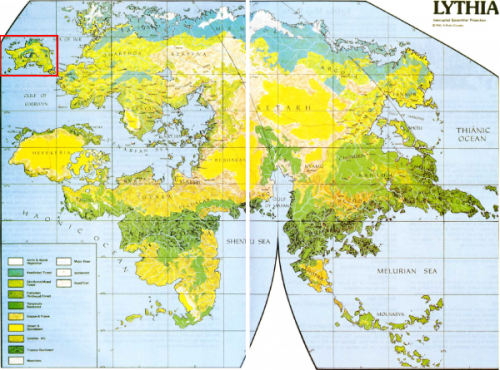 |
Aside, then, from my admiration of Hârn as a setting, I think it along with the HârnMaster have some very interesting general design principles built in. From the setting side there is the idea of a "framework" setting that provides rich high-level detail but maximum creative freedom for the group and GM, done elsewhere but, I think, never so well as here. The integration of travel and weather rules adds a great deal to those wanting to run an exploration-driven sandbox. And of course many details of the setting itself, including the abundant wilderness through which stretches long and perilous trade routes, the rationale for a near-infinite array of weird monsters, the precursor race which left an array of ruins and magical (or perhaps technological) artifacts laying about, and the interplanar gates found here and there, allowing for a number of interesting things to happen.
From the HârnMaster rules, there is a very interesting and elegant cosmology underlying an equally interesting magic system that's very reliant on player-created spells and magic items... without an Ars Magica-style array of rigid rules for designing them. Instead, GM are given latitude in determining what works for their table along with instructions to use the provided examples as guidelines... and a couple of different ways to approach informing players of whether their designs will work or not, a couple of which will satisfy the most Gygaxian tastes. There are also some really cool and clever rules for psionics, and a combat system that, like Rolemaster, deals out specific injuries rather than just marking off hit points.
 |
Which brings me to one final oddity. In its creator's final years there was a dispute over creative control and ownership of Hârn and its world, with neither party having the financial wherewithal to settle the matter in the courts. The result is that two companies are publishing HârnWorld material. Columbia Games, the original publisher, is mostly doing revisions (some of them substantial) of older material set on the island of Hârn itself, made available as individual articles. The other, Kelestia Productions, is doing mostly all-new material set outside of Hârn proper, in the wider world of Kethira upon which Hârn is set. I have no idea how much angst there is between the two companies, but from a fan's perspective there is little to complain about, especially since Columbia had largely let Hârn fall fallow before the current status quo arose.
A
- A
- A
A
- A
- A
Notes
- A
- A
