Difference between revisions of "Hârn History Chronology"
m (→Appendix VI: Languages and Scripts) |
m (→Appendix VI: Languages and Scripts) |
||
| Line 227: | Line 227: | ||
'''Émhlè''' – ancient language of the Eméla, written in '''Khrúni'''. | '''Émhlè''' – ancient language of the Eméla, written in '''Khrúni'''. | ||
| − | Eméla – middle and modern language of the | + | '''Eméla''' – middle and modern language of the Eméla, written in Khrúni and Lakíse. |
| − | Eméla, written in Khrúni and Lakíse. | + | |
| − | Zónawè – ancient language of the Járind of | + | '''Zónawè''' – ancient language of the Járind of Zonâra; Khrúni script. |
| − | Zonâra; Khrúni script. | + | |
| − | Zonâran – middle language of Zonâra; Zérin | + | '''Zonâran''' – middle language of Zonâra; Zérin script. |
| − | script. | + | |
| − | Old Járin – middle language of the Járin of Hârn. | + | '''Old Járin''' – middle language of the Járin of Hârn. |
| − | Járin – modern language of the Járin of Hârn. | + | |
| − | There are a number of dialects spoken by the | + | '''Járin''' – modern language of the Járin of Hârn. There are a number of dialects spoken by the tribal Járind peoples of Hârn. |
| − | tribal Járind peoples of Hârn. | + | |
| − | Yaríli – modern language of the Yaríli of Iváe. | + | '''Yaríli''' – modern language of the Yaríli of Iváe. |
| − | Yârla – modern language of the Yârla of Hârbáal. | + | |
| − | Old Áltic – middle language of the Áltwè. | + | '''Yârla''' – modern language of the Yârla of Hârbáal. |
| − | Áltic – modern language of the Álti; there are a | + | |
| − | number of regional dialects, broadly grouped as | + | '''Old Áltic''' – middle language of the Áltwè. |
| − | Western and Eastern. Runic script. | + | |
| − | Uméni – modern language of the tribal Uméni of | + | '''Áltic''' – modern language of the Álti; there are a number of regional dialects, broadly grouped as Western and Eastern. Runic script. |
| − | Ûmélria; influenced by Azéri, Quâr and Kétar. | + | |
| − | Hârnic – language of Hârn; there are a number | + | '''Uméni''' – modern language of the tribal Uméni of Ûmélria; influenced by Azéri, Quâr and Kétar. |
| − | of regional, local and tribal dialects. Runic and | + | |
| − | Lakíse scripts. | + | '''Hârnic''' – language of Hârn; there are a number of regional, local and tribal dialects. Runic and Lakíse scripts. |
==== Phâric ==== | ==== Phâric ==== | ||
| − | Phâri – ancient language group of the Phâric | + | Phâri – ancient language group of the Phâric peoples. |
| − | peoples. | + | |
Quâr – ancient language of the Quâr. | Quâr – ancient language of the Quâr. | ||
| − | Quârphic – modern language of Quârphor; | + | Quârphic – modern language of Quârphor; dialects include Huriséan, Western, Northern, Southern and Eastern. Runic script. |
| − | dialects include Huriséan, Western, Northern, | + | |
| − | Southern and Eastern. Runic script. | + | |
Shôrki – old language of the Sôrki. Khrúni script. | Shôrki – old language of the Sôrki. Khrúni script. | ||
| − | Shôrka – modern language of Shôrkýnè; dialects | + | Shôrka – modern language of Shôrkýnè; dialects include Melódan, Pelódan, Loálan, Quálren, Stálfi, Fédin, Kolâren, Sábes, Énseler, Jándi and Nístalen. Lakíse script. |
| − | include Melódan, Pelódan, Loálan, Quálren, | + | |
| − | Stálfi, Fédin, Kolâren, Sábes, Énseler, Jándi and | + | |
| − | Nístalen. Lakíse script. | + | |
Old Tríerzi – middle language of the Tríerzi. | Old Tríerzi – middle language of the Tríerzi. | ||
Tháneman – middle language of the Thánemi. | Tháneman – middle language of the Thánemi. | ||
| − | Tríerzi – modern language of Tríerzòn; has many | + | Tríerzi – modern language of Tríerzòn; has many dialects, including Ligúno-Áthaman, Sénedar, Stálfi, Mélsa-fáldon, Alonádi, Areshýmen, Cherýkan, Zánori, and Tengálin. Lakíse script. |
| − | dialects, including Ligúno-Áthaman, Sénedar, | + | |
| − | Stálfi, Mélsa-fáldon, Alonádi, Areshýmen, | + | |
| − | Cherýkan, Zánori, and Tengálin. Lakíse script. | + | |
Ivíni – old language of Ivínia. Khrúni script. | Ivíni – old language of Ivínia. Khrúni script. | ||
Ivínian – modern language of Ivínians. Runic script. | Ivínian – modern language of Ivínians. Runic script. | ||
| − | Orbáaler – dialect of Ivínian spoken in Orbáal, | + | Orbáaler – dialect of Ivínian spoken in Orbáal, Hârn. Runic and Lakíse script. |
| − | Hârn. Runic and Lakíse script. | + | |
Hârbáaler – modern language of Hârbáalers, considered | Hârbáaler – modern language of Hârbáalers, considered | ||
by some a dialect of Ivínian. | by some a dialect of Ivínian. | ||
Revision as of 14:41, 21 August 2018
Note: Text Highlight and Background Colour: Kandáy
Note: Green = I Have, Red = Don't Have, Orange = Old Scan, Blue = Misc, Black = ALL Base (Template)
Colour LINK Text: Possible Link NAME
Note: Hidden comments <!-- TEXT HERE WILL NOT BE DISPLAYED -->
Note: Anchor Points - Section linking WITHIN pages USE [[Help:Section#Section_linking|Section linking]] or To link to a section in the same page you can use [[#section name|displayed text]], and to link to a section in another page [[page name#section name|displayed text]].
Note: Section linking with arbitrary id USE <span id="anchor_name"></span>. Be sure to use a name that is not likely to be duplicated. One way to do this is to incorporate the titles of the higher-level sections, at least in abbreviated form, e.g., Ontario-Natural_features for the "Natural features" subsection of the "Ontario" section of an article about the provinces of Canada. ADD inside Table Caption/Heaer Text
Contents
Chronology (Timeline)
Replace “ ” with "
Possible Link
INSERT TABLE
Note: ADD Chronology (Timeline) of Kandáy within each Manor, then create a table of Dates, listing Events and the various campaigns, old Petty Kingdoms, Wars, etc.
Note: ADD relavent timeline information from Summa_Venariva & Venarive with Hârnic references.
Venârivè Chronology
All year numbers are given in Túzyn Reckoning (TR) or Before Túzyn Reckoning (BT). Throughout this publication, it is assumed throughout that the current date is the first day of the first month of tr720.
- Page 23: (Before BT300) - The Beginnings of Venârivè
- Page 37: (BT300 - TR1) - The Summer of the Classic Age
- Page 47: (TR1-TR150) - Crisis and Depression
- Page 59-60: (TR150-TR450) - The Imperial Age
- Page 73: Religious Chronology (TR1-TR450) - The Imperial Cults
- Page 80: (TR450-TR550) - The Imperial Autumn
- Page 88: (TR550-TR600) - The Red Death
- Page 110-111: (TR600 to TR720) - The Modern Age
Breakdown of Regions & Timelines
- Summa_Venariva.pdf ~ A Social History of Venârivè
- Pronunciation and Accents: page ii
- Hârn (region) 1, 2, 14, 19, 20, 23, 25, 26, 28, 31, 37, 47, 55, 56, 59, 60, 63, 66, 70, 73, 77, 79, 80, 82, 84, 88, 93, 96, 107, 108, 110, 111.
- Venarive_102.pdf
- Venarive_Index_102.pdf
- Hârn — Island 1, Region 110, Hârnic — Language 19, 110, 183, Pantheon 85, Religious Peculiarity 85, Tribes 112
- Kandáy, Kingdom of (Realm) 111
- Venarive_Index_102.pdf
Venârivè Eras & Periods
History
Venârivè P03
There are a variety of systems for counting the years in Venârivè. These are discussed in detail in Daily Life. This section follows the most widely used system, the Tuzyn Reckoning. Tuzyn Reckoning uses the foundation of the Kingdom of Mèlderýn as its starting point. All dates after that point are identified by tr; all dates prior are identified as Before Tuzyn or bt. The current date in this system is tr720.
Most historians of Venârivè divide the history of the region into a number of eras and periods. The simplest divisions are the ‘eras’:
- Ælder / Heroic Era – before bt1300
- Ancient / Classical Era – bt1300 to bt300
- Middle Era – bt300 to tr500
- Modern Era – tr500 to present (tr720)
A more detailed division is by ‘periods’, which overlap:
- Legendary Period – pre bt3000
- Megalith Period – bt3000 to bt1600
- Migrations Period – bt1600 to bt680
- Foundations Period – bt680 to tr1
- Early States Period – tr1 to tr300
- Imperial Period – tr200 to tr500
- Viking Period – tr250 to tr550
- Modern Kingdoms Period – tr500 to present
See Folk of Venârivè (P161) for a list of notable personalities of from the history Venârivè.
Note: ADD History section of Venârivè (P3-18)
Venârivè Timeline
Note: ADD additions for the TimeLine image to be rendered, see Timeline of architectural styles: 6000 BC–present
- 8000 years - The last 1000 years (fine grid) is expanded in the timeline above
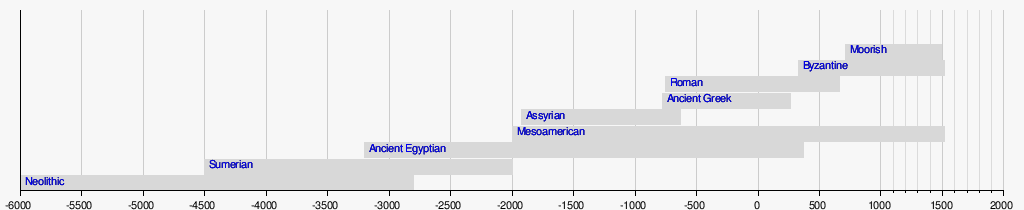 |
<timeline> DateFormat = yyyy ImageSize = width:1024 height:auto barincrement:18 PlotArea = left:20 right:20 bottom:20 top:10 Colors = id:noir value:black id:canvas value:rgb(0.97,0.97,0.97) id:egypt value:rgb(1,1,0.6) id:gris value:gray(0.85) id:gris2 value:gray(0.70) id:grilleMajor value:rgb(0.80,0.80,0.80) id:bleuclair value:rgb(0.56,0.56,0.86) id:rouge value:red id:rougeclair value:rgb(0.86,0.56,0.56) id:bleuclair value:rgb(0.76,0.76,0.96) id:grilleMinor value:rgb(0.86,0.86,0.86) Period = from:-6000 till:2000 TimeAxis = orientation:horizontal format:yyyy AlignBars = justify ScaleMinor = unit:year increment:100 start:1000 gridcolor:grilleMinor ScaleMajor = unit:year increment:500 start:-6000 gridcolor:grilleMajor BackgroundColors = canvas:canvas bars:canvas BarData= bar:epoque barset:evennement PlotData= barset:evennement color:rouge shift:(2,0) width:15 at:550 #blank line #at:800 text:"[[Carolingian architecture|Carolingian]]" #france and [[Northern Europe|northern europe]] from:711 till:1492 text:"[[Moorish architecture|Moorish]]" shift:(5,-2) color:gris anchor:from #Spain, Portugal, North Africa from:330 till:1520 text:"[[Byzantine architecture|Byzantine]]" shift:(5,-2) color:gris anchor:from from:-753 till:663 text:"[[Roman architecture|Roman]]" shift:(5,-2) color:gris anchor:from from:-776 till:265 text:"[[Ancient Greek architecture|Ancient Greek]]" shift:(5,-2) color:gris anchor:from from:-1920 till:-630 text:"[[Architecture of Mesopotamia|Assyrian]]" shift:(5,-2) color:gris anchor:from from:-2000 till:1519 text:"[[Mesoamerican architecture|Mesoamerican]]" shift:(5,-2) color:gris anchor:from from:-3200 till:373 text:"[[Ancient Egyptian architecture|Ancient Egyptian]]" shift:(5,-2) color:gris anchor:from from:-4500 till:-2000 text:"[[Architecture of Mesopotamia|Sumerian]]" shift:(5,-2) color:gris anchor:from from:-6000 till:-2800 text:"[[Neolithic architecture|Neolithic]]" shift:(5,-2) color:gris anchor:from #To start the indentation on top again #barset:break #at:1919 #blank line </timeline>
Venârivè Timeline Clade
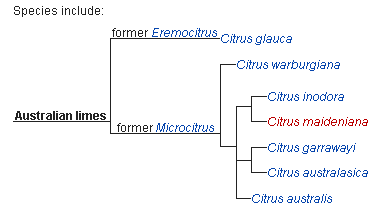
Note: ADD Clade tree (see Template:Clade and Template:Cladogram)
Example: Australian lime
 |
Tribes, Kingdoms & Linguistics
CREATE a hierarchy for all the Clans over time and who died out, when, and which merged with each other.
Note: ADD a new style for referencing language (Linguistics) and family groups (Tribes).
See: Linguistics, Dendrogram, Tree Model, Linkage (linguistics), Genetic relationship (linguistics), Language isolate, Language family, Indo-European languages, English language, Linguistic maps, etc. for Breaking it all down.
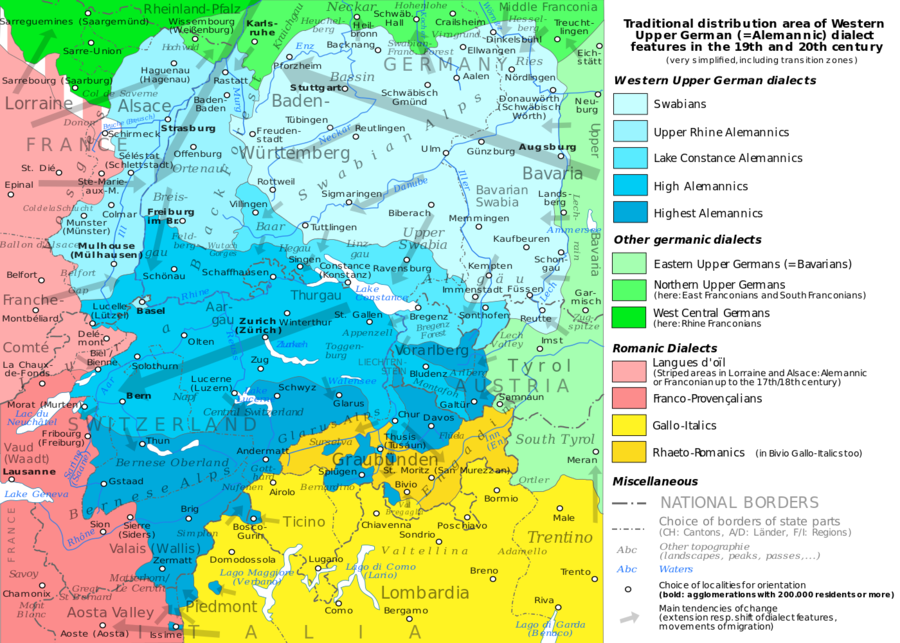
Note: ADD Style like Swabian German See Image: Alemannic-Dialects-Map & Family tree of the German monarchs to the Template Style
 |
Template:Legend
Note: ADD Template:Legend Template:Legend
- ie. {{#if:|{{{text}}}| }} Swabian
{{legend|color|label|outline=outline color|border=css border}}
Language Family
Language family: Indo-European
- Germanic
- West Germanic
- High German
- Alemannic
- Swabian
- Alemannic
- High German
- West Germanic
NOTE: ADD Colour Boxes just as Indo-European does.
Templates: Template:Infobox language/family-color, Template:Language families
See: Indo-European family tree in order of first attestation
Appendix VI: Languages and Scripts
- See Venârivè: Northwestern Lýthia P183
ADD colour for name of Language and another for Script. Put into a Language Table. Link to History of Hârn PDF.
As noted in Culture and Languages, a wide variety of languages and dialects are in use across Venârivè, and an equally wide range of scripts are used to write them.
Elder
Sináin – language of Elves, written in Selénian.
Kúzhan – language of Dwarves, Khrúni script.
Járind
Járind – ancient language group of Járind people.
Émhlè – ancient language of the Eméla, written in Khrúni.
Eméla – middle and modern language of the Eméla, written in Khrúni and Lakíse.
Zónawè – ancient language of the Járind of Zonâra; Khrúni script.
Zonâran – middle language of Zonâra; Zérin script.
Old Járin – middle language of the Járin of Hârn.
Járin – modern language of the Járin of Hârn. There are a number of dialects spoken by the tribal Járind peoples of Hârn.
Yaríli – modern language of the Yaríli of Iváe.
Yârla – modern language of the Yârla of Hârbáal.
Old Áltic – middle language of the Áltwè.
Áltic – modern language of the Álti; there are a number of regional dialects, broadly grouped as Western and Eastern. Runic script.
Uméni – modern language of the tribal Uméni of Ûmélria; influenced by Azéri, Quâr and Kétar.
Hârnic – language of Hârn; there are a number of regional, local and tribal dialects. Runic and Lakíse scripts.
Phâric
Phâri – ancient language group of the Phâric peoples. Quâr – ancient language of the Quâr. Quârphic – modern language of Quârphor; dialects include Huriséan, Western, Northern, Southern and Eastern. Runic script. Shôrki – old language of the Sôrki. Khrúni script. Shôrka – modern language of Shôrkýnè; dialects include Melódan, Pelódan, Loálan, Quálren, Stálfi, Fédin, Kolâren, Sábes, Énseler, Jándi and Nístalen. Lakíse script. Old Tríerzi – middle language of the Tríerzi. Tháneman – middle language of the Thánemi. Tríerzi – modern language of Tríerzòn; has many dialects, including Ligúno-Áthaman, Sénedar, Stálfi, Mélsa-fáldon, Alonádi, Areshýmen, Cherýkan, Zánori, and Tengálin. Lakíse script. Ivíni – old language of Ivínia. Khrúni script. Ivínian – modern language of Ivínians. Runic script. Orbáaler – dialect of Ivínian spoken in Orbáal, Hârn. Runic and Lakíse script. Hârbáaler – modern language of Hârbáalers, considered by some a dialect of Ivínian. Runic and Lakíse script. Chéler – modern language of the inhabitants of Chélemby; viewed by some as a dialect of Hârbáaler with a considerable number of foreign terms. Runic and Lakíse script. ‘Trade Ivínian’ – (Kántâl) the lingua-franca of trade in much of northwestern Venârivè; very similar to Chéler, but with an even greater number of foreign terms and idioms. Runic and Lakíse scripts. Pálithàner – modern language of Palíthanè. Runic and Lakíse scripts.
Azéri
Azéri – ancient language group of the Azéri peoples. Written in both Alánta and Tiánta scripts. Àzeryáni – language of Azéri settlers of Ázeryàn. Zérin script. Zâkimladal (High Àzeryáni) – modern language of high-class Àzeryáni. Ayâran Script. Nâsik Azéri (Low Àzeryáni) – modern language of lower-class / common Àzeryáni. Ayâran and Lakíse scripts. There are several recognised dialects within the Empire including: Prime, Central, Northern, Western, Southern, Island and Eastern. In addition, there are several dialects of low Àzeryáni spoken outside the Empire, principally: Lánkori, Terâzin, Górik, Kôlvisar, Dálazeri. Vénic – ancient language of Vénic island culture. Written in both Alánta and Tiánta scripts. Kàruía – language of Kàruía islands culture. Written in both Milánta and Zérin scripts. Karéjian – language of Karéjia; uses the Ayâran and Lakíse scripts. Ûrméch – language of Ûmélria; influenced by Uméni. Ayâran script. Elbýthian – language of eastern Venârian. Ayâran and Nerámic scripts. Býrian – language of Býria. Ayâran and Lakíse scripts.
Ketâric
Kétar – original language of the people of the central plateau. Màfakéta – language of Ketâric nomads who conquered Mafáni empire. Shéni script. Old Ketâri – middle language of central Ketârh. Ketâri – modern language of Ketâri nomads. Ánil Ketâri – language of western Ketâri. Reksýni – modern language of Reksýna. Shénya script. Bésha – language of Béshakan nomads. Nerámic script. Hácherian – language of the Hácherim. Nerámic script. Namârdi – language of the Namârdim. Nerámic script. Dálken – language of Dalkésh. Nerámic script.
Mafáni
Old Mafáni – ancient language of the Empire of Mafáni. Kóno script. Mafâsh – middle language of the Mafáni. Tankóno and Nerámic scripts. Mafáni – modern language of the Mafáni. Tankóno script. Shénti – modern language of the eastern coast of Anzelôria, a mixture of Anzelôrian and Mafáni. Tankóno script. Modern Mafáni is influenced by Mólken, the language of Molkûra. The script of Molkûra (Milúan) also influenced Kóno, and together with influence from Nerámic, this led to the development of Tankóno.
Anzelôrian
Anzéla – ancient language group of Anzelôria. Néri script. Panhaónic – northern Anzelôrian language group. Nerámic script. Târgan – extinct language of the Târga River valley; replaced by Dálken. Nerámic script. Neshái – modern language of the Neshái tribes. Chogôri – modern language of Chogôro. Tankóno script. Pèchalâri – modern language of Pèchalâri. Nerámic script. Tuvâran – modern language group of Tuvârans; includes numerous sub-languages and dialects grouped as Eastern, Southern and Western. Thónian – modern language group of Thónians; includes a number of sub-languages and dialects grouped as Mountain, Laker, Inner, Northern, Western, and Southern. Hérei – Thónian language of the indigenous people of Árlanto. Elánasi – a Tuvâran language, spoken in western Árlanto. Búqdin – a Thónian language of Hèpekéria.
Númec
Hepéka – ancient language group of Hèpekéria. Tiánta script. Old Númec – middle language of the Númec. Hekôri script. Númer – modern language of Númec. Hekôri script. Kôrlic – modern language of the Kôrlic peoples, descended from old Númec, but heavily influenced by Azéri, Ivínian and Kàruía. Hekôri, Runic and Ayâran scripts. Dálani – the mixed Járind/Númec language of the tribal people of Dalánya. Faláni – modern language of the Faláni, descended from old Númec. Hekôri script.
INSERT TABLE
Lakíse Numerals 0 0 1 1 2 2 3 3 4 4 5 5 6 6 7 7 8 8 9 9
Tribes & Kingdoms of Hârn
ADD new article data from harn-history - Tribes & Kingdoms of Western Harn (TR300-453).pdf
Linguistic Dialects & Languages of Hârn
ADD new article data from harn-history - Tribes & Kingdoms of Western Harn (TR300-453).pdf
- Linguistics ~ Breakdown into DIALECT GROUPS and colour code. Could also add as sub section of Side Bar Template Entries
- Chronology (Timeline) of Kandáy
Ideas
Note: ADD a list of ideas and how & what Templates can create a good timeline to cross reference the various topics needed.
Using both Historic interaction and contact with another tribe, with that in mind, use both Linguistics and Historic influences to build a timetable for various events, blending (social/tribal, technology, etc.) them all together to fill in a clearer picture of the peoples, settlements, a create a "local" sense of their world for that particular region, but more so for creating atmosphere to each and every Manor, rural village, and further enhance a sense of a living world.
There would have been many changes over the course of time for any Culture that comes into contact with one another. Be it from assimilation, merging, annihilation, etc. This can mean certain cultural affects, technology changes, right through to shifts in language, architecture, and right down to social influences.
Painting a picture of where a people have come from (ancestors relocating) to how they've been influenced (contact with others) by one another to form a unique society of the now.
Using all this we can create a better reflection of why a building looks the way it is in a certain Kingdom, to why a military acts the way it does and why it has a certain piece of technology, and so on.
A
- A
- A
A
- A
- A
A
- A
- A
A
- A
- A
A
- A
- A
Name & Dates List
Note: ADD a proper/seperate page for this all as a table. Once broken down into the Book Style like Kanday's split page style, can then add Category for each section part so that a complete list then gets made for all the pages for "said name". The once this is done, can then add this comprehensive list to "that" Index Section for "Category". In the end the aim is to create a complete "Name & Dates List/Index" so all the LINKS for names can then not only be categorised, but also interlinked between ALL articles and books, especially for DATES as this will be required to create a comprehensive Chronology Timeline and quick inter-referencing of the subject link(s).
Note: ADD links to each Name & Date within the Tabled Index, these should also include Eras & Periods for dates.
Note: INCLUDE all these into the Template (Sidebars & other data) Tables and so on.
Note: Example: Mercenary Companies would not only have a template for the Company, but be interlinked with that Type as a Category reflecting and showing Country, Shire, Hundred, Leader, Associated to/Sponsor, Location/Region and all other manner of data links within the design of the template and interact automatically with other templates, catergories, and index link lists.
Note: Example: A river would have a sidebar template that includes it's source length and so on, but also show not only the Catergories & Names, but be reflected within each of those Categories & Names Listed together. Basically internested Data, Links, Catergories, and so on to save redoing all links again with new pages or modifications, it automatically gets updated once interconnected correctly.
Notes
- A
- A


