Difference between revisions of "Hârn HârnMaster Barbarians"
m |
m (→GOZYDA) |
||
| Line 4,338: | Line 4,338: | ||
</span>''' | </span>''' | ||
| − | The Gozyda range over the '''<span style="color:#006699">Mimea Hills</span>''' and on '''<span style="color:#006699">Domid Island</span>'''. Their home lies within land claimed by both '''<span style="color:#006699">Kanday</span>''' and the '''<span style="color:#006699">Thardic Republic</span>'''. There are three sub-nations: the '''<span style="color:#006699">Domi</span>''', the '''<span style="color:#006699">Ramali</span>''', and the '''<span style="color:#006699">Mimeyi</span>'''. The Mimeyi and Domi number about 1500 each and there are about 1000 Ramali. | + | The Gozyda range over the '''<span style="color:#006699">Mimea Hills</span>''' and on '''<span style="color:#006699">Domid Island</span>'''. Their home lies within land claimed by both '''<span style="color:#006699">Kanday</span>''' and the '''<span style="color:#006699">Thardic Republic</span>'''. There are three sub-nations: the '''''<span style="color:#006699">Domi</span>''''', the '''''<span style="color:#006699">Ramali</span>''''', and the '''''<span style="color:#006699">Mimeyi</span>'''''. The Mimeyi and Domi number about 1500 each and there are about 1000 Ramali. |
=== HISTORY === | === HISTORY === | ||
| Line 4,347: | Line 4,347: | ||
The Corani Empire had little effect on the Gozyda. Most of the imperial energy for barbarian suppression was directed against the Kom and Shira, both of whom were conquered, and against the northern Kubora and Equani tribes, who were not. The debacle of the northern campaign in 477 gave all barbarians a century of relative peace from the Corani. | The Corani Empire had little effect on the Gozyda. Most of the imperial energy for barbarian suppression was directed against the Kom and Shira, both of whom were conquered, and against the northern Kubora and Equani tribes, who were not. The debacle of the northern campaign in 477 gave all barbarians a century of relative peace from the Corani. | ||
| − | The Morgathian theocracy regarded the Gozyda cannibals as “offal” and sent expeditions against them. Thus, when Andasin of Kand led his clan into exile in the Mimea Hills, he found the Mimeyi to be willing allies. When he founded Kanday, Andasin swore that the Mimeyi would live free in their hills as long as his kingdom stood. His heirs have not always been diligent about upholding the oath, but it has been renewed upon each succession. | + | The Morgathian theocracy regarded the Gozyda cannibals as “offal” and sent expeditions against them. Thus, when Andasin of Kand led his clan into exile in the Mimea Hills, he found the Mimeyi to be willing allies. When he founded Kanday, Andasin swore that the Mimeyi would live free in their hills as long as his kingdom stood. His heirs have not always been diligent about upholding the oath, but it has been <u>renewed upon each succession</u>. |
<center> | <center> | ||
| Line 4,434: | Line 4,434: | ||
=== CURRENT RELATIONS === | === CURRENT RELATIONS === | ||
| − | Relations between the three sub-nations varies. There is little conflict between them, although the Ramali raid the Mimeyi on occasion. The Domi regard the Mimeyi as backward and the Ramali as degenerate. The Gozyda and Tulwyn seldom come into contact. Both tribes avoid the other’s territory. | + | Relations between the three sub-nations varies. There is little conflict between them, although the Ramali raid the Mimeyi on occasion. The <u>Domi regard the Mimeyi as backward and the Ramali as degenerate</u>. The <u>Gozyda and Tulwyn seldom come into contact. Both tribes avoid the other’s territory</u>. |
| − | Since the Domi travel by sea as far from home as Cape Gemal to the west and the mouth of the Kald river to the east, they have some contact with the Adaenum, Chymak, and the Sindarin. The Domi regard the elves with awe and call them | + | Since the Domi travel by sea as far from home as '''<span style="color:#006699">Cape Gemal</span>''' to the west and the mouth of the '''<span style="color:#006699">Kald river</span>''' to the east, they have <u>some contact with the Adaenum, Chymak, and the Sindarin</u>. The Domi regard the elves with awe and call them "'''<span style="color:#006699">the children of Oyinath</span>'''." |
| − | The Domi and Mimeyi have reasonably good relations with Kanday and there is significant trade between them. Officially, the Kandians regard the Domi and Mimeyi as self-governing allies. The Gozyda are not interested in the official position—they just want to be left alone. | + | <u>The Domi and Mimeyi have reasonably good relations with Kanday and there is significant trade between them</u>. Officially, the Kandians regard the Domi and Mimeyi as self-governing allies. <u>The Gozyda are not interested in the official position—they just want to be left alone</u>. |
| − | Relations between the Ramali and Mimeyi and the Thardic Republic have always been bad. Thardic slavers capture tribesmen for the Pamesani Games (the Ramali are particularly victimized) and the Republic claims sovereignty over much of the tribal range. Although the Gozyda are not really much of a threat to the Republic or to caravans on the Salt Route, their practice of cannibalism is a “great offense to civilization that must be exterminated.” Every Marshal of Ramala province has sent expeditions against the Gozyda. The support given to the Gozyda by Kanday is a favorite argument of expansionists in the Thardic Senate to justify aggression against that kingdom. | + | Relations between the Ramali and Mimeyi and the Thardic Republic have always been bad. Thardic slavers capture tribesmen for the Pamesani Games (the Ramali are particularly victimized) and the Republic claims sovereignty over much of the tribal range. Although the Gozyda are not really much of a threat to the Republic or to caravans on the Salt Route, their practice of cannibalism is a “great offense to civilization that must be exterminated.” Every '''<span style="color:#006699">Marshal of Ramala</span>''' province has sent expeditions against the Gozyda. The support given to the Gozyda by Kanday is a favorite argument of expansionists in the Thardic Senate to justify aggression against that kingdom. |
===== How to Embarrass a General ===== | ===== How to Embarrass a General ===== | ||
| Line 4,587: | Line 4,587: | ||
|} | |} | ||
</center> | </center> | ||
| − | |||
== HODIRI == | == HODIRI == | ||
Revision as of 04:40, 5 October 2017
Note: ADD proper names and cross-internal links.
Note: ADD list of "special" details to add the various details for extras, ie. saltmarshes of Vashel, under Tamsen Forest.
Note: Text Highlight and Background Colour: Kandáy, Réthem, Thârda, Káldôr, Mèlderýn, Chybísa, Orbáal, Ázadmêre, Eváel.
Note: Green = I Have, Red = Don't Have, Orange = Old Scan, Blue = Misc, Black = ALL Base (Template)
Note: Colour Highlights: Yellow
Colour LINK Text: Possible Link NAME
Note: Hidden comments <!-- TEXT HERE WILL NOT BE DISPLAYED -->
Note: Anchor Points - Section linking WITHIN pages USE [[Help:Section#Section_linking|Section linking]] or To link to a section in the same page you can use [[#section name|displayed text]], and to link to a section in another page [[page name#section name|displayed text]].
Note: Section linking with arbitrary id USE <span id="anchor_name"></span>. Be sure to use a name that is not likely to be duplicated. One way to do this is to incorporate the titles of the higher-level sections, at least in abbreviated form, e.g., Ontario-Natural_features for the "Natural features" subsection of the "Ontario" section of an article about the provinces of Canada.
ADD inside Table Caption/Heaer Text
Contents
- 1 HârnMaster Barbarians COL 4761
- 2 TRIBAL LIFE
- 2.1 TRIBAL ECONOMICS
- 2.2 TRIBES OF HÂRN
- 2.3 TRIBAL OCCUPATIONS
- 2.4 Tribal Nations Map
- 2.5 TRIBAL WARFARE
- 2.6 TRIBAL LAW
- 2.7 HUNTING
- 2.8 TRACKING TABLE
- 2.9 HUNTING TABLE
- 2.10 APPROACH TABLE
- 2.11 TRAPPING
- 2.12 TRIBAL RELIGION
- 2.13 TRIBAL RITUAL SKILL
- 2.14 SHAMANS
- 2.15 SHAMAN SKILLS & PIETY
- 2.16 TRIBAL INVOCATIONS
- 2.17 TRIBAL CAMPAIGNS
- 3 BARBARIAN CHARACTERS
- 4 ADAENUM
- 5 ANOA
- 6 BUJOC
- 7 CHELNI
- 8 EQUANI
- 9 CHYMAK
- 10 GOZYDA
- 11 HODIRI
- 12 Kabloqui
- 13 Kamaki
- 14 Kath
- 15 Kubora
- 16 Pagaelin
- 17 Solori
- 18 Taelda
- 19 Tulwyn
- 20 Urdu
- 21 Ymodi
- 22 Back Cover
- 23 A
- 24 A
- 25 A
- 26 A
- 27 A
- 28 Notes
HârnMaster Barbarians COL 4761
Possible Link
 |
A
TRIBAL LIFE
- Barbarians 1
The deep forests of Hârn are home to 18 tribal nations whose total population exceeds 100,000. Each nation has a fairly well-defined homeland indicated on the Tribal Nations map (p3) and detailed in each tribe’s article. The tribal nations are of the same Jarin and Pharic racial stock as civilized human cultures but have remained barbaric or semi-civilized.
Although civilized Hârnians look down on them as backward, most tribesmen have more freedom and leisure time than manorial peasants who spend virtually their entire day in the fields. However, much of that spare time must be spent sharpening spears and fletching arrows because the wilderness is a significantly more dangerous environ than the manor.
TRIBAL ECONOMICS
All Hârnic tribes are hunter-gatherers or fisher-gatherers although a few practice rudimentary herding and agriculture. The tribes are nomadic or seminomadic, meaning they tend to move from one location to another within their territory seasonally or every few years. Hence, they have no permanent homes and instead use portable tents or temporary huts as needed. Because wilderness areas are sparsely populated, tribal villages can be widely spaced.
Trade with Civilization
Hârnic tribes are usually able to find enough food and other essentials to survive. However, trade with civilized mercantylers is common for tribes on the edges of civilization or those located along established trade routes like the Salt Route or Fur Road. The tribes trade furs, wild beasts for the arena, slaves, and rare herbs and minerals like amber and jade, in exchange for metal tools and weapons, woven textiles, jewelry, and most other specialized products of civilized technology.
Mining and Metals
Tribes mine and smelt only small amounts of metal; their artifacts are primarily made of stone, horn, wood, and leather. Metal acquired in trade or looted from civilized settlements or caravans is used for making axeheads, arrowheads, spearheads, and daggers. Larger weapons such as swords or battleaxes, however obtained, are status symbols. A few tribes trade with local gargun for metal goods.
The Kubora, Urdu, and Equani are unusual in that they use significant quantities of metal and even know how to make iron. This was one of the factors that enabled Arlun’s hordes to conquer Rethem.
Some tribes gather copper and tin ore from surface deposits and know how to smelt it to produce bronze tools and weapons. These have the same statistics as their iron equivalents except Weapon Quality is −1.
TRIBES OF HÂRN
Note: ADD links to each tribe page.
Ten tribal nations are descended from early Jarin colonists and six from the later Pharic invaders. Two are of hybrid origin.
JARIN TRIBES
Adaenum
Fisherfolk of Anfla Island off the southwest coast of Hârn.
Anoa
Nomadic hunters of the Anoth River valley in southern Orbaal.
Bujoc
Nation of shy, superstitious, forest nomads with a strong matrilineal culture.
Chymak
Famed sea-folk of Belna Island. They range the Gulf of Ederwyn in large sea-going canoes, and are much valued as seamen on merchant ships.
Equani
Warrior tribesmen of Equeth, noted for their elaborate facial scars and tattoos and their merciless treatment of intruders.
Kabloqui
Degenerate cannibals from the north shore of Lake Benath. They are related to the Equani, who detest them. Their gargun neighbors may destroy them, if their own treachery doesn’t first.
Kubora
Powerful warrior nation of Peran. They once united under Arlun the Barbarian and conquered Rethem. They export wild beasts for the Pamesani Games.
Taelda
Nomadic hunter-gatherers who inhabit the vast forests of southern Nuthela. The Taelda are renowned healers and woodsmen.
Urdu
Nomadic hunters who inhabit the range between the Chetul and Pemetta rivers in northwestern Hârn.
Ymodi
Wild forest tribesmen of Himod in northern Hârn. Beleaguered by the Equani to the west, Anoa to the east, and gargun to the north and south, they survive because of their impressive skill with the bow and spear.
TRIBAL OCCUPATIONS
- Barbarians 2
Hârnic tribes have few speciality craftsmen. Tribesmen help in the production of tools, weapons, pottery, clothing, and other artifacts. Some occupations might be reserved for one clan, and some are often restricted to men or women. Tribesmen mostly improve their quality of life by trading the bounty of nature for the manufactured products of the civilized world.
Compared to their civilized cousins, tribesmen have fewer occupations. The descriptions below are general. Occupations vary among the tribes. Refer to the Occupation Table for each tribe to identify specific occupations and skills.
Hunter: The default occupation for men in most tribal cultures. The hunter is an expert at wilderness survival and is often highly skilled with a bow and javelin/spear, which are used regularly to hunt. The enhanced Eyesight, Hearing, and Smell that tribal characters possess give them an edge in such useful wilderness skills as Awareness, Stealth, Tracking, and Survival. Some tribes, such as the Tulwyn and Equani, have a class of elite warriors. These are just hunters who are particularly skilled at combat.
Fisherman: Most coastal tribes survive on fish and favor marine skills over hunting and fur-trapping skills. Tribal fisherman have higher weapon skills than most seafarers because they, like hunters, are the primary defensive manpower. Some Chymak seamen serve in the Seamen’s Guild.
Herder: Some tribes herd goats, cattle, horses, and other animals. This occupation is sometimes handled by children and young adults.
Grower: A few tribes grow crops to supplement their gathering. This role is usually filled by women and slaves.
Slave: Warrior tribesmen much prefer to have slaves perform hideworking and other unclean work. Slaves number as much as ten percent of some tribal populations. It is a custom encouraged by Hârnic slavers, who offer valuable trade goods in exchange for human goods. Slaves are generally well treated but are forbidden to carry weapons and cannot normally leave the tribal camp without an escort. Unruly or inefficient slaves are typically sold to a slaver.
Shaman: Most tribes have shamans or similar holy men. There are many different religions among the tribal peoples of Hârn. See Barbarians 8 for full information on shaman characters.
Chieftain: The traditions of leadership vary widely between tribal nations. A few nations lack the occupation of “chieftain,” usually because shamans fill that role.
PHARIC TRIBES
Chelni
A loose federation of 30 tribes, ranging in size from 60 to 200, who occupy the Chelna Gap and surrounding hills. The Chelni breed ponies that are traded for civilized goods.
Gozyda
Forest tribesmen who control the Mimea Hills in western Hârn. Organized into bands of 60 or less, the Gozyda include some outlaws from Tharda and Kanday. This has brought them new blood and technology.
Hodiri
Proud nomadic horsemen of Horadir. The Hodiri are extremely fierce warriors. There are about 80 tribes, 60 to 300 strong.
Kath
A loose federation of wild and primitive tribes inhabiting the Kathela Hills in eastern Hârn. There are about 60 bands, few of which exceed 30 in number. Kath women are known for their beauty.
Pagaelin
The violent, vicious tribal nation dwelling roughly between the Osel River and Setha Heath. There are approximately 120 tribes of 60–240 members. They are under the influence of a heretical Navehan sect.
Tulwyn
Merciless barbarians who inhabit the wilderness of Athul. They are divided into some 90 tribes, of 60–150 members. The Tulwyn use weapons and tools taken from traders along the Salt Route.
OTHER TRIBES
Kamaki
The herdsmen of the island of Kamace off southwestern Hârn. There are fourteen tribes, few exceeding 100 in number.
Solori
A primitive and wild nation in southeastern Hârn. There are about 30 tribes, each of 40–150 people. The Solori are slowly being exterminated in a genocidal crusade waged by the knights of the Order of the Lady of Paladins.
Tribal Nations Map
- Barbarians 3
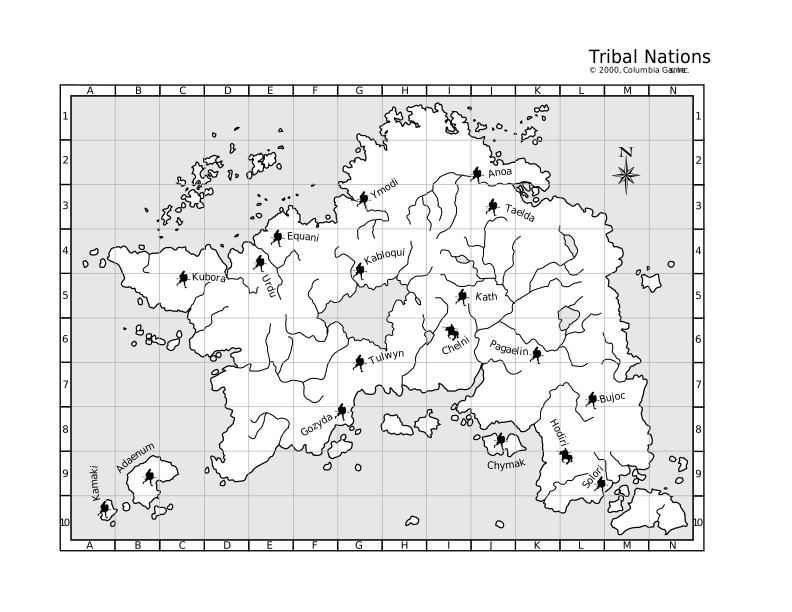 |
TRIBAL WARFARE
- Barbarians 4
Most tribes are perpetually at war with the gargun although a few, notably the Tulwyn, trade with the orcs for their much superior metalwork and weapons. Before the gargun appeared on Hârn some six centuries ago, tribal folk shared the wilderness only with a few bothersome predators and Ivashu and numbered two or three times their present population. The gargun proved to be vastly more fertile and aggressive rivals for wilderness domination. They initially forced many tribes to flee into civilized parts, creating a period of unrest known as the Migration Wars that lasted from 178 to 235. By the year 250, the struggle stabilized at its present situation; roughly 50,000 gargun dominate the alpine and highland wilderness and double that number of tribesmen control the lowland forests.
Tribesmen prefer to fight lightly encumbered. They rarely wear metal armour, although it is common to loot mail and plate from fallen foes and convert it into more useful artifacts or trade it to civilized mercantylers. Tribal warriors prefer leather, although thick furs (treat as Quilt) are used in cold weather conditions. Most tribes can white-taw hides, creating a tough leather that retains the fur (treat as Leather+Quilt). Some tribes, especially sea-faring peoples, never use armour.
Warring tribes rarely engage in pitched battles. Ambush or surprise raids are the preferred tactics, and bloodshed is kept to a minimum. Tribesmen much prefer to take captives than scalps, for prisoners can be exchanged, ransomed, or kept as slaves. In a meeting engagement between warring tribes, it is customary for one side to retire after suffering just one or two casualties; battles to defend a camp are usually more brutal and tend to be avoided.
TRIBAL LAW
A major difference between the barbarian peoples of Hârn and their civilized cousins is their respective freedom. The feudal order is based upon a social contract that requires peasants to sacrifice legal freedom in exchange for security. The vast majority of Hârnic folk are born into a feudal culture and lead a relatively peaceful but unfree life.
All barbarians are freemen. They are not bound by law to their tribes, only by bonds of blood and friendship, and need not fear the retribution of an armed and annoyed overlord should they desire to leave. Of course the dangers lurking in their surrounding wilderness tends to keep tribesmen close to home, as leaving it is often fatal.
Law is established by tribal custom and handed down by the chieftain. Judgements can be harsh, but a cruel or unjust chieftain is easier to depose than a knight or baron.
SPIRIT MARKERS
Spirit markers define territory and convey information. They normally take the physical form of a stick to which objects have been tied, typically feathers, scraps of fur, bones, and carved wood. Sometimes the markers are attached to branches or carved into trees. Spirit markers are imbued with spirit magic during their fabrication. This makes them visible to the ethereal world.
Markers are unique, but can be grouped into four broad classifications:
[1] Camp Markers indicate a clan camp is being approached. Those wishing to enter the camp should wait beside the marker until they are approached and given permission to proceed. Levels I to III.
[2] Curse Markers warn that trespassers will suffer some form of bad luck until they are ritually purified. Levels II to V.
[3] Pestilence Markers are warnings to indicate that the area they enclose is populated with evil spirits. Levels IV to VI. Those with an Aura of 13+ who touch the marker may be able to see the spirits.
[4] Death Markers are a more powerful form of the first three. They summon a tribal spirit who enters into Mental Conflict with anyone who attempts to violate the marker or its message. Levels V to VII.
Spirit Markers have a rated level as with invocations or spells. The level depends on the skill of the shaman during fabrication and the effect or intent. Higher level markers are easier to detect by sensitivity skills and talents.
HUNTING
- Barbarians 5
Hunting (or fishing) accounts for 40–60% of the tribal diet. Obtaining meat is primarily a male role, partly because of the danger and weapons employed, partly to ensure and maintain male dominance.
Tracking Animals
Most hunters do not track live prey; too much energy is consumed in the process to justify the return. Animals have habits, and good hunters know the spots frequented by game or use information gleaned from trails to determine where to lie in wait for prey.
Skilled trackers make deductions about the species, size, weight, and age of an animal by examining its footprints. Some clues are the depth of the prints and their spacing. If leaves or twigs have fallen in the print or insect tracks cross it, the hunter can surmise the age of the trail. The time of day the creature passed is also discernable from the path of the trail, particularly in open or sparsely treed ground. If the tracks meander from tree to tree, the animal likely passed at midday when the sun’s heat encouraged it to seek shade. Whether the tracks pass to the east or west of a tree indicates the time of day as well; morning shade is cast to the west and afternoon shade to the east. When combined with knowledge of local weather and an animal’s habits, the best hunters can determine the age of a trail to within fifteen minutes.
Tracking skill is used to determine the frequency of animal encounters. Roll on the Tracking Table modified at GM discretion for current weather and local abundance of game. Heavy rain or snow would justify a penalty of 10–60 to Tracking skill. The result determines the number of animals encountered. Species and food value can be generated on the Hunting Table.
Approaching Animals
Refer to the Missile Data T able in HârnMaster core rules. The prey can be attacked from Extreme, Long, Medium, or Short range. Animals are usually sighted at Extreme range. The hunter may attack immediately or attempt to close. A Stealth Roll is made on the Approach Table to determine if the animal is alerted during each attempt to close. Modify the roll according to terrain (GM discretion). At each Range Class, the hunter may attack (fire/throw a missile weapon) or attempt to move closer.
Downing Animals
The attack may be resolved with the Hârnmaster (combat 16) rules. Animal defense on the first shot is probably Ignore, then Dodge or Charge (Counterstrike) on later shots if any. If a strike is made, determine injury. If the animal fails a Shock Roll, it is downed and helpless. A wounded beast may flee, or attack the hunter. If the attack misses, animals will generally flee, but some may charge the hunter.
TRACKING TABLE
| CS: | 1d3 animals sighted. |
| MS: | One animal sighted. |
| MF: | Animal sighted, but flees. |
| CF: | Animal charges hunter if applicable, or flees. |
HUNTING TABLE
| 1d100 | Type | Food1 |
|---|---|---|
| 01–05 | Black Bear | 75 |
| 06–08 | Beaver/Otter | 10 |
| 09–21 | Boar | 25 |
| 22–25 | Cougar | 15 |
| 26–45 | Deer | 75 |
| 46–50 | Fox/Weasel | 10 |
| 51–55 | Moose/Elk | 300 |
| 56–65 | Rabbit/Hare | 2 |
| 66–75 | Sheep/Goat | 20 |
| 76–80 | Wolf | 20 |
| 81–85 | Gargun | Inedible |
| 86–95 | Human | 40 |
| 96–00 | GM Discretion | –– |
| 1 Man-days of meat. Assumes 50% of animal weight is meat, and two pounds (1KG) of meat per day. Randomize values plus or minus 20% if desired. | ||
APPROACH TABLE
| CS: | Close two Range Classes. |
| MS: | Close one Range Class. |
| MF: | Range same. Animal makes Awareness Roll and flees if it detects hunter. |
| CF: | Hunter stumbles. Prey flees. |
Releasing the Spirit
When a tribal hunter makes a kill, the invocation Spirit Release is performed over the corpse. This prayer is known by all hunters from an early age.
In some tribes, the head is mounted on a stick or buried. Most believe that when an animal’s skull has been cleaned of flesh by scavengers, the animal has been reborn in a new body.
TRAPPING
- Barbarians 6
Many tribes rely on tools, weapons, clothing, and other manufactured goods paid for with pelts they trap and harvest. The fur trade is particularly lucrative in Orbaal, Nuthela, Equeth, Himod, and Peran, as well as the remoter reaches of the Sorkin and Rayesha Mountains. Some fur-bearing animals change the colors of their fur to white in the winter, and then back to a deep brown or black in the summer. Each hue enjoys a special status, but the lighter colors are generally more valuable.
Trapping Animals
Trapping is the skill of snaring a useful fur-bearing animal, protecting the trapped animal from predators, skinning the creature without damaging the pelt, and cleaning it and transporting it to a buyer. Trapping (a new HârnMaster skill) is described in the sidebar.
The Fur Trade
Nobles buy furs as trim and accessories, and even as whole coats and cloaks. They are willing to pay handsomely to be seen in rich garb and this supports a thriving Hârnic fur trade.
Some civilized mercantylers specialize in the fur trade. They typically journey to traditional trading posts in the early to late spring to acquire pelts trapped throughout the winter. Payment is never in coin, for which tribesmen have little use, but rather in metal weapons and tools, woven cloth and dyes, and shiny but inexpensive jewelry. Although values can vary dramatically, pelts can generally be obtained for about 10% of their retail value and then transported and sold to a furrier or hideworker for about 50% of their retail value. The trader must then deal with the settlement’s guards, hawking tax, and other bureaucratic hallmarks of civilization.
TRAPPING SKILL
INSERT HEADER TABLE
AGL DEX EYE Ula/Ara +2 SB2
Used to set traps and check them. Traps are suitable for small mammals (not larger than a fox or badger). It takes one daylight watch to deploy/harvest a onemile trapline.
The trapper sets out a trapline and then checks it every few days.
CS: 1d6 pelts per mile of trapline.
MS: 1d2 pelts per mile of trapline.
MF: No Pelts.
CF: Traps destroyed by animals, gargun, or rivals.
For every day that a trapline goes unchecked, there is a 20% chance that local predators will get to trapped animals fi
Overhunting
Hunting/Trapping reduces the amount of game in an area. Drives reduce the available game to sparse; other methods reduce abundance according to their success at GM discretion. It is not possible to hunt an area repeatedly and still find plenty of game.
Fishing & Foraging for Food
See HârnMaster core rules, Skills 16.
Fur/Hide Prices (retail)
| Fur/Hide | Price (retail) |
|---|---|
| Bear | 18d |
| Beaver | 20d |
| Boar/Pig | 5d |
| Cattle/Ox | 12d |
| Cougar | 6d |
| Deer | 6d |
| Elk | 10d |
| Ermine/Sable | 30d |
| Fox | 18d |
| Goat | 4d |
| Horse | 10d |
| Lamb | 3d |
| Moose | 12d |
| Otter | 24d |
| Rabbit/Hare | 1d |
| Seal | 24d |
| Weasel | 24d |
| Wolf | 8d |
TRIBAL RELIGION
- Barbarians 7
An important feature of most Hârnic tribal societies is their extreme superstition. Most folk on Hârn are superstitious to some degree but tribal societies have more rules about taboo activities, plants, and animals. Although tribal religions are not overly concerned with proselytizing nor with complex theology, they are defining features of the society.
While some tribal deities are independent demigods, several are really aspects of the gods worshiped by civilized folk. However, since the needs of a tribal community are different, deities known to civilized folk usually appear in different guises to their tribal worshippers. Although Ilvir and K’orr are one and the same, shamans of the Anoa tribal nation are unaware of this fact.
The Spirit World
Most tribes believe that everything in nature has a spirit, not only all living creatures, but also such things as rocks, trees, rivers, winds, and mountains. For some tribes, there is no such thing as an inanimate object. Differences in the natural world of a tribe are reflected in its spirit world. Forest spirits do not exist in the spirit world of a desert tribe. Sea creatures are not often found in the spirit world of an inland tribe although, in some cases, corruptions do exist because the tribe migrated from a coastal region in the distant past. Most spirits are benign but there are always evil spirits to be overcome.
Because tribal cultures interact closely with nature, almost any activity is likely to disturb a spirit or two. Hence, the spirit world is never far from the natural world. Pursuits such as hunting, fishing, or gathering herbs are accompanied by rituals to ward off the displeasure of spirits affected. If not properly appeased, hazards visited upon the tribe or individual by evil or angry spirits can be dire indeed. The shaman is the tribe’s intermediary with the spirit world. Attitudes toward them vary from honor to distrust.
TRIBAL RELIGIONS
| TRIBE | CHIEF DEITY | Identity/Supporter/Afterlife | TITLE | Morality | Intervention1 |
|---|---|---|---|---|---|
| Adaenum | Manaclir | Eder/Totem/Reincarnation | Olna2 | 05–16 | <16/61+/81+ |
| Anoa | K’orr | Ilvir/Spirits/Reincarnation | Shaman | 05–16 | <11/51+/76+ |
| Bujoc | (Animist) | None/Totem/Reincarnation | Sha Woman | 05–16 | <21/41+/81+ |
| Chelni | (Animist) | None/Spirits/Yashain | Shaman | 05–16 | <21/41+/81+ |
| Chymak | Kualthurlu | Eder/Demigod/Reincarnation | Sarfaeda | 05–16 | <16/61+/81+ |
| Equani | Kemlar | Demigod/Spirits/Yashain | Shaman | 05–10 | <11/51+/86+ |
| Gozyda | Oyinath | None/Reincarnation | Shaman | 03–10 | <21/41+/81+ |
| Hodiri | — | None//None/Other | n/a | 05–16 | <21/41+/81+ |
| Kamaki | Shadet-Etu | Eder/Demigods/Yashain | Shaman | 08–16 | <16/61+/81+ |
| Kabloqui | (Animist) | None/Ancestor/Yashain | Shaman | 03–10 | <21/41+/81+ |
| Kath | (Animist) | None/Totem/Yashain | Shaman | 05–13 | <21/41+/81+ |
| Kubora | Kemlar | None/Demigod/Yashain | Shaman | 05–13 | <11/51+/86+ |
| Pagaelin | Saraen | Sarajin/Demigods/Yashain | Shaman | 05–16 | <16/41+/81+ |
| Solori | Matasum | Demigod/Ancestor/Other | Clanhead3 | 05–13 | <11/51+/86+ |
| Taelda | Cothllynn | Siem/Spirits/Reincarnation | Tuathar | 08–18 | <16/41+/91+ |
| Tulwyn | Kekamar | Demigod/Spirits/Yashain | Priest2 | 05–13 | <16/41+/81+ |
| Urdu | Kemlar | Demigod/Spirits/Yashain | Shaman | 05–13 | <11/51+/86+ |
| Ymodi | Wajok | Demigod/Totem/Reincarnation | Shaman | 05–16 | <16/61+/91+ |
| 1Intervention/Conditions/Retribution | 2 Have some form of clerical rank | 3 Not a true shaman, but has some religious functions | |||
Eder
During the Natal Wars, many Lesser Gods were slain or imprisoned in the struggle for divine dominance. Eder was a god expelled from the “high forest of the undamned” and imprisoned in a huge cave beneath the ocean. The Gulf of Ederwyn, lying to the south of Hârn, is named after the captive god. Locals say that Eder’s endless struggles to escape cause the notorious rough seas of this gulf.
The sea-faring Adaenum, Chymak, and Kamaki peoples along Hârn’s southern coast worship aspects of Eder. The god’s attributes vary between the tribes, although the invocations available to their shamans are similar. None of the three tribes is aware that the other two worship the same deity as they do.
Divine Intervention
Some tribal religions do not recognize divine intervention, either because they acknowledge no powerful deities or because they do not believe that the gods protect humans.
See HârnMaster Religion 6 for Divine Intervention rules.
TRIBAL RITUAL SKILL
- Barbarians 8
Each tribal religion has its own Ritual skill with its own Skill Base. All barbarian characters have an automatic ritual skill in their own tribal religion, which they open at SB2.
TRIBAL RITUAL SKILL TABLE
INSERT HEADER TABLE
| Tribe | Ritual SB | Sunsign |
|---|---|---|
| Adaenum | Voi Int Dex | Lad+2, Hir+1, Sko+1 |
| Anoa | Voi Int Aur | Sko+2, Tai+1, Ula+1 |
| Bujoc | Voi Int Aur | ● |
| Chelni | Voi Int Aur | Ahn+2, Fen+1, Tai+1 |
| Chymak | Voi Int Dex | Lad+2, Fen+1, Sko+1 |
| Equani | Voi Int Aur | Ara+2, Ang+1, Fen+1 |
| Gozyda | Voi Int Wil | Ahn+2, Tai+1, Tar+1 |
| Hodiri | n/a | ● |
| Kabloqui | Voi Int Aur | Ara+2, Ang+1, Fen+1 |
| Kamaki | Voi Int Dex | Lad+2, Ahn+1, Ula+1 |
| Kath | Voi Int Aur | Hir+2, Ahn+1, Ula+1 |
| Kubora | Voi Int Aur | Ara+2, Ula+1, Tar+1 |
| Pagaelin | Voi Int Aur | — |
| Solori | Voi Voi Int | Ang+2, Nad+1, Tai+1 |
| Taelda | Voi Int Aur | Ula+2, Hir+1, Tai+1 |
| Tulwyn | Voi Int Str | Hir+2, Ang+1, Sko+1 |
| Urdu | Voi Int Aur | Ara+2, Mas+1, Tai+1 |
| Ymodi | Voi Int Aur | ● |
Animism
In HârnMaster, “animism” refers to the worship of ethereals rather than deities. Most tribal religions include an element of animism, even if they worship a specific deity. Spirits are much less powerful than deities, sometimes on a level with humans. This puts the animist shaman on a different footing to the civilized priest. Power is gained from spirits by bargaining or, in some cases, by capturing or tricking them to help.
Animist religions are concerned with matters directly affecting survival, such as staving off disease, famine, or enemies. Belief in animism is strong. Improperly killing an animal may cause its spirit to bring bad luck on the hunter, so warding spells and charms are common. Many such taboos have no apparent practical purpose, perhaps because the tribesmen have misinterpreted the demands of their deity.
Totemism
Totemism is a special type of animism in which the worshiper takes on some of the properties of a particular entity, usually an animal but sometimes a natural phenomenon. The entity chosen is always a useful one, often a fierce and strong animal seen as more powerful than an unassisted human. Lions, wolves, and bears are common totems, as are whales and eagles among some tribes. The totemist (sometimes an entire clan) becomes stronger by emulating the creature. Totems may be treated as demigods providing specific benefits to their followers. The interaction between individuals or groups with different totems is governed by strict social rules and rituals.
SHAMANS
- Barbarians 9
The generic term for a religious functionary in Hârnic tribal societies is “shaman,” although some tribes have their own titles. Their functions vary from culture to culture, some being closer to civilized priests than to a genuinely animist shaman. They accrue piety as do priests, although tribes have a very different approach to services, which may be seasonal or even less frequent. Lengthy communing with their deities is the main source of piety points for many shamans. Most tribal cultures have no offices above Shaman (Circle III).
Tribal societies cannot feed those who do not provide a useful service; thus, shamans are less isolated than many civilized priests. Many have skill in hunting or other mundane abilities, while others concentrate on providing healing magic, blessing weapons, warding off evil spirits, or cursing enemies. In other cases, the shaman’s communion with the spirit world is unsettling to the people, and he is prohibited from doing mundane work.
In addition to occasional services, shamans perform ceremonies to guide the soul of the tribal member through the important rites of passage. Other duties vary considerably from tribe to tribe; for example, the shamans of Manaclir (Adaenum) double as the village chieftains.
Shamans have access to invocations, although those worshipping demigods may have a limited selection. Even those shamans whose religion does not include deities (Bujoc, Chelni, and Kath) can use invocations. Although these are gathered from a variety of beings, which may have different demands, piety should be calculated in the same way as for theistic religions.
Some tribal invocations are similar to those found in civilized lands, but a number are unique. Usually the shaman must enter an ecstatic state rather than employ formulaic prayer. Other invocations include prayers for good hunting, rituals to acknowledge outsiders as friends of the tribe (or curses to mark them as enemies!), and invocations that allow the shaman to be temporarily possessed by a spirit to gain or transmit knowledge or power.
Tribal societies seldom differentiate between types of supernatural power. Those with psionic powers or Shek-Pvar spells may be referred to as “shamans” by tribesmen and may even be granted similar rights and responsibilities.
SHAMAN SKILLS & PIETY
Characters enter play as newly initiated shamans of the third circle. The Shaman Occupation Skills table (sidebar) replaces the normal Cleric Occupation Skills (HârnMaster Religion 8). Shamans are otherwise generated in the same way as civilized priests with regard to starting invocations, optional skills, and piety.
Where tribal religions lack gods, Piety represents the shaman’s devotion to the whole panoply of local spirits worshiped by the tribe; angering any one of them could lead to a loss of piety points.
SHAMAN OCCUPATION SKILLS
ALL: Ritual/4, Folklore/5, Intrigue/4, Mental Conflict/4, Rhetoric/4, Weatherlore/4, Dancing/3, Foraging/3, Oratory/3, Embalming/2, Herblore/2, Physician/2.
Adaenum: Initiative/5, Survival/5, Fishing/5, Weatherlore/5, Law/3, Seamanship/3.
Anoa: Animalcraft (Ivashu)/4, Survival/4, Tracking/3, 1 Weapon OML+SB.
Bujoc: Awareness/5, Intrigue/5, Rhetoric/5, Herblore/4, Woodcraft/4, Law/3, Animalcraft/2.
Chelni: Awareness/5, Survival/4, Herblore/3, Physician/3, 1 Weapon OML+SB.
Chymak: Weatherlore/5, Fishing/4, Survival/4, Herblore/3, Physician/3, Metalcraft (bells)/2.
Equani: Initiative/5, Survival/4, Herblore/3, Tracking/2, 2 weapons OML+SB.
Gozyda: Awareness/5, Cooking/4, Stealth/4, Survival/4, 2 Weapons OML+SB.
Hodiri: No shamans.
Kabloqui: No shamans.
Kamaki: Fishing/4, Herblore/3, Survival/4, Physician/3, Seamanship/3.
Kath: Survival/4, Herblore/3, 1 weapon OML+SB.
Kubora: Survival/4, Herblore/3, Tracking/3.
Pagaelin: Survival 5, Tracking/3, 2 weapons OML+SB.
Solori: No shamans.
Taelda: Herblore/4, Physician/3, Script (Taelda) 70+SB.
Tulwyn: Survival/5, Weatherlore/5, 2 Weapons OML+SB.
Urdu: Survival/4, Herblore/3, Tracking/3.
Ymodi: Foraging/5, Weatherlore/5, Survival/4, Herblore/3.
TRIBAL INVOCATIONS
- Barbarians 10
The following invocations are similar for all tribal religions. Experienced shamans know them all, or similar rites by a different name. Unique invocations are given at the end of each tribal article.
Band of Brothers II
INSERT HEADER TABLE
| Band of Brothers | II | |
|---|---|---|
| Time: 15−RSI seconds | Ritual: Prayer | |
| Range: Touch | Duration: One use | |
| Allows adherents of the same deity to voluntarily transfer piety to the shaman. The intent is to give the shaman more piety for some desired use. All donors of piety must touch the shaman. | ||
| CS: Shaman receives up to 20pp from each donor. | ||
| MS: Shaman receives up to 10pp from each donor. | ||
A
| Initiation II |
| Time: 15−RSI minutes Ritual: Prayer/Chant/Dance |
| Range: Touch Duration: N/A |
| Initiates a child or adult convert into the mysteries of the tribe. |
| The ceremony often involves an ordeal of some kind. |
| CS: Subject receives 5d6 pp from Deity/Spirit. |
| MS: Subject receives 5d6 pp from Shaman. |
| CF: Shaman is struck blind and mute for 3d6 hours. |
A
| Spirit Blessing II |
| Time: 25−RSI seconds Ritual: Prayer/Chant/Dance |
| Range: Touch/Sermon Duration: One Blessing |
| A ritual to bestow Piety on the subject. The piety is transferred |
| from the shaman to the subject. The shaman determines in |
| advance how much Piety to bestow. With CS, bestowed piety is |
| deducted at half-cost from the shaman. |
| Blessing may (optionally) be used to neutralize the effect of a |
| Hex psionic talent or a Curse invocation. |
A
| Pair Bonding II |
| Time: Variable Ritual: Prayer/Chant |
| Range: Touch Duration: The Ceremony |
| A marriage ceremony which lasts about one hour. Both the |
| groom and bride must already be Initiated into the tribal |
| religion. The ceremony blesses and awards 3d6 piety to each |
| spouse, from the deity with success, or from the shaman with |
| failure. |
A
| True Name II |
| Time: 35-RSI seconds Ritual: Chant |
| Range: Touch Duration: N/A |
| All plants, animals, and ethereals have a unique True Name. |
| Invoker learns the True Name of the subject touched. Those |
| with Will can initiate Mental Conflict. |
| CF: True Name not learned and subjects with Will |
| automatically initiate Mental Conflict. |
A
| Spirit Release II |
| Time: 15−RSI mins Ritual: Prayer |
| Range: N/A Duration: N/A |
| A funeral ceremony to aid a soul in making a quick and |
| uneventful death journey. The intent is for the shaman and/ |
| or mourners to give the departed sufficient piety to ensure |
| Divine Grace. The shaman provides 3d6 piety and each attendee |
| provides 1d6 piety to the departed. Individuals may give |
| additional piety by special prayer, etc. |
| Hunters perform this ritual after making a kill to ensure the |
| spirit of the slain animal may peacefully rest. Success on this |
| roll transfers 1d6 Piety from the Hunter to the animal, while |
| failure indicates an angry spirit. |
A
| Sign of the Spirit III |
| Time: 25−RSI seconds Ritual: Prayer |
| Range: RML feet/Touch Duration: One Initiative Test |
| Creates a feeling of the presence of the deity. In crisis |
| situations, the effect is to cause ALL persons within Range who |
| are not adherents to test Initiative (Combat 18), modified as |
| noted for success level: |
| CS: −20 MS: −10 CF: +20 |
A
| Spirit Balm III |
| Time: 15-RSI seconds Ritual: Chant |
| Range: Self/Touch Duration: N/A |
| Ritual to aid with healing. Shaman selects a wound, covers it |
| with a dressing of leaves/moss, and invokes ritual. |
| CS: Stops bloodloss and +2 HR (Healing Rate) to that wound. |
| MS: Stops bloodloss and +1 HR (Healing Rate) to that wound. |
| MS: Stops bloodloss. No healing. |
| CF: Stops bloodloss. Wound becomes infected. |
A
| Spirit Walking III |
| Time: 15−RSI minutes Ritual: Chant/Meditation |
| Range: Self Duration: 10 (MS) or 30 (CS) mins. |
| Allows the shaman to become ethereal for Duration. In this |
| state, he cannot interact with the physical world but can interact |
| directly with other spirits. While “walking,” the Shaman’s |
| physical body remains in a state of metabolic suspension and |
| is vulnerable to harm or ethereal possession. See HârnMaster |
| Religion 16 for information on ethereality. |
A
| Spirit Bonding III |
| Time: 15−RSI hours Ritual: Prayer/Meditation |
| Range: Self Duration: Trance for 5 minutes |
| An attempt to establish a close spiritual relationship with the |
| deity. The shaman hopes to earn the deity’s favor, reflected by |
| receiving bonus Piety. |
| MS: 2d6 Piety CS: 4d6 Piety |
| CF: The deity/spirit is annoyed by this intrusion and |
| punishes the shaman by reclaiming 4d6 Piety. |
A
- Barbarians 11
| Curse IV |
| Time: 15−RSI seconds Ritual: Prayer/Verbal Declaration |
| Range: RML yards Duration: As below |
| An attempt to invoke the displeasure of the shaman’s deity |
| upon one named victim. Curses cannot kill nor be randomly |
| directed. A curse is usually a short, simple declaration. |
| CS: The victim suffers a substantial curse, such as a |
| disfigurement or mental problem (which lasts until |
| removed by a Blessing). The Medical/Psyche tables |
| (Character 9, 11) can help inspire effects. |
| MS: The victim sustains a special penalty on the next skill |
| roll (GM discretion). |
| CF: The curse rebounds on the curser. |
A
| Spirit Call IV |
| Time: 25−RSI minutes Ritual: Prayer/Meditation |
| Range: Unlimited Duration: One Summoning |
| Allows the shaman (only) to perceive all ethereal phenomena |
| in the tribal spirit world, and then to summon a specific |
| denizen. Invocation EML is reduced by Aura×2 of the |
| summoned ethereal; the more powerful the denizen, the more |
| difficult it will be to summon. A summoned denizen will |
| appear immediately with CS, or in 3d6 minutes with MS. The |
| summoned spirit may be asked one specific yes/no question, or |
| a broader question with CS. |
| The summoned spirit may be willing to perform a task if |
| an appropriate sacrifice is made. Significant tasks are often |
| required by powerful spirits. |
| CF: The wrong spirit is summoned by accident. It is likely to |
| be malevolent or at least mischievous. |
A
| Banish Spirit/Disease V |
| Time: 15−RSI Minutes Ritual: Prayer/Song |
| Range: RML Feet Duration: One Mental Conflict |
| Seeks to banish a hostile spirit within Range or to exorcise a |
| possessing spirit from its host victim. The invocation involves |
| one Mental Conflict (Skills 23–24) with the spirit, modified by |
| the success level of this ritual. |
| CS: +30 MS: +10 CF: −20 |
| Banishing disease is synonymous with banishing an evil spirit. If |
| this is the intent, the modifier above is used with an immediate |
| roll on the Infection Table (Physician 3). The invocation cannot |
| revivify a corpse. |
A
| Spirit Marking V |
| Time: 15−RSI minutes Ritual: Prayer/Suitable Object. |
| Range: Touch Duration: Indefinite (MS) |
| Permanent (CS). |
| Blesses an artifact like an amulet, bone, claw, or feather. The |
| artifact stores a known invocation, such as Curse or Spirit Call, |
| for instant activation on touch. Shaman determines the number |
| of charges to install; each charge costs Circle×5pp. Hence, |
| storing three charges of a Circle V invocation costs 3×(5×5pp) |
| = 75pp. |
| For more information on Spirit Markers, see sidebar on |
| Barbarians 4. |
A
| Soul Death V |
| Time: 25−RSI mins Ritual: Prayer/Chant |
| Range: Unlimited Duration: Indefinite |
| Strips an adherent of all Piety and places a curse on any other |
| adherent who shelters or otherwise comforts the subject. The |
| intent is to drive the subject away from the tribe. The shaman’s |
| deity might not agree with the action and may, especially in |
| cases of impiety or corruption, penalize the invoker instead. |
| CF: The Deity is certain to punish the invoker instead. |
TRIBAL CAMPAIGNS
- Barbarians 12
Tribal characters can become involved in HârnMaster campaigns in dozens of different ways. Use the following tables to choose or generate adventure ideas.
Tribal Characters in Wilderness Hârn
Campaigns where all the PCs are tribesmen enjoy greater freedom for travel and bearing weapons but barbarians are rarely welcome in civilized parts unless they have earned the respect and/or gratitude of locals.
01–30 Raid on/by neighboring tribes or gargun.
31–50 Raid on/by slavers, miners, mercenaries, or caravan.
51–60 Tribal leader requests help to gather the various tribes of a nation together or to forge an alliance with a neighboring tribal nation against gargun or another common enemy.
61–70 Intruders must be driven or lured away from a sacred site.
71–80 Civilized folk are lost, warned of danger, or rescued from captivity by gargun or rival tribes and escorted home.
81–90 Creature troubles a tribe, perhaps a unique Ivashu or a rare animal like a cave bear. Hunting such animals might be a source of honor (Tulwyn, Kubora) or grant blessings from the spirits (Kath, Chelni).
91–00 The spirits are angry. Appeasing them may require a visit to a distant place to make an offering, sacrifice of a rare animal, or recovery of a lost/stolen holy item. The task may involve defeating or earning the cooperation of ethereals.
Tribal Characters in Civilized Hârn
Tribal characters are sometimes found in civilized areas. The GM must determine why the character resides among civilized peoples and this generally suggests many adventure scenarios.
01–50 Character leaves to make fortune in civilization, planning a short stay, although many never return home. Tribesmen are employed as mercenaries or scouts to lead parties and caravans into the wilderness, perhaps to visit Earthmaster ruins. They are also hired as hunters, trappers, and foresters by nobles living on the edge of wilderness regions. Chymak are highly prized as crewmen aboard merchant ships.
51–80 Character is taken captive by a civilized party. Slavers from Orbaal, Rethem, and Tharda buy and kidnap tribal children to be raised as slaves. Adults may be taken prisoner as potential gladiators for the Pamesani Games or as pleasure slaves.
81–90 Character is outcast for some reason, perhaps for violation of a tribal taboo or fleeing a rival claimant to the position of chieftain or shaman.
91–00 Character is sole survivor of a gargun swarm or tribesmen raid and is rescued by a civilized party. Tribal characters raised in civilized Hârn are not restricted to tribal occupations.
Missionary Activity
Peonian missionaries are active in many tribal lands. Sometimes they establish small, self-sufficient settlements. Peonians usually travel without military guard and are often in peril. The Church may send a party to learn the fate of a mission with which they have lost contact.
Laranians have had little success among the tribes, despite their missionary zeal. Most tribesmen see a warrior goddess as the antithesis of their tribal culture.
Ilviran missions are typically a single traveling holy man. Although few permanent converts are made, most Ilvirans are well received, especially among Jarin tribes.
Agrikan missions have met with little success because their religion appeals only to warlike tribes that typically have their own warrior codes and beliefs that clash with Agrikanism.
Two religions not normally associated with missionary activity are influential. Many Chelni have converted to Sarajinism and there are Navehan heretics among the Pagaelin.
Miners as Villains
Miners are considered villains by many tribal nations since they often intrude and establish mines in valuable hunting ground or sacred sites. Clearcutting and diverting and poisoning of streams are ecologically damaging processes that miners employ and tribesmen resent. One major effect is that the amount of available game drops drastically within several miles of a mine.
The Miners’ Guild on Hârn is powerful and wealthy. It is not uncommon for mines to employ slaves, runaway serfs, and hardened criminals. They are not above acquiring additional slaves from a nearby tribe or trading weapons to one in exchange for captives from a rival tribe.
In addition to armed rough-and-ready miners, mercenaries are often hired to protect the interests of the guild.
In areas close to civilization, the guild can usually count on the assistance of the sheriff ’s men or a company of the local Legion in the event of difficulty.
BARBARIAN CHARACTERS
- Barbarians 13
Using the random birthplace generation tables in HârnWorld, one in six player characters will be from a tribal culture. Compared to civilized folk, those raised in tribal societies have a unique set of wilderness skills and equipment, sharper senses, and a vastly different world view. Generate barbarian characters with the following modifications to the HârnMaster core rules.
A
BIRTH ATTRIBUTES
Species: All tribesmen are human.
Sex, Birthdate, Sunsign: Use HârnMaster core rules.
Birthplace: Within the home range of the tribe.
Culture: Tribal.
Social Class: Unguilded, except noble (chieftain and entourage) or slave.
FAMILY DEVELOPMENT
Sibling Rank: Tribal families tend to be smaller than their civilized counterparts. Use the Sibling Rank Table (HârnMaster core rules, Character 4) but subtract 20 from the die roll.
Parent: Roll on the Tribal Parent Table (sidebar). The GM may apply modifiers for different tribes.
Estrangement and Clanhead: Use HârnMaster core rules.
APPEARANCE ATTRIBUTES
Height, Frame, Weight: Use HârnMaster core rules.
Comeliness: Some tribesmen tattoo, scar, or paint their bodies. Comeliness reflects how attractive the PC is to members of the same tribe. Among Equani, for example, ritual scarring is considered attractive and a high roll means extensive and intricate scarring. However, the character will not likely be attractive to outsiders. Kath women have a reputation for beauty.
Physical Attributes: Tribal characters have heightened sensory attributes. HârnMaster gives tribal characters bonuses for Eyesight +1, Hearing +2, and Smell +2.
PERSONALITY ATTRIBUTES
Intelligence, Aura, and Will: Use HârnMaster core rules.
Psyche: Use HârnMaster core rules, but with discretion. Phobias relating to the natural world, such as fear of birds, insects, and snakes, tend to be less severe in tribal cultures. Conversely, fear of the supernatural and xenophobia are likely to be more common.
Morality: The Tribal Religions table (page 7) lists a range of morality scores appropriate to each tribe. If morality is too low, characters may become an outcast; if too high, they will probably be unpopular.
Deity: This is determined by the character’s tribe. See Tribal Religion (page 7).
TRIBAL PARENT TABLE
| 01–75 Offspring: Re-roll below: |
| 01–60 Both parents alive and |
| living together. |
| 61–70 Father Absent: desertion, |
| divorce, etc. |
| 71–75 Mother Absent: desertion, |
| divorce, etc. |
| 76–80 Father Dead |
| (Mother widow). |
| 81–85 Father Dead |
| (Mother remarried). |
| 86–90 Mother Dead |
| (Father widower) |
| 91–00 Mother Dead |
| (Father remarried) |
| Step-parent and half-sibling data can |
| be generated as desired. |
| 76–80 Bastard: Character’s mother |
| may have been raped. Subtract |
| 25 from Estrangement roll. |
| 81–00 Orphan: Character raised by |
| a tribal relative. |
LANGUAGES
All tribal characters have an OML of 60+SB in their native language. Many tribes have distinctive dialects so civilized speakers of the same language may have difficulty understanding them. In these cases, apply a penalty of −20 to the ML of the characters conversing unless one of the characters has significant experience in the dialect of the other (e.g., a tribesman living in civilized lands). Native languages among the tribal nations of Hârn are as follows:
Hârnic Tongues
Chelni, Gozyda, Hodiri, Kath, Pagaelin, Tulwyn.
Jarin Tongues
Adaenum, Anoa, Bujoc, Chymak, Equani, Kabloqui, Kubora, Taelda, Urdu, Ymodi.
Other Languages
The Solori speak a language that is part of the Azeri language family.
The Kamaki speak Kamakin, which has elements of both Jarin and Anzelan languages.
Tribes that interact with the gargun often speak a gargun language.
ASSIGNMENT OF SKILLS
- Barbarians 14
The final step in character generation is to assign skills. Please read “Assignment of Skills” in HârnMaster (Character 19) before proceeding.
[1] Automatic Skills
Skills that every character has regardless of background or training. Calculate and record the SB for each automatic skill. Tribal characters have an automatic Ritual skill for their own tribal religion (see Barbarians 8).
[2] Occupation Skills
The occupations available to tribal characters and their associated skills are listed in each tribal article. Generate (or choose) an occupation and open the listed skills at SB indicated. Occupational skills for most female barbarians are given in the sidebar, although some tribes give women a wider choice of occupations and skills.
[3] Optional Skills
Tribal characters, including women, have five Option Points (OPs) to open new skills and/or improve open skills. Each OP may be used to open one new skill on the Tribal Optional Skills table (sidebar) at its noted OML, or to open any tribal occupation skill at standard OML (Skills 4). OPs can also be expended to improve an open skill by SB1, including any just opened, but never more than one increase per skill.
[4] Psionic Talents
Generate psionic talents normally, using the HârnMaster core rules.
EQUIPMENT
Tribal player characters begin play with the same amount of equipment as other PCs (see HârnMaster, Character 20) but lack coinage and credentials. The GM may permit characters to begin play with trade goods equal in value to WIL×3d in lieu of coinage.
TRIBAL OPTIONAL SKILLS
Acrobatics/3, Acting/3, Animalcraft/2, Brewing/3, Ceramics/3, Cookery/4, Dancing/3, Drawing/3, Fishing/4, Folklore/4, Foraging/4, Herblore/2, Hidework/3, Musician/2, Survival/3, Timbercraft/3, Weaponcraft/2, Weatherlore/4, Woodcraft/3, suitable tribal Weapon/OML+SB.
Female Skills
The task of foraging for foods like berries and nuts is usually performed by women. In most tribes, women cannot become hunters and the taking of life is taboo. Women receive little, if any, training in combat. In tribes that practice agriculture and herd animals, women also perform this work. The skills of a typical tribal woman are:
Cooking/4, Foraging/6, Herblore/2, Hidework/3, Physician/2, Stealth/4, Survival/5, 1 Weapon to OML.
Chelni and Hodiri women add Riding/3. Tulwyn women learn two weapon skills.
Not all tribes restrict female roles. Among the Anoa, Kamaki, Kath, Taelda and Ymodi, talented women may become shamans, and the Bujoc and Chymak tribes insist their shamans be female. Among the Kath and Ymodi, women can perform any function; some become chieftains.
| OCCUPATION YEARS CP |
| Chieftain 7 20 |
| Shaman 7 10 |
| Hunter 6 7 |
| Fisherman 5 6 |
| Forager 5 5 |
| Slave 2 0 |
Years: The average length of training that the GM can vary plus/minus one year. Characters begin play having completed the training for their vocation. That is, a career choice was made when the character was 7–14 years old and several years of training have been completed.
CP: Cost for each occupation using the HârnMaster Character Points system.
A
A
A TABLE
INSERT HEADER TABLE
ADAENUM
- Barbarians 19
The isle of Anfla is home to the Adaenum tribal nation. There are 20 tribes, ranging from 60 to 400 members in size. Fourteen coastal tribes subsist primarily by fishing, while six inland tribes practice primitive agriculture.
A
ORIGINS AND HISTORY
Most scholars believe that the islands of Anfla and Kamace were once connected to the Hârnic mainland by a now submerged land bridge. They point to the shallow waters of Emaba Strait and to the stumps of ancient trees visible in Sarkum Bay during the lowest tides. Adaenum legends recounting voyages to “the last place the Sea desired” are said to confirm the theory beyond doubt.
The Jarin ancestors of the Adaenum migrated to their present island home between 1100 and 900 BT. Little is known of their early history. Oral traditions are ripe with heroic tales of great sea monsters and demons, defeats of invading giants, and victorious raids on the nearby Kamaki. Contact with mainland Hârn was certainly minimal for many centuries and isolation made the Adaenum a hardy and insular people.
The first recorded contact with civilized Hârnians occurred in 441 TR, when King Xuaka of Aleathia sent an expedition to explore the islands. The visitors were greeted with suspicion and hostility and returned to Aleath having made little progress. An armed exploration the following year had more success, but these troops were withdrawn in 443 when Xuaka invaded the Corani Empire.
In 572, some ships of the Aleathian Odyssey were wrecked on the coast of Anfla. The fate of any survivors is unknown but it is unlikely they would have been welcomed by the coastal peoples. It may be significant that the practice of agriculture by the interior Adaenum tribes dates from about this time.
Adaenum OCCUPATIONS
| 01–70 Anac-Adaenum |
| 01–97 Fisherman |
| 3 Weapons to OML+SB, |
| Fishing/6, Seamanship/5, |
| Weatherlore/5, Foraging/4, |
| Survival/4, Piloting/3. |
| 98–99 Slave |
| Cookery/4, Foraging/4, |
| Intrigue/4, Hidework/3. |
| 00 Olna |
| See Shaman rules. |
| 71–00 Shu-Adaenum |
| 01–55 Grower |
| Weatherlore/5, Agriculture/4, |
| Foraging/4, Animalcraft/3. |
| 56–80 Herder |
| Animalcraft/4, Survival/4, |
| Tracking/4, Weatherlore 4. |
| 81–99 Hunter |
| 3 Weapons to OML +SB, |
| Survival/5, Tracking/5, |
| Foraging/4, Stealth/4, |
| Hidework/3, Fletching/2. |
| 00 Olna |
| See Shaman rules. |
Adaenum WEAPONS
| WQ Weapon AQ Armour |
| 9 Club +0 Cloth |
| 10 Dagger +0 Leather |
| 9 Sling |
| 10 Spear/Trident |
WAY OF LIFE
- Barbarians 20
Although they are racially identical, there are significant cultural differences between the coastal and inland Adaenum. The reasons for the division are obscure. The inland tribes have oral traditions of terrible storms that forced their ancestors to abandon the fishing life, and also of a fair folk who came in canoes bigger than a whale and taught them the ways of the land. Although the coastal Adaenum regard themselves as superior to their inland brethren, there are good relations between them. Trade between the two groups is common and marriage, though infrequent, is not unknown. Both live in exogamous (taboo to marry within one’s tribe) patrilineal groups.
ANAC-ADAENUM (The Coastal Tribes)
The Anac, or coastal Adaenum, draw most of their sustenance from the sea, either by fishing or by foraging for shellfish, edible seaweeds, and bird eggs. They are skilled fishermen, whether operating from small boats or surf fishing. Trade is conducted through barter, although the practice of using elaborately carved abalone shell tokens as a medium of exchange is gaining popularity. Anac houses, especially on windward coasts, are constructed of turf, stone, and wood. The houses are sturdy and often exist for two or three generations.
The coastal Adaenum have a deep reverence for the sea. They believe in a pantheon of animist sea spirits (Gull, Crab, Seal) ruled by Manaclir, “the great grey god,” master of wind and wave. They believe Manaclir is equally capable of peace and wrath, and changes his moods with capricious frequency. The coastal Adaenum regard drownings as “the dues of Manaclir.”
The chief and shaman of each coastal tribe is called the Olna, the “Lesser Guide.” The Olna is a semi-hereditary office passing from father to “son,” who is often adopted and is the Olna’s apprentice. There may be several apprentices. If an Olna dies without an heir, his successor is chosen by lot from the adult men. This is regarded as a major calamity by the tribe, who consider themselves “bereft of blessing” until the new Olna is properly trained.
The most sacred place to the coastal Adaenum is Ahond, “the Weirding Place,” on Enlaya Island. This is the residence of the Holna or “High Guide,” an oracle of Manaclir who “knows the breaking of each wave.” Each Olna endeavors to visit Ahond once per year to receive guidance. The Holna has a bodyguard of 28 warriors, two from each coastal tribe, who defend and support him. It is a great honor to be chosen for the Holna’s bodyguard. The small community also receives tribute from visitors. Late in life, the Holna chooses a successor from one of the Olna or their apprentices.
SHU-ADAENUM (The Inland Tribes)
- Barbarians 21
The inland tribes are known to the coast dwellers as Shu, or “hidden” Adaenum. They practice primitive agriculture and raise goats, moving their villages as the soil is depleted every three to five years. Shu dwellings are circular huts, 10 to 14 feet in diameter, with a domed roof of wood frames and woven sticks covered with an insulating layer of mud.
The tribe shares the work of tending the land. Caring for the herds of goats is the responsibility of younger children. Tribesmen measure wealth by the number of goats owned.
The Shu Adaenum acknowledge the existence of Manaclir but practice a form of fertility worship. Rituals are held beneath the full moon. A similarity to Peonian and Halean rituals and beliefs, although much degenerated, lends credence to tales of Aleathian influence. When children reach puberty, they attend their first Adsih, or “moon meeting.” Marriages are performed under a new moon and involve much revelry. The tribes of the Shu Adaenum, like their coastal brethren, are led by an Olna, but have no equivalent of the Holna.
PRESENT SITUATION
The last century has seen gradually increased contact between the Adaenum and mainland Hârnians. Such contact has varied widely, ranging from Orbaalese pirate raids to peaceful missionaries.
The Earl of Sarkum has laid claim to Anfla and the other islands in the
group. Since 716, he has sent annual expeditions to Anfla with the aim of both
exploring the island and convincing the Adaenum of the benefits of the earl’s
protection. The response of the tribes has been polite disinterest, although they
have accepted all gifts. In 719, an attempt by the Kandians to introduce farming
techniques and implements to the coastal tribes was met with scorn and anger.
The earl has so far attempted to peacefully co-opt the Adaenum but has not
ruled out the possibility of military conquest. He plans another expedition for
the spring of 720.
The increased contact with mainland Hârn is creating stress for the coastal Adaenum. Exposure to Kandian traders and missionaries has raised questions for which the Olna and Holna have few answers. Some tribesmen have left the islands to make new lives on mainland Hârn and the ancient ways of life are under increasing pressure. The emergence of the witch-hunting Dalaga cult reflects the increasing paranoia and disruption among the coastal Adaenum. Sherene and her “witch smellers” grow increasingly fanatical, the most extreme of them believing that the Kandians are witches sent by the inland tribes or the Kamaki. Others believe that the Kandians are a test sent by Manaclir and that those who accept their gifts are tempting his wrath.
Despite the efforts of the Dalaga, the coastal groups are growing accustomed to the strangers and find many trade goods far superior to items of their own manufacture. So far, there has been minimal contact between Hârnians and the inland tribes since the coastal Adaenum are unwilling to allow outsiders to roam freely across the island.
Relations between the Kamaki and the Adaenum are poor and have been so for centuries. Disputes with the Kamaki over fishing rights in Tieka Strait are common. The west coast Adaenum periodically raid Kamace Island, usually with the intent of stealing nets and boats or simply for sport. This ongoing conflict sometimes escalates to violence. The Dalaga witch hunters call the Kamaki Ulno (demons) and blame the drowning deaths of several Adaenum fishermen in Tieka Strait on Kamaki witchcraft.
The Vulna
The Adaenum believe strongly in the existence of witches (Vulna). Vulna are persons with dormant powers, activated by the curse of evil earth spirits or by sex with other witches. Vulna are known to commit incest, murder children, and mate with wild animals and woodland spirits.
The Dalaga
For the last decade, the Dalaga, a witchhunting cult, has enjoyed widespread popularity among young Anac-Adaenum. The Dalaga is led by Sherene, a young woman who commands a cadre of “witch smellers.” Sherene has accused 22 persons of witchcraft. According to ancient custom, all such unfortunates must be brought before the Olna for treatment or become Duhlno (outcast). Treatment consists of feeding the accused a compound of the ordeal drug Tasparth, which often results in death. Voices of dissent among the elders say that Sherene is the true witch and a deadly struggle for power has begun to unfold.
ADAENUM INVOCATIONS
- Barbarians 22
Wisdom of Ahond II
Time: 15−RSI seconds Ritual: Prayer Range: Self Duration: One situation Offers insight when the invoker is unsure of the proper course of action. This applies only to moral quandaries. The GM should reveal any information in some subtle way. CF: Invoker is struck blind for 3d6 hours.
Seal’s Blessing III
Time: 15−RSI seconds Ritual: Chant Range: RSI hexes Duration: 1 minute Causes a surge of euphoria to overwhelm all folk within RSI hexes except those excluded by the invoker. Subjects will dance with wild abandon, squirm with ecstasy, and the like. Victims test against WIL×3 (MS) and WIL×1 (CS) to avoid the effect. CF: Invoker only is subject to the effect.
Crab’s Blessing III
Time: 15−RSI Seconds Ritual: Chant Range: Touched Weapon Duration: One Strike Blesses one weapon by doubling the Edge and Point impact for one strike. Blood must be drawn for the blessing to terminate. With CS on invocation, combat skill for the blessed weapon is +10. Weapon can be used by anyone. CF: Weapon shatters.
Olna’s Way III
Time: 15−RSI seconds Ritual: Chant Range: Touch Duration: 1 (MS), 3 (CS) mins. Initiates the subject into training as an Olna. Recipient is anointed and receives a special blessing. CS: The deity/spirit grants the subject Piety equal to one half of the shaman’s piety. MS: The deity/spirit transfers one half of the shaman’s Piety to the subject. MF: No Blessing. CF: No Blessing. Both subject and shaman are struck deaf and blind for 3d6 hours.
Puffin’s Blessing III
Time: 15−RSI seconds Ritual: Prayer/Sacrifice Range: Self/Touch Duration: One skill use Enhances one maritime skill for one use: MS +10, CS +30. The bonus, at the shaman’s option, is applied to one Fisherman occupation skill of that tribe. CF: Results in a permanent ML reduction of 1d6 points to the designated skill.
Embrace of Adsih IV
Time: 15−RSI mins Ritual: Trance Range: Touch Duration: 3 days Increases fertility of a human female by promoting a very strong desire for sex during her ovulation. The invocation cannot guarantee pregnancy, nor overcome barrenness, and may raise some doubt as to paternity. CF: May result in permanent Nymphomania.
Wisdom of the Waves VI
Time: 15−RSI hours Ritual: Trance Range: Touch/Self Duration: One Divination Invoker enters into a trance, staring at breaking waves for Time and seeking to divine the future. Success allows invoker to “see” up to a month into the future. Critical Success allows for greater detail and divination deeper into the future. CF: Invoker learns nothing and falls unconscious for 3d6 hours.
A
A
A TABLE
INSERT HEADER TABLE
ANOA
- Barbarians 23
The extensive forests north of the Anoth River to the Jahl Mountains in Orbaal are home to the Anoa tribal nation. They number about 4,500 folk, divided into 47 tribes of 80 to 120 members. Beleaguered by gargun and subject to attacks from Lorkin and Leriel, the Anoa are nomadic. Each tribe moves to a new location every two to four weeks.
A
ORIGINS AND HISTORY
Originating on the Lythian mainland, the Anoa are closely related to the Jarin and Taelda. The first Anoa landed on the shores of Jarin Bay around 1100 BT, about the same time as the Taelda arrived in the Anoth Delta. The Anoa settled upriver in the forested region between the Anoth River and the Jahl Mountains. For a half millennium, they dwelled in solitude and peace in semipermanent clanholds, hunting bountiful forests of wild game and fishing rivers teaming with seasonal salmon and trout.
The Anoa had little contact with the Sindarin and Khuzdul and kept most of their traditional customs. Their peaceful existence was first challenged by civilized Jarin moving north in the centuries following the Atani Wars. The two peoples had distinct cultures, but serious strife was avoided because the newcomers respected Anoan territory and mostly settled south of the Anoth river or north of the Jahl mountains. The first significant threat to the Anoa occurred in the second century, when gargun began to appear in the north. Increasing raids by the gargun from Diaffa, Ejatus, and Amekt culminated in 159, when swarming Diaffa Gargu-arak massacred three Anoan tribes in one day. The Anoa adopted nomadic lives to survive the gargun threat.
The nomadic life led to a major change in tribal aggressiveness. Mobile cultures are generally warlike, and civilized caravans soon became an obvious target when food was short. The Jarin lords of Lorkin and Leriel retaliated with punitive attacks and cruel tortures of captured Anoa, who responded in kind. Three centuries of merciless bloodletting with the Jarin now include the recent Ivinian conquerors of the region.
Anoa OCCUPATIONS
| 01–71 Hunter |
| 3 Weapons to OML +SB, |
| Survival/5, Tracking/5, |
| Foraging/4, Stealth/4, |
| Hidework/3, Fletching/2. |
| 72–92 Fisherman |
| 2 Weapons to OML + SB, |
| Fishing/6, Foraging/4, |
| Seamanship/4, Survival/4, |
| Shipwright/2. |
| 93–96 Slave |
| Cookery/4, Intrigue/4, |
| Hidework/3. |
| 97–98 Shaman |
| See Shaman rules. |
| 99–00 Chieftain |
| Hunter skills as above, plus |
| Intrigue/5, Rhetoric/4, |
| Oratory/3, Law/3. |
Anoa WEAPONS
| WQ Weapon AQ Armour |
| 10 Dagger +0 Cloth |
| 10 Handaxe +0 Leather |
| 12 Leather Shield +1 Fur |
| 10 Shortbow |
| 11 Spear |
Anoa-Taelda Conflict
Both the Taelda and the Anoa claim the south bank of the Anoth River as their own. Over the years, this dispute has kept both tribes fighting each other to the benefit of more deadly enemies like the gargun and the Ivinians.
WAY OF LIFE
- Barbarians 24
The Anoa practice no agriculture; their nomadic movements preclude even the most primitive methods of farming. The tribes subsist by hunting and gathering and their diets are supplemented by fish from the Anoth River system. Anoan males are taught hunting skills at an early age, usually a few years before puberty; the women are given the tasks of gathering and cooking. The Anoa wear cloth and hide in summer and furs in winter.
Anoan warriors carry spears, axes, and bows. When fighting gargun or civilized humans, the Anoa use guerrilla tactics, primarily because of their limited numbers. Although Anoan warriors would be no match for organized Ivinian or Jarin troops in pitched battle, their practice of fighting from ambush and hit-and-run raiding causes significant havoc among their enemies.
Caravans traveling through Anoan territory are commonly escorted by at least a half-company of well-armed mercenaries. Skirmishes between Anoan and caravan troops are often bloody. Tribal tactics vary. While some tribes prefer to ambush the leading and rear wagon, trapping the caravan, most Anoa prefer to attack only the rear wagons, hoping to isolate and destroy them. The Anoa often set ambushes at fords or narrow valleys. Volleys of arrows precede any attack. Caravan escorts have been known to rout under the fire of Anoan arrows and are sometimes massacred by a foe they never see.
A select few of the younger men are initiated into the shaman brotherhood and instructed in worship and prophecy. The shamans maintain oral histories in poetic form. Foretelling the future is also practiced by gazing into a still pool for several hours under moonlight, ideally on nights of the full moon.
The Green Demons
Anoan hunters are accomplished woodsmen and often dye their skin with a dark green fluid extracted from a common berry (Uthwyll) to aid in camouflage. The stain also masks their body scent so that a shift in wind direction will not endanger success while stalking game. The Anoth Valley is well known to be the home of an enchanted race of “green demons.”
RELIGION
- Barbarians 25
The Anoa worship Ilvir, who they refer to as “K’orr,” seeing the deity as a spirit of chaotic creation and a judge of souls. K’orr is embodied in the carved wooden idols found in woodland shrines throughout northern Nuthela. The Anoa believe that “K’orr’s eyes reflect all that is Kelestia” and that worship of the idols can reveal an understanding of the whole. Almost all Anoa follow K’orr; the few who do not are pitied by their tribal brethren.
The Ovien and Anoth Rivers periodically flood and their clear waters become swift and murky, generally in the late spring or early summer. Anoa are taught to keep a respectful distance from the two rivers at such times because the unwary have been “devoured by creatures of the murk.” The shamans claim the “muds that flow spawn K’orr’s children.” The Anoa regard these creatures (Ivashu) with respectful fear, and many of them play major roles in the tribal mythos. Hru, for example, are believed to devour evil souls, leaving empty bodies.
Since the refoundation of the Ilviran Order of Chuchlaen Wheelwright at Gedan in 686, many Anoans have begun to accept a more “sophisticated” vision of their deity. The clerics of the order have made some attempts to proselytize among the tribes and are enjoying some success. The tribal shamans act as intermediaries between the Order of Chuchlaen Wheelwright and the tribes. Some of the more recently interred Anoan chieftains have had their funerals blessed by a cleric of the order.
PRESENT RELATIONS
The Anoa and Taelda have a long history of mutual conflict because both tribes claim the south bank of the Anoth River. This has mainly been a struggle pursued by the Anoa. The relatively peaceful Taelda allow their neighbors to hunt the disputed land but have never surrendered their claim; this provokes the odd skirmish. Despite this, both tribes have cooperated in battling gargun on several occasions.
Some Anoan hunters, generally outcasts, have been hired by their civilized neighbors as scouts or guides. The lord of Shese, Saanfrin Haidaar, has three Anoans in his employ to assist his wilderness hunting. Punitive expeditions against the Anoa have little chance of success unless guided by outcast scouts.
One faction of the Jarin resistance, the Aengyhsa of Gedan, exploit Anoan aggression for their own ends. In 718, the Ivinian clanhold of Carnheim, five leagues northeast of Lorkin, was attacked by 50 tribesmen led by 10 Jarin. The Anoans lost 20 men while the Aenghysa lost only one. The Anoa are kept content through gifts and the influence of the clerics of the Order of Chuchlaen Wheelwright, who speak of the “purity of death by battle” and suggest that K’orr is most pleased by those who die fighting the “yellowhairs.” The Aenghysa have been known to leave evidence implicating the Anoa as cover for their own attacks against Ivinians. The Ivinian masters of Lorkin no longer consider the Anoa to be “a mere nuisance.”
Caravan masters and clansmen in isolated settlements consider the Anoa an implacable foe to be exterminated on sight. The Anoa do trade with a few Jarin mercantylers, brave souls who are in more danger from their own folk because trading weapons to the Anoa is taboo. Ironically, these merchants mostly bring the Anoa peaceful goods like pots and blankets; weapons and armour are readily available from the bodies of Anoan victims.
Anoa and Ivashu
To many folk, the Anoan attitude towards Ilvir’s creatures is contradictory. While they fear the Ivashu, they also revere them as the servants of K’orr. It is considered a privilege to see one, for a sighting brings good luck. The barbarians are not foolish, and will rarely attempt to approach one of the creatures.
Lodge of a Thousand Souls
The Anoa bury their heroes and chieftains in the barrows at Gedan, following ancient practices that go back to their arrival on Hârn. Such honored dead are customarily buried with most of their earthly possessions for use in the afterlife. This has resulted in stories of “chief ’s treasure” being told in Orbaalese mead halls, as well as in more distant places. Expeditions periodically arrive to search for the supposed wealth. Such treasure hunts usually result in failure. The Anoa do not take kindly to having their barrows violated, and Gargu-arak from Diaffa always make searches risky. Some of the burial sites have been excavated by gargun to build their lodges. This does little to cool the extreme animosity the Anoa feel toward the foulspawn.
ANOA INVOCATIONS
- Barbarians 26
Succor of the Spruce II
Time: 15−RSI minutes Ritual: Meditation/Spruce Bark Range: Self/Touch Duration: 2 (MS), 5 (CS) days Enables the subject to ignore the need for food for Duration. The subject must chew on a small piece of bark from the Orbaalese Spruce during Time. Weight loss is minimal provided there is at least a 10-day period of normal sustenance between each use. Does not help with the need for water.
True Arrow III
Time: 15−RSI seconds Ritual: Chant Range: Self/Touch Duration: 1 (MS), 3 (CS) days Blesses a quiver of arrows, increasing their point impact by 1 (MS) or by 2 (CS) for Duration. CF: Destroys the arrows and quiver in a ball of fire.
Ivashu Song III
Time: 35−RSI seconds Ritual: Song Range: RSI miles Duration: N/A Invoker mouths a high-pitched, unearthly song that can be heard by 1d6 random Ivashu within Range who respond by moving toward the singer. Unless CF is rolled, called Ivashu will be friendly to Ilvirans in Divine Grace, but hostile to others. Species can be generated on Encounter Subtable 15. Ivashu arrive at their normal movement rate. CF: Hostile and/or hungry Ivashu are called.
Eyes of K’orr III
Time: 15−RSI minutes Ritual: Chant/Dance Range: RSI miles Duration: RSI hours Invocation to bless a wooden idol of K’orr for Duration. Shaman can then see through the eyes of the idol when located anywhere within Range. With CS, the effect includes hearing and smell. The shaman’s own attributes of Eyesight, Hearing, and Smell apply; they are not enhanced. CF: A CF during the blessing renders the shaman blind for Duration.
Shield of K’orr III
Time: 25−RSI seconds Ritual: Chant Range: Self/Touch Duration: RSI minutes Grants the subject +1 (MS) or +2 (CS) to all protection values for non-metallic armour or bare skin for Duration. Locations covered by even partially metallic armour are unaffected. CF: Clothing ignites and causes minor burns (serious burns unless doused within 10 seconds) on relevant body parts.
Way of the Hunter III
Time: 15−RSI seconds Ritual: Prayer/Sacrifice Range: Self/Touch Duration: One skill use Enhances one wilderness skill for one use: MS +10, CS +30. The bonus, at the shaman’s option, is applied to one Hunter occupation skill of that tribe. CF: Results in a permanent ML reduction of 1d6 points to the designated skill.
Swiftblade IV
Time: 15−RSI seconds Ritual: Prayer Range: Touch Weapon Duration: RSI Rounds Enhances one combat skill for Duration: MS +10, CS +30. The bonus, at the shaman’s option, is applied to one of the subject’s tribal weapon skills. CF: Results in a permanent ML reduction of 1d6 points to the designated skill.
Ivashu Bargaining IV
Time: 35−RSI seconds Ritual: Chant/Sacrifice Range: RML feet Duration: One bargain Grants the ability to communicate with Ivashu, usually to convince them to perform a task for the shaman. Significant conditions are often required by powerful Ivashu. CS: The Ivashu will help the shaman and require a lesser sacrifice than usual, or none at all if the request is minor. CF: The Ivashu is angered and will either depart or attack the shaman, depending on its nature.
Bellow of the Aklash IV
Time: 15−RSI seconds Ritual: Prayer Range: RSI Feet Duration: 1 (MS), 3 (CS) minutes Invoker’s breath is foul and causes nausea and sickness in those within Range. Victims roll vs. SML×3 (MS) or SML×5 (CS) or lose their turn due to nausea. Vomiting is likely. CF: Invoker vomits for Duration.
Withering IV
Time: 35−RSI seconds Ritual: Prayer Range: Self/Touch Duration: RSI hours Causes subject to age rapidly. Subject ages two years per hour for Duration, then returns to its natural age at the same rate. A subject reaching 50 years of age must roll on the Aging Table (Character 22) each year that apparent age is over 50. There are no long-term effects. Subject must be an adult at the beginning of the invocation. CF: Duration is RSI minutes. Subject ages two years per minute and then returns to natural age at same rate. The rapid change causes F3 fatigue at conclusion of the effects.
A
A
A TABLE
INSERT HEADER TABLE
BUJOC
- Barbarians 27
The Bujoc homeland is the rugged and densely forested Anadel Highlands in southeast Hârn. There are about 3,500 Bujoc, divided among 34 tribes that seldom exceed more than 100 members. They are a semi-nomadic people. At their spring moot, each tribe is allotted a region of Anadel for the coming year. The words tribe and clan may be used interchangeably.
A
HISTORY
Seven hundred years before the founding of Melderyn, the Bujoc lived on the Lythian coast of the modern kingdom of Emelrene. The tribes had a peaceful matrilineal existence similar to that of their descendants today. This culture was disrupted by pressures from other Lythian peoples and many Bujoc fled across the Sea of Ivae to Hârn, initially settling south of the Horka estuary during the time of the Atani Wars. Finding themselves hard pressed to maintain their new homeland without constant warfare, the Bujoc moved inland to the Anadel hills, where they were able to live in isolated peace for many centuries.
The Bujoc resurfaced in Hârnic history during the Migration Wars (178–223). The kingdom of Elorinar, centered on the Horka valley, gradually encroached on the Bujoc range during the second century. By 200, much of southern Anadel, the most fertile part of the Bujoc lands, was in the grip of the kingdom. The pressure was increased by the appearance of gargun in the northern part of their range about the same time.
The Bujoc called the Elorinarians “The Others” and thought them hateful of the land. They believed the Others wounded the land and hid from the sight of it inside walls. They believed the gargun to be the twisted spirits of the Others, angry at being ignored and walled in. The traditional peacefulness of Bujoc culture gave them few means to fight the intruders and they suffered greatly.
BUJOC OCCUPATIONS
| 01–65 Hunter |
| 3 Weapons to OML +SB, |
| Stealth/5, Survival/5, |
| Tracking/5, Foraging/4, |
| Hidework/3, Fletching/2, |
| Weaponcrafting (Flint)/3. |
| 66–85 Herder |
| Tracking/5, Animalcraft/4, |
| Survival/4, Weatherlore/4. |
| 86–95 Fisherman |
| 2 Weapons to OML + SB, |
| Fishing/6, Foraging/4, |
| Seamanship/4, Survival/4, |
| Weaponcrafting (Flint)/3, |
| Shipwright/2. |
| 96–97 Slave |
| Cookery/4, Intrigue/4, |
| Animalcraft/3, Hidework/3. |
| 98–99 Shawoman |
| See Shaman rules. |
| 00 Chieftain |
| Hunter skills as above, plus: |
| Initiative/5, Intrigue/4, |
| Survival/4, Law/3. |
BUJOC WEAPONS
| WQ Weapon AQ Armour |
| 9 Dagger +0 Cloth |
| 10 Handaxe −1 Leather |
| 9 Shortbow |
| 10 Spear |
| Note: All weapons have flint blades; |
| metal weapons are taboo. |
Chindra Gargun
There are no permanent gargun cave complexes in the Bujoc range. The northern Anadel Highlands are, however, home to the Chindra, a disorganized group of cave-dwelling Gargu-hyeka.
- Barbarians 28
In 218, a charismatic young man took the name Ah Who is Strong. He preached a jihad against the Others. Although the elder (Sha) women counseled peace, many starving, desperate Bujoc abandoned their peaceful matriarchal traditions and put their fate in his hands. When the gargun cut the Bujoc off from their northern moot site, the Bujoc wrath exploded, led by Ah Who is Strong.
The transformation from peaceful hunter-gatherers to bloodthirsty warriors utterly surprised the Elorinarians. The tribesmen sacked Laket in 218, slaying Janokar, king of Elorinar. For five years, they ravaged Elorinarian settlements at will; only the Bujoc preoccupation with the detested gargun prevented absolute genocide. In 223, King Korob of Elorinar swore fealty to Shelir I of Melderyn in return for protection from the Bujoc.
Shelir sent emissaries to the Bujoc. The ambassadors clearly colluded with the Bujoc Sha women. The Sha women exerted their diminishing power to draw the clans to the winter moot in 224. There a stranger pointed north to the lights of Telumar and, claiming to speak with the voice of the spirits, threatened to prevent the rebirth of the world. The stranger commanded a return to the peaceful maintenance of the Sha (way of life). The Sha women counseled agreement, as long as the Bujoc remained free within their lands.
Ah Who is Strong objected that the stranger could not be trusted. The stranger challenged the Bujoc war leader to come with him to the home of the spirits and argue his case there. To avoid loss of face, Ah Who is Strong had little choice but to accompany the stranger. According to Bujoc legend, the lights of Telumar flared suddenly after the two had entered, and only the stranger returned to the moot site. There he told the Bujoc that the spirits had judged Ah Who is Strong and found him wanting and that the young man was no more. He demanded that the Bujoc choose immediately between returning to the Sha or the peril of “the long night.” The Bujoc were impressed and swore to maintain the Sha. The stranger demanded the Bujoc must renew their pledge each year. One Bujoc man would recite the pledge and monitor its adherence. Over the last 500 years, renewal of the oath has become one of the major events of the Bujoc winter moot.
Bujoc Language
The Bujoc language is a dialect of Hârnic, with a few significant differences. The most obvious of these is the universal pronoun “Ah” meaning “he,” “she,” “they,” “it,” and “we” as applicable. This seems to relate to the Bujoc view of the world.
WAY OF LIFE
- Barbarians 29
The Bujoc pairbond for companionship but do not see marriage as a sexual institution. Bujoc women, married or not, may summon any unmarried man to their bed; married men can be summoned with the permission of their mates. Wives usually give such permission cheerfully. Visitors to the Bujoc are usually startled, if not embarrassed, by the open sexuality of the women.
Pairbonding occurs at the instigation of the woman, usually in her middle teens and after considerable dalliance. The Bujoc would find the notion of a virgin bride or groom hilarious. Pairbonding takes place at one of the moots and is almost always between members of different tribes. A woman’s chosen mate always joins her tribe, in theory at the invitation of the Sha woman.
Male Bujoc shave and both sexes braid their hair. Scarring and tattooing are considered repugnant, but men dab their cheeks with blue berry dies while women use red and purple dies. Bujoc of both sexes wear a tunic and pants, both of soft leather, that favor agility and comfort over protection. They carry bows, spears, handaxes, and daggers, all with flint heads or blades. Bujoc do not use metal blades and will not trade for them. The taboo against metal weapons is part of the oath to maintain the Sha that us renewed every winter moot.
Tribal encampments are circular groupings of 10–12 communal huts around the perimeter of a small clearing. The communal huts reflect the Bujoc attitude that nothing is private other than personal totems. Bujoc huts always contain some intentional minor fault in construction to symbolize their transitory nature. When the Bujoc abandon their villages, they leave the huts standing. The abandoned sites are often adopted as lairs by local creatures, the origin of a belief among gargun and Pagaelin tribes that whole villages of Bujoc can transform themselves into animals.
The diet of the Bujoc is largely vegetarian, supplemented by grubs and game. They do not farm. Women improve favorite gathering spots by selective weeding, but do not plant seeds. The clans seek out old, damaged trees, pull them down, and puncture them in spots along one side. After a reasonable interval, the clan returns to split the trees and harvest a rich source of grubs.
Their most common staple is kapatti bread. Gathered in late fall, the kapatti is a large tuber, dried and ground to a flour, mixed with water, and baked in underground stone ovens. This root is also used to make an alcoholic mash by mixing over-ripe tubers with water and spices and fermenting in wooden pots over the winter. The resulting brew is a sweet and potent beer.
It is the foragers who serve the most important function in the community. Women carry the rhythm of the land in their bodies and are trained throughout their lives to understand nature’s cycles. Under the guidance of the local Sha woman, and often under the influence of the sacred drug Fletharane, they spend hours contemplating the “Ways of Life” during the long winter months. This implants a deep subconscious sensitivity to the land and ensures the best foragers are female.
Hunting Bujoc Style
Despite their knowledge of woodlore, Bujoc hunters rarely provide more than 20% of the encampment’s diet, and their status is diminished compared to other tribal nations. They receive no special portion of the kill. They hunt in small groups of 3–6 and use small bows or short-range spears. The arrow tips and the spear are anointed with a concoction of Wylorafina and a paste made from the boiled hides and bones of the desired animal. This custom is believed to give a weapon a special affinity for the chosen prey. The Wylorafina mixture is produced by the Sha women using a secret recipe.
A large animal wounded by a Bujoc arrow does not usually die from the blow. However, the poison ensures that the animal soon tires and the hunters chase it down. Great shame comes to one who wounds and loses track of an animal. When the prey tires and collapses, a hunter approaches it quietly and strokes it soothingly. In a calming voice, he explains to the animal his clan’s need for food and asks that it forgive him. The hunter then kills the animal swiftly and painlessly. Because of the lengthy chase that often takes place during the hunt, most game taken has an acidic taste that the Bujoc like but that most others find unpleasant.
Fletharane
An uncommon marshland plant 4–8 feet wide and 1–3 feet high when mature. It has a strong musty odor. Dried leaves are twisted into a rope; when lit, the smoke is inhaled. This gives lightheadedness and heavy perspiration, then a trance for 1–2 hours, during which hallucinations occur. Lethargy and hunger are noticeable aftereffects. Overdoses may result in amnesia.
Tribal Moots
The Bujoc gather at three moots each year, one in early spring, another in mid-summer, and a third in mid-autumn, called the winter moot. The summer moots are short, local affairs with little religious significance, held during Larane, at two or three different and varying locales The more important spring and winter moots are held at fixed sites.
The spring moot, held during Nuzyael near the headwaters of the Ulmerien, celebrates the rebirth of the earth. It is largely a festival for the young, and the time when Sha women plan activities and tribal ranges for
- Barbarians 30
the coming year. The winter moot, the most important gathering, is held near Telumar during Halane. The Bujoc believe the world dies in winter to be reborn in the spring. All disputes and tribal policies must be settled before the onslaught of the winter.
All Bujoc are expected to attend the winter moot and pledge renewal of the Sha, lest the world die forever. For southern tribesmen, the journey to the winter moot is arduous, but only the infirm do not make the effort. Bujoc who cannot attend send a wooden copy of their totem with someone worthy of great trust. These copies are tossed into a pyre at a moot ceremony while the Sha women remind the Great Spirit of the owner’s name and lineage.
Elderly Bujoc who do not expect to survive the winter often take advantage of the winter moot to take the “Long Walk.” This involves entering the nearby sacred site of Telumar, where the spirits of the Sha dwell. The Bujoc bring the totems of those who have died during the year to the winter moot to be carried within by one making the Walk. No Bujoc has entered Telumar and returned.
Although Telumar has a permanent resident, Lepridis of Melderyn, the Bujoc take no notice of him. They regard Lepridis as a servant of the spirits and make no attempt to speak with him or his companions. Any attempt to converse with Lepridis is viewed as a presumptuous act that might anger the spirits.
TRIBAL ORGANIZATION
The male chief of each Bujoc tribe is mostly a figurehead. In almost all matters he acts on the advice and instructions of his wife, the Sha woman of the tribe. The authority of the Sha woman will not be apparent to non-Bujoc. All the women of the tribe frequently meet in a council known as the Halasa.
A higher level of organization is the council of Sha women. Called the Masava, it is made up of the 34 Sha women, one from each tribe. Elements of this council meet frequently, although a full quorum is generally only possible during spring and winter moots. They decide on the division of the tribal range in the spring, arbitrate inter-tribal disputes, and otherwise act as over-chiefs of the Bujoc.
Sha women are thought to have magical abilities. They sometimes travel from tribe to tribe carrying news and performing “spells.” A Sha woman’s entourage consists of five or six female apprentices. She has a chief apprentice, frequently a daughter, but any position with her is considered important.
When a Sha woman dies, her husband immediately takes the Long Walk, journeying alone to Telumar, never to return. If the chief predeceases his wife, she takes a new husband, who becomes chief. The Sha woman is succeeded by her chosen heir (usually her principal apprentice), whose mate becomes chief.
The only male who holds a position of genuine power among the Bujoc is the Ritespeaker, and there is only one for the entire Bujoc nation. His primary function is the renewal of the pledge to maintain the Sha at the winter moot. At other times of the year, the Ritespeaker travels with his apprentice and a few companions from clan to clan. He acts as a bard and historian and serves as a sort of communal grandfather. When a Ritespeaker dies, he is succeeded by his apprentice, who must abandon his totem, signifying the terrible sacrifice his special relationship with the spirits requires. The Ritespeaker and his apprentice are sacrosanct. The Bujoc will go to any lengths to preserve their safety.
Defilers of the Land
The Bujoc are troubled by the mines established in Anadel by Chybisa and Thay, believing them defilers of the land. If they find unguarded mines, they often flood or otherwise sabotage them. Another tactic is to lure gargun and other dangerous creatures to such mines, knowing they will adopt them as homes. This not only discourages further mining but also allows the Bujoc to keep track of gargun complexes. These habits have resulted in many mine sites being guarded throughout the winter by mercenaries.
Travel in Bujoc Territory
The Bujoc have been known to give warnings of danger to persons who have not harmed them or the forest. They have also given assistance to lost or injured travelers. It is considered impolite to point to a Bujoc observing you from hiding.
Wayfarers who cause the Bujoc distress are sometimes ambushed, but the tribes more often try to arrange “meetings” between the interlopers and the gargun or Pagaelin. They regard this indirect violence as part of their oath to peacefully maintain the Sha. They similarly regard the deadfall traps they set for persons that have roused their ire.
RELIGION
- Barbarians 31
The basic tenet of Bujoc religion is the Sha, a great cyclical force that is the Way of Life. They believe that everything in the world has a cycle of birth, life, death, and rebirth. When the world “dies” during the winter, it is reborn in the spring. Various ceremonies during the winter moot are intended to please the spirits and encourage a renewal of the world. Similar concepts involve night and day rituals.
The Bujoc believe in life cycles for all creatures, including themselves. There is a strong faith in reincarnation in a repeating cycle of: female animal, male Bujoc, male animal, and female Bujoc. The Bujoc are given animal totems as children. These are represented by a painted wooden icon carried in a small leather pouch around the neck. They are more than good-luck charms. The Bujoc believe their future “animal life” will be in the form of their totem, and it connects the wearer’s spirit to that animal.
The totem disk is the most well-guarded possession of any Bujoc. It is never shown to anyone other than a Sha woman except in very unusual circumstances. Bujoc believe the totem weakens if seen by other eyes. Losing it means that the individual will never be reborn; it must be recovered to avoid this fate.
The Sha woman chooses totems, awarding them as soon as possible after birth. Once the Sha woman decides on the totem, she makes two small wooden icons. These are not identical. The totem worn for the duration of the child’s life bears a complicated symbol. Such symbols are unique to each individual, even those with the same animal totem. The second icon, worn by the mother, bears a simple design and symbolizes the link between mother and child. Copies of this second icon are sent to represent absentees at the winter moot.
Naturally, ancestor worship is an alien concept to the Bujoc. These notions also serve to prevent the waning of matriarchal dominance. It is considered unlucky to interfere with the life cycle of any creature. Hunting and war, the usual preserve of men (and the principal reason for their dominance in patrilineal societies), are thus restricted and discouraged. Theoretically, only game clearly approaching death through age or injury are allowed to be killed, although excessive hunger may temper this custom.
Bujoc are extremely reluctant to hunt or kill their totem animals. Sha women often assign deer and other common food animal totems to males. This further restricts the dominance of hunters and hunting.
PRESENT RELATIONS
The Bujoc have little contact with outsiders. They avoid and are ignored by the Hodiri and Solori. Their northwestern villages are occasionally raided by the Pagaelin. The Bujoc usually notice hostile interlopers in their range well before they present a threat.
Relations between the Bujoc and the Chindra Gargu-hyeka in the north of the range are poor. The Bujoc loathe the orcs and try to avoid them. The gargun display their unpleasant nature when they encounter small groups of wandering Bujoc, but seldom raid villages.
Their most frequent contact with outsiders is with travelers on the Genin Trail, which cuts through their mid-range. These contacts often occur around the time of the spring moot, when many Bujoc tribes are in the region. They trade bear and wolf pelts and rare herbs for pottery, cloth, and alcohol. They also trade for non-metal tools and artifacts, but never for weapons. They ignore travelers on the trail, although such persons are kept under observation.
Bujoc Totems
Every Bujoc is associated with a particular totem that defines their personality and natural skills. Some totems are more commonly associated with one gender, but it is possible to have a totem of the opposite sex. Totems grant bonuses to Bujoc Skill Bases.
Feminine Totems
Crow (vigilance): Awareness +1, Tracking +1, Weatherlore +1. Frog (athleticism): Jumping +1, Swimming +1, Acrobatics +1. Fox (cunning): Intrigue +1, Awareness +1, Stealth +1. Kingfisher (artistry): Drawing +1, Musician +1, Woodwork +1. Mountain Goat (agility): Climbing +2, Jumping +1. Mouse (homelife): Cookery +1, Brewing +1, Ceramics +1. Owl (keen sight): Awareness +1, Foraging +1, Weatherlore +1. Squirrel (prudence): Survival +1, Awareness +1, Foraging +1. Vole (plant lore): Herblore +1, Brewing +1, Cooking +1. Wild Cat (stealth): Stealth +1, Awareness +1, Survival +1.
Masculine Totems
Beaver (artifice): Timbercraft +1, Swimming +1, Woodwork +1. Eel (swimmer): Swimming +1, Fishing +1, Seamanship +1. Fallow Deer (strength): Climbing +1, Spear +1, Timbercraft +1. Perch (fishing): Fishing +1, Spear +1, Swimming +1. Pheasant (hunting): Tracking +1, Bow +1, Stealth +1. Rabbit (keen hearing): Awareness +2, Dancing +1. Roe Deer (combat): Spear +1, Bow +1, Weaponcraft +1. Salmon (vigor): Acrobatics +1, Jumping +1, Swimming +1. Wild Pig (stamina): Survival +1, Dagger +1, Foraging +1.
BUJOC INVOCATIONS
- Barbarians 32
Communion with the Sha II
Time: 15−RSI seconds Ritual: Prayer Range: Self Duration: One situation Offers insight when the invoker is unsure of the proper course of action. This applies only to moral quandaries. The GM should reveal any information in some subtle way. CF: Invoker is struck blind for 3d6 hours.
Commune with Elders II
Time: 25−RSI seconds Ritual: Meditation Range: Self Duration: 5 (MS), 15 (CS) minutes Sends the Sha woman into a trance, from which she can see into the spirit world. Local ethereals can be seen, but she cannot interact with them nor they with her. The Sha woman remains aware of her physical surroundings and may end the ritual at any time.
Beastfriend III
Time: 15−RSI seconds Ritual: Chant Range: RSI miles Duration: 1 (MS), 3 (CS) hours Calls a friendly animal within Range. The animal may resist with a WIL×3 check, unless its True Name is used in the invocation. The animal may approach close enough to be touched and will assist a Sha woman in distress if asked. CF: Calls a hostile animal within Range.
Bounty of the Kapatti III
Time: 15−RSI seconds Ritual: Prayer/Sacrifice Range: Self/Touch Duration: One skill use Enhances one wilderness skill for one use: MS +10, CS +30. The bonus, at the shaman’s option, is applied to one Hunter occupation skill of that tribe. CF: Results in a permanent ML reduction of 1d6 points to the designated skill.
Harmony of the Sha III
Time: 35−RSI seconds Ritual: Chant Range: RSI hexes Duration: 30 (MS), 90 (CS) mins. Creates a spherical zone of radius RSI hexes around the invoker within which ALL living entities are disinclined to fight. All affected sit down and rest. Those who enter the zone when active are overcome by the effect. CF: All within the zone go Berserk. See Combat 18.
Spirit of the Totem III
Time: 15−RSI minutes Ritual: Prayer/Sacrifice Range: Touch Duration: Indefinite An invocation to create a totem charm. This artifact grants the bearer a bonus of 5–20 when calling for Divine Intervention. Activation requires the wearer to touch the totem charm and speak a particular key word or phrase. Totems are safe to invoke only by pious adherents of the spirit(s). Other use may cause a “misfire” with unpredictable results. CF: Destroys the charm.
True Arrow III
Time: 15−RSI seconds Ritual: Chant Range: Self/Touch Duration: 1 (MS), 3 (CS) days Blesses a quiver of arrows, increasing their point impact by 1 (MS) or by 2 (CS) for Duration. CF: Destroys the arrows and quiver in a ball of fire.
Sweet Life IV
Time: 35−RSI seconds Ritual: Prayer/Honey Range: Touch Duration: Indefinite Blesses a cup of honey with healing properties. If the subject consumes the entire cup during daylight hours of a single day, then all normal healing rolls are at +20 (MS) or +50 (CS) until all current injuries and diseases are healed. The honey must be acquired from a local wild hive. CF: Honey destroyed.
Vessel of the Spirit IV
Time: 35−RSI minutes Ritual: Prayer and Drug Range: RML yards Duration: RSI minutes Enables the Sha woman to identify a nearby ethereal in the spirit world and invite it to share her body for Duration. The intent is to allow the Sha woman to mindlink with a friendly ethereal but there is always risk of melding with a malevolent spirit. Requires consumption of a drug such as Tasparth to produce an ecstatic state. CS: The Sha woman may specify the precise type of ethereal to contact, otherwise one is randomly selected from those nearby. CF: Meld is made by a malevolent spirit who will undoubtably require an exorcism ritual to banish. It is always wise to restrain the Sha woman in some way, lest a malevolent spirit opt to go for a joy ride.
A
A
A TABLE
INSERT HEADER TABLE
CHELNI
- Barbarians 33
The Chelni are a loose confederation of 28 tribal groups organized into the Serachelni, Isochelni, and Garachelni subnations. Each has its own dialect of Hârnic and a distinct range. Individual tribes number from 60 to 200, but most are about 120 strong. The average tribe has about 200 horses and a similar number of oxen. Total Chelni population is about 3,200.
A
ORIGINS AND HISTORY
The division of the Chelni into three sub-nations occurred after their migration to Hârn from present-day Palithane. Like many Hârnic tribes, the Chelni were driven from their homeland by massive barbarian migrations from the Lythian interior. The Chelni, then a small tribe, landed near the mouth of the Ulmerien River around 830 BT. From there they pushed northward along the western margin of Setha Heath and finally settled along the south bank of the river Shomos in a woodland area that is now forested. At the Battle of Sorrows in 683 BT, the Chelni allied with their barbarian cousins. Soundly defeated by King Daelda’s army, the beaten but resilient Chelni drifted northwestwards. Crossing the Kald, they adopted the extensive woodland region of the Chelna Gap as their new home. In this new region they prospered, partly because it suited their mounted nomadic lifestyle and partly due to its proximity to Evael. The Sindarin, despite having defeated them in battle, admired the Chelni for their free spirit and regarded them as children of nature to be protected like any other animals in the woods. The elves did not interfere overmuch in Chelni affairs except to discourage other barbarians from approaching the area. The Chelni were thus left in peace for several centuries, grew in number, and eventually split into three sub-nations: the Serachelni near Lake Heras, the Isochelni around Elkall-Anuz, and the Garachelni at the eastern end of the gap.
CHELNI OCCUPATIONS
| 01–68 Hunter |
| 3 Weapons to OML +SB, |
| Initiative/5, Riding/5, |
| Survival/5, Horsecraft/4, |
| Tracking/4, Hidework/3, |
| Fletching/2. |
| 69–93 Herder |
| 2 Weapons to OML +SB, |
| Horsecraft/3, Oxcraft/3, |
| Foraging/3, Survival/3, |
| Weatherlore/2. |
| 94–97 Slave |
| Cookery/4, Intrigue/4, |
| Hidework/3, Oxcraft/3. |
| 98–99 Shaman* |
| See Shaman rules. |
| *May be a Sarajinian |
| missionary priest at GM |
| discretion. |
| 00 Chieftain |
| Hunter skills as above, plus: |
| Initiative/5, Riding/5, |
| Intrigue/4, Survival/4, Law/2. |
CHELNI WEAPONS
| WQ Weapon AQ Armour |
| 10 Dagger +0 Cloth |
| 12 Shortsword +0 Leather |
| 12 Leather Shield |
| 10 Shortbow |
| 11 Spear |
The Empire of Lothrim
- Barbarians 34
Squabbling among the sub-nations prevented unification and expansion until Lothrim the Foulspawner rose to power. Where Lothrim came from is uncertain although many believe he was a renegade mage from Melderyn. A man of learning with knowledge of the black arts, Lothrim used his undoubted charisma and arcane techniques to gain control of the proud but simple Chelni. The Foulspawner gave the Chelni a new sense of their strength as he unleashed their superb mounted warriors upon the neighboring tribes. Aided by his dark magic, the Chelni swept away all opposition. Continuous wars, however, depleted the ranks of Chelni horsemen. Within a decade, it became clear that they could not hold what had been conquered so far, let alone expand the empire. The Chelni also tired of war. What had started off as an exhilarating adventure had caused the deaths of many great warriors and taken the Chelni far from the simple nomadic life of their beloved home.
Lothrim hungered for the total conquest of Hârn. Faced with the depletion of the Chelni horsemen and increasing opposition from outside his domains, he created a new army. The Foulspawner came to the conclusion that the Earthmasters had conquered and governed by means of a semi-human race of warrior-slaves that had since vanished from Hârn. Using the secrets of his dark arts and the facilities of the Earthmaster site at Elkall-Anuz, Lothrim brought the gargun into the world. He built a large underground complex at Elkall-Anuz to house his new slaves and shifted more and more of the burden of war onto their shoulders. Their quick, violent tempers and their disregard for human decency and custom earned them the hatred of virtually all of Lothrim’s subjects, especially the Chelni. The Chelni came back from the far reaches of his empire to their homes, where they found that the rapacious and foul gargun had little concept of allies. Having no more use for the Chelni, Lothrim was indifferent to the unspeakable atrocities inflicted on the loyal Chelni by his gargun. When Lothrim perished in 120 after the disastrous Battle of Sirion, the Chelni exacted their revenge, sacking Elkall-Anuz and butchering the remaining gargun. Only a few escaped their vengeance by fleeing into the nearby mountains. The Chelni have avoided Elkall-Anuz since and feel that any trespass could bring a return of the Foulspawner and his hated gargun armies.
With the demise of the Foulspawner, the Chelni returned to breeding horses and hunting and fighting gargun and each other. Any idea of the unification of sub-nations was scorned. Tribal legends nurtured hatred of Lothrim and memories of the bitter fruits of ambition.
The Migration Wars
Around the end of the second century, there were many years of mild winters and warm summers. Hunting, gathering, and farming improved dramatically and all tribes of eastern Hârn enjoyed a population boom. When this cycle of favorable weather changed, combined with increasing competition with gargun, population pressure brought about a century of nomadic conflict known as the Migration Wars. The Chelni growth in population had been slowed by increased fighting so they suffered little when the climate returned to normal.
Elkall-Anuz
Ruins of Earthmaster origin, north of the Chelna Gap. The site was Lothrim’s capital from 110 to 120, when it was the largest human city on Hârn. The site is almost in the center of the Isochelni range. They avoid the ruins and are rarely friendly to travelers seeking to explore them.
RELIGION
- Barbarians 35
The Chelni are not strongly religious. Since the time of Lothrim, they have refused to subjugate themselves to an outside will, even if it is divine. Most tribesmen have simple and personal animistic beliefs. However, since 690, Sarajinian missionaries from Chybisa have successfully preached among the Chelni. Their informal style and warrior code (Ljarl) are respected by Chelni traditions. Nearly 20% of the population, most of them young warriors, have been converted to Sarajinianism.
TRIBAL ORGANIZATION
Each tribe has 30–40 warriors; all males from puberty to old age are trained warriors. The Chelni are armed with bow and arrows, spear, and leather shield. Many carry a shortsword. They are mounted on the Chelni horse, a small but sturdy animal well suited to the open woodland of the Chelna Gap.
Society is clearly divided on the basis of gender. Women are homemakers and do not participate in hunting; riding horses is taboo. Old men and women known for their wisdom are considered a resource for their advice. Lesscompetent elders are poorly treated and often leave the tribe for a more settled life at Trobridge Inn or in Kaldor; some simply wander off to die. Magic and herblore are the preserve of women; competence in the arcane arts greatly enhances the status of a wife.
The Chelni always marry out of tribe. Since the sub-nations are generally hostile to each other and feuding between tribes is common, the whole Chelni nation observes a truce each year in the early spring. During this truce, they meet at Trobridge Inn for their annual festival, the Chelni Gather. Contests showcase the skills of prospective brides and warriors.
Wives are purchased but the necessary payments to the bride’s family are usually the burden of a warrior’s kin. Bride prices range from a couple of oxen; a horse; a fine bow, spear, and shield; or a good tent; to all of these. The status of the bride’s family also affects the bride price.
The festival is also used for the ceremony that admits boys into manhood. This rite involves three days of chanting, dancing, and intricate riding and hunting exercises. Boys who do not perform well may try once more the next year. After two failures, they cannot become warriors and are destined for menial tasks such as herding oxen. Some boys reject this ignominy and leave the tribe. Custom allows that such boys may be later accepted as warriors if they accomplish feats of great valor (unspecified). Young girls for whom no marriage has been arranged after three seasons are free to choose husbands from the failed warriors. Children of these marriages theoretically have an equal chance to become warriors or prized brides but usually lack the advantages of the better horses and training.
The Chelni are almost born on horseback and ride before they can walk. Boys select their own foal around the age of six. This is a very serious choice, as the man and horse are bonded for life. The boy lives with his horse, training with it as a pair. At age 10, mounted training starts in earnest and the boy has two or three years to prepare for the rites of manhood at the Chelni Gather.
The death of a warrior’s horse, especially his first horse, is a great tragedy. The bond of mutual respect and dependence takes years of training to achieve and a warrior must have a trained horse. Some warriors seek death in battle when their horse dies. However, the more common tradition is to take a foal or yearling into the hills and return with a semi-trained horse after a one-year exile. Two or three more years of training and maturing are then required. Wealthier warriors escape these burdens by training two or three horses.
THE CHELNI HORSE
The Chelni horse is unique on Hârn. Only 13 to 14 hands high and weighing less than 1000 pounds, these diminutive steeds have been bred by the Chelni to carry their warriors swiftly over rugged country. The Chelni horse dates back at least 1500 years and the Chelni have always been fanatical about keeping the strain pure. No other horses are allowed near a Chelni mare. If a Chelni horse is sold (never a prime animal suited for a warrior) or for some other reason leaves a tribal range, it is never allowed to return. The Chelni never steal horses from another tribe; a warrior may kill another and steal his wife, but never his horse. It is a grave insult to offer to buy a Chelni warrior’s horse but it is even worse for a stranger on a foreign breed of horse to ride close to a mounted Chelni warrior. One should never get between a Chelni and his mount.
Chelni horses are distinguished by a unique gait. Called the hosk, this is a running walk, a four-beat gait that can attain speeds up to 12 leagues per hour. A troop of horse in the hosk quickly falls into rhythm; enemies of the Chelni fear the four-beat staccato that thunders towards them. The final charge at the gallop reaches up to 16 leagues per hour, a true shock attack.
The Chelni horse matures slowly and is not ridden seriously until it is four years old. It achieves its greatest strength from eight to 18 years.
Not all Chelni horses are prized. Only the best are used by warriors. The Chelni also maintain herds for trade and for use as utility animals. Although strong and fast, the Chelni horse is too small to be a warhorse for a mounted knight.
CHELNI INVOCATIONS
- Barbarians 36
Spirit of the Horse II
Time: 35−RSI seconds Ritual: Chant/Prayer Range: RSI feet Duration: 2 (MS), 6 (CS) hours Grants the ability to communicate with horse spirits. The invocation is sometimes used to commune with a dead horse, but is more often used to communicate with and cure a sick or injured horse. Bonus healing rolls are granted for success. CF: The horse dies and an angry spirit may attack.
Warrior’s Aid II
Time: 15−RSI seconds Ritual: Chant Range: Self/Touch Duration: 10 (MS), 30 (CS) seconds Increases subject’s WIL by RSI/2 (MS) or by RSI (CS) for Duration. Recalculate END for Duration.
Armour III
Time: 25−RSI seconds Ritual: Chant Range: Self/Touch Duration: RSI minutes Grants the subject +1 (MS) or +2 (CS) to all protection values for non-metallic armour or bare skin for Duration. Locations covered by even partially metallic armour are unaffected. CF: Clothing ignites and causes minor burns (serious burns unless doused within 10 seconds) on relevant body parts.
Way of the Hunter III
Time: 15−RSI seconds Ritual: Prayer/Sacrifice Range: Self/Touch Duration: One skill use Enhances one wilderness skill for one use: MS +10, CS +30. The bonus, at the shaman’s option, is applied to one Hunter occupation skill of that tribe. CF: Results in a permanent ML reduction of 1d6 points to the designated skill.
Swiftblade III
Time: 15−RSI seconds Ritual: Prayer Range: Touch Weapon Duration: RSI Rounds Enhances one combat skill for Duration: MS +10, CS +30. The bonus, at the shaman’s option, is applied to one of the subject’s tribal weapon skills. CF: Results in a permanent ML reduction of 1d6 points to the designated skill.
The Hosk Dance III
Time: 15−RSI minutes Ritual: Chant/Dance Range: RML hexes Duration: One summoning Creates a feeling of the presence of the Chelni. All persons within Range must test Morale. Test Initiative, but all Chelni are +20 (MS) or +50 (CS). For Morale effects, see Combat 18. CF: Has the same effects, except all Chelni test at –20.
True Arrow III
Time: 15−RSI seconds Ritual: Chant Range: Self/Touch Duration: 1 (MS), 3 (CS) days Blesses a quiver of arrows, increasing their point impact by 1 (MS) or by 2 (CS) for Duration. CF: Destroys the arrows and quiver in a ball of fire.
True Blade III
Time: 15−RSI Seconds Ritual: Chant Range: Touched Weapon Duration: One Strike Blesses one weapon by doubling the Edge and Point impact for one strike. Blood must be drawn for the blessing to terminate. With CS on invocation, combat skill for the blessed weapon is +10. Weapon can be used by anyone. CF: Weapon shatters.
Way of the Warrior IV
Time: 25−RSI seconds Ritual: Prayer/Battle Cry Range: RML feet Duration: RSI minutes An invocation to produce battle frenzy in a shaman’s allies. Each friendly warrior within Range whose Will is less than the shaman’s automatically goes Berserk for Duration. Those with a higher or equal Will have the option to go Berserk (or not). Berserkers have double move, must always select the most aggressive combat option, and enjoy +20 for all combat skills. At end of Duration, each berserker is assessed F3 Fatigue. CS: Ignore fatigue effect. CF: Extends effects to all enemy warriors within Range.
NOTE: Priests of Sarajin may perform any known invocations of that deity.
A
A
A TABLE
INSERT HEADER TABLE
EQUANI
- Barbarians 37
The hilly, forested region of Equeth is home to the Equani tribal nation, consisting of 87 tribes ranging in size from 40 to 130 members. They are nomadic, ranging freely over Equeth.
A
HISTORY The Equani are of Jarin descent and once dwelled in Nuthela with their cultural relatives, the Urdu, the Kubora, and the Kabloqui. Equani legends speak of a semi-divine figure, Akala Strong Heart, who led them to Equeth. The Kubora and Urdu call this person Kemlar the Guide. According to Equani legends, Akala gave them Equeth as their own, instructing those “of the late sun” to journey further to the west. The Equani settled into their range and their population expanded rapidly. They soon began raiding Urdu villages, reopening “the wars before the Passage,” which implies that enmity between the Urdu and Equani predates their trek to Equeth. The Equani are a violent and merciless folk. The Equani encountered the dwarves of Kiraz soon after their arrival in Equeth. Records in Azadmere, salvaged from Kiraz, refer to the arrival of the Equani, although it seems that any contact was minimal. Equani legends recount great respect for “the men who walk beneath the mountains.” The spread of gargun in the Rayeshas in the second century gave the Equani an enemy as violent and savage as themselves. Conflict between the tribesmen and the orcs was merciless but, although the Equani were able to prevent the gargun from overrunning Equeth, they could not exterminate them. The most obvious remnant of these early wars with the orcs is the Equani practice of removing the scalps of defeated enemies.
EQUANI OCCUPATIONS
| 01–70 Hunter |
| 3 Weapons to OML+SB, |
| Tracking/5, Survival/5, |
| Foraging/4, Stealth/4, |
| Hidework/3, Fletching/2. |
| 71–80 Herder |
| Tracking/5, Animalcraft/4, |
| Survival/4, Weatherlore/4. |
| 81–87 Fisherman |
| 2 Weapons to OML+SB, |
| Fishing/6, Seamanship/5, |
| Survival/5, Foraging/4, |
| Shipwright/2. |
| 88–92 Grower |
| Weatherlore/5, Agriculture/4, |
| Animalcraft/3. |
| 93–97 Slave |
| Cookery/4, Intrigue/4, |
| Hidework/3. |
| 99 Shaman |
| See Shaman rules. |
| 00 Wenrahi (Chief) |
| Hunter skills as above, plus: |
| Initiative/5, Intrigue/4, |
| Law/2. |
EQUANI WEAPONS
| WQ Weapon AQ Armour |
| 9 Club +0 Cloth |
| 11 Dagger +0 Leather |
| 11 Handaxe +0 Fur |
| 10 Javelin |
| 12 Leather Shield |
| 10 Shortbow |
| 11 Shortsword |
| 11 Spear |
Equani-Ymodi Conflict
The Ymodi claim a large swath of Equani territory west of the Peliryn River. This affront to Equani pride is the major cause of their bitter struggle that has lasted for centuries.
Equani-Urdu Conflict
The Urdu and Equani both claim the headwaters of the Suthen River as their own, a conflict they share with several gargun colonies who really have more control than either tribe.
- Barbarians 38
The second pressure on the Equani was the arrival of the Ymodi in Himod during the second and third centuries. Many warriors welcomed the presence of a new enemy and began raiding Ymodi villages wherever they could find them. Up to this point, Ymodi and Equani legends agree; but whereas the Ymodi tell of a great battle in which their enemy was repulsed by the intervention of a divine force, the Equani speak of glorious victories by which the Ymodi were driven across the Weben River.
In the fifth century, the Corani Emperor Mejenes the Great led troops across the Pemetta River in an attempt to expand his empire. The campaign cost Mejenes his life; he died of fever in 465. This was the high-water mark of Corani expansion. A few outposts existed along the Pemetta until 475, but by then Equani raids had made the Imperial position tenuous.
In 477, a few Equani tribes joined the confederation assembled by the charismatic Kuboran chieftain Nebran. Although this alliance destroyed Kustan, the main Corani fortress in Peran, unity was short lived. Nebran died in the assault and old quarrels erupted, particularly between Urdu and Equani warriors. Few Equani survived to return to Equeth, something that has not been forgotten. The Urdu version of this story is somewhat different.
TRIBAL ORGANIZATION
The Shevrach, the Equani war cult, lies at the heart of their culture and forms the center of their tribal organization. Each tribe’s Shevrach is composed of its finest warriors, seldom more than 10 at any time. Any Equani man can declare himself to be Shevrachi but must be prepared to defend his claim by mortal combat if challenged. Shevrachi warriors have a unique code of behavior that seems bizarre to outsiders. Except when in combat or hunting, they reverse normal activity, washing in dirt and drying in water, saying yes for no, walking backwards, etc.
Women are encouraged to train in weapon skills. They are rarely allowed to join a raiding party but are expected to defend a village to the death if necessary. Members of the Shevrach have the right to take up to six wives, a custom clearly intended to encourage competition for membership in this elite group and to raise as many Equani with warlike spirit as possible. Only the greatest warriors have six wives, many of them female captives from other tribes.
The Wenrahi, or chief, is chosen from the Shevrach. He makes all decisions, enforcing his authority with the support of the Shevrach. The fact that the Wenrahi, like the rest of the Shevrach, does everything in a contrary fashion, has caused some observers to believe that Equani chieftains are treacherous liars. Wenrahi are usually chosen by challenge to combat. They can “retire” but most eventually fall to a younger and quicker opponent.
WAY OF LIFE
The Equani seem to live for war. Raids on nearby Equani tribes or against external enemies are undertaken as much for sport as for gain. When the Equani war among themselves, they tend to be less vicious than when they attack Ymodi, Urdu, or gargun. Equani warriors, particularly Shevrachi, are fierce opponents and seldom give quarter to any foe.
Equani warriors commonly cut the scalp from fallen enemies as a trophy. Most Shevrachi warriors decorate their spears and belts with the hair of their victims. The scalp of a yellowhair is most highly prized, followed by a redhair, and then a blackhair.
Wife-Swapping
The competition among Equani warriors to acquire six wives is intense. Some women are known to have been captured and recaptured more than once. Some wives might even encourage it.
- Barbarians 39
Males undertake the Aka hajar (branding the man) at puberty. This is related to the tattooing and scarring of the Kubora and Urdu although the Equani “decorations” tend to be cruder and are restricted to males. Equani inflict the Aka hajar with red-hot irons. Warriors add brands for first raid, first kill, and first single combat, as well as for deeds of particular courage or daring. Since the brands of Aka hajar are inflicted on the face, the practice is excruciatingly painful. Equani warriors take pride in stoic acceptance of pain; those who cry out or faint suffer the mockery of the tribe.
The Equani celebrate a successful hunt or raid with an orgiastic feast. The combined effects of gorging on meat and the liberal intake of alcohol mash often leaves the entire tribe in a stupor. Enemies have slaughtered entire Equani tribes found in this state.
RELIGION
Equani religion is a confused meld of animism, ancestor worship, and corruptions of the Urdu and Kubora religions. Most tribes have a shaman whose job is keep the spirits and ancestors happy and to enlist their aid in war. He is likely the only untattooed adult male in the tribe and therefore incredibly ugly to Equani women. Cape Mefim is the sacred burial ground of their chieftains. The Equani bury their dead in barrows similar to those of the Kubora.
PRESENT SITUATION
Relations between the Equani and the Ymodi have never been less than smoldering war. Both nations claim the same land on the west bank of the Peliryn River. They initiate raids and skirmishes against each other and massacre or enslave each other’s prisoners. A favorite insult of the Equani is to urinate in the Weben River, which is sacred to the Ymodi.
Several attempts by Orbaalese clans to establish colonies on the coast of Morvilya Bay have been repulsed by the Equani. Clan Cyeen of Arathel is particularly interested in expanding their lands to the shores of the Equani range. Their last attempt, led by the Lord of Arathel’s youngest son, was wiped out in 710. Clan Cyeen has been attempting to reach an agreement with Ymodi tribesmen to neutralize the Equani. This may result in a massive escalation of the hostilities between the two tribal peoples.
At the western end of their range, the Equani often raid Urdu villages for food, women, and sport. The ancient hostility between them has deepened since 477 and, although individual Urdu and Equani tribes will sometimes cooperate to defend against a gargun swarm, their mutual distrust always makes this peace a short-lived affair.
To the south, the Equani sometimes encounter a fleeing Kabloqui tribesmen seeking to join them. They are related to the Kabloqui but they are also related to the Urdu and Kubora. All of the Kabloqui encountered, even those who surrender, are immediately slain. The Equani find the Kabloqui imitation of their own tattoos both crude and insulting.
The gargun colonies at Ushet, Qustup, and Gedyf, as well as the nomadic Toset Gargu-arak, frequently skirmish with Equani warriors. Battles between the orcs and the Equani are fierce, with no quarter asked or given. The murderous Gargu-khanu of Ushet are particularly dangerous and delight in the torture of captured Equani. Various attempts by the Ushet gargun to colonize the ruins of Kiraz have resulted in bloody reprisals by the Equani.
Remarkably, the Equani thrive amid all this violence.
Kiraz
Legends of Kiraz, the abandoned city of the Khuzdul, figure prominently in Equani folklore. Tales ascribe otherworldly powers to the dwarves, who loved the Equani and taught them much wisdom.
The destruction of Kiraz by Lothrim created new myths among the Equani. Tales speak of the “lamentation of the mountains,” and “shadow-haunted stones.” Legend predicts the return of the “men who walk through mountains.”
The Equani regard Kiraz as sacred; it is taboo for them to enter the city and they will seek to kill or enslave those who try. One or two short, bearded men have survived certain death because of their physique.
EQUANI INVOCATIONS
- Barbarians 40
Craven Heart II
Time: 15−RSI Seconds Ritual: Prayer/Chant Range: RML Yards Duration: Instantaneous Causes an immediate Morale Check for all warriors within Range. Test Initiative, but all Equani are +10 (MS) or +30 (CS). For Morale effects, see Combat 18. CF: Same effects, except Equani test at −10.
Banish Sickness III
Time: 15−RSI minutes Ritual: Chant Range: Self/Touch Duration: 5 (MS), 15 (CS) minutes Helps a patient overcome a disease or infection with an immediate roll on the Infection Table modified for success: MS +10 CS +30 CF: Reduces Healing Rate (HR) by one.
Beastfriend III
Time: 15−RSI seconds Ritual: Chant Range: RSI miles Duration: 1 (MS), 3 (CS) hours Calls a friendly animal within Range. The animal may resist with a WIL×3 check unless its True Name is used in the invocation. The animal may approach close enough to be touched and will assist a shaman in distress if asked. CF: Calls a hostile animal within Range.
Way of the Hunter III
Time: 15−RSI seconds Ritual: Prayer/Sacrifice Range: Self/Touch Duration: One skill use Enhances one wilderness skill for one use: MS +10, CS +30. The bonus, at the shaman’s option, is applied to one Hunter occupation skill of that tribe. CF: Results in a permanent ML reduction of 1d6 points to the designated skill.
Aka Hajar III
Time: 15−RSI seconds Ritual: Chant Range: Touch Duration: 1 (MS), 3 (CS) hours Reduces the pain suffered during the branding process. Shaman traces the area to be branded and applies a herbal balm. Subject still makes a shock roll but with reduced values: −1d6 (MS) or 3d6 (CS). CF: Branding pain is intensified.
Swiftblade IV
Time: 15−RSI seconds Ritual: Prayer Range: Touch Weapon Duration: RSI Rounds Enhances one combat skill for Duration: MS +10, CS +30. The bonus, at the shaman’s option, is applied to one of the subject’s tribal weapon skills. CF: Results in a permanent ML reduction of 1d6 points to the designated skill.
Skin of the Shevrach III
Time: 25−RSI seconds Ritual: Chant Range: Self/Touch Duration: RSI minutes Grants the subject +1 (MS) or +2 (CS) to all protection values for non-metallic armour or bare skin for Duration. Locations covered by even partially metallic armour are unaffected. CF: Clothing ignites and causes minor burns (serious burns unless doused within 10 seconds) on relevant body parts.
True Arrow III
Time: 15−RSI seconds Ritual: Chant Range: Self/Touch Duration: 1 (MS), 3 (CS) days Blesses a quiver of arrows, increasing their point impact by 1 (MS) or by 2 (CS) for Duration. CF: Destroys the arrows and quiver in a ball of fire.
True Blade III
Time: 15−RSI Seconds Ritual: Chant Range: Touched Weapon Duration: One Strike Blesses one weapon by doubling the Edge and Point impact for one strike. Blood must be drawn for the blessing to terminate. With CS on invocation, combat skill for the blessed weapon is +10. Weapon can be used by anyone. CF: Weapon shatters.
Way of the Warrior IV
Time: 25−RSI seconds Ritual: Prayer/Battle Cry Range: RML feet Duration: RSI minutes An invocation to produce battle frenzy in a shaman’s allies. Each friendly warrior within Range whose Will is less than the shaman’s automatically goes Berserk for Duration. Those with a higher or equal Will have the option to go Berserk (or not). Berserkers have double move, must always select the most aggressive combat option, and enjoy +20 for all combat skills. At end of Duration, each berserker is assessed F3 Fatigue. CS: Ignore fatigue effect. CF: Extends effects to all enemy warriors within Range.
A
A
A TABLE
INSERT HEADER TABLE
CHYMAK
- Barbarians 41
The Chymak occupy Belna Island, lying off the south coast of Hârn in the Gulf of Ederwyn. They have several seasonal fishing camps along the coast of Hârn between Cape Horab and the mouth of the Kald River. The Chymak number just over 2000, spread among 60 extended clan groups.
A
HISTORY
The ancestors of the Chymak fished the coasts of Emelrene until driven out by the incursions of Pharic barbarians over 2000 years ago. They were established on Belna as early as 1300 BT. Belna was largely ignored by the hordes of Lythian barbarians who invaded Hârn. What few landed were assimilated into the Chymak.
By the middle of the sixth century BT, the Chymak had established fishing camps on the islands of Yaelin and Keboth, unaware of Sindarin interest in the islands. Normally this should have caused no difficulties but, due to an accident of fate, the early Chymak developed an almost pathological dislike of the Sindarin.
Some Chymak children interrupted a Sindarin ceremony opening an interdimensional channel to the Blessed Realm. Their disruption caused the channel to become unfocused and, before control could be regained, this vortex drew the children into the void. Stricken, the Sindarin tried to explain what had happened to the confused and frightened adult Chymak. The Chymak searched for days over the island, finally accepting the elves’ story. Angry and vengeful, several of the parents attacked the Sindarin but were easily subdued. An uneasy truce developed, mitigated only by the Sindarin promise to do all they could to return the children. Eventually all but one of the children, Ayaela Ma’Khyn, were returned to their parents, blessed with forgetfulness of their ordeal.
This event had two major repercussions: the Chymak became fearful of the Sindarin and the Cult of the Shrouded Walker was born. Originally composed of the mothers of the vanished children, the cultists presented a xenophobic view of the elves. In time, as memories faded and legends were embroidered, this animosity was modified. The Sindarin are remembered as the “treacherous ones,” shadowy demons who bring disaster and meager catches. The Cult still exists, telling a version of the truth that makes contact with the Sindarin taboo.
The last 400 years have seen a growth in trade between Hârnic cities. Ships sailing from Melderyn to western Hârn have visited Belna to seek refuge from storms or to acquire fresh water. Early contacts with the Chymak were hostile, but peace developed when the visiting captains offered trade goods in exchange for fish, fruits, and vegetables for their crews. In addition to normal trade goods, the Chymak took breeding stock of sheep, goats, and pigs, and barley and rye seed. They learned better techniques for agriculture and offered the mariners even more reasons to call for fresh victuals.
The maritime skills of the Chymak were soon noted by ship captains. They began to hire Chymak as local pilots and then as seamen. Eventually, some signed on for longer voyages and the Chymak reputation spread throughout the western world.
CHYMAK OCCUPATIONS
| 01–70 Fisherman |
| 2 Weapons to OML +SB, |
| Fishing/6, Seamanship/5, |
| Sewing/4, Survival/4, |
| Weatherlore/4, Woodcraft/4, |
| Shipwright/3, Piloting/2. |
| 71–80 Grower* |
| Agriculture/4, Foraging/4, |
| Sewing/4, Animalcraft/3, |
| Woodcarving/3, |
| Weatherlore/3. |
| 81–97 Herder* |
| Animalcraft/4, Foraging/4, |
| Sewing/4, Survival/4, |
| Tracking/4, Weatherlore/4, |
| Woodcraft/4. |
| 98–99 Slave |
| Agriculture/4, Cookery/4, |
| Foraging/4, Intrigue/4, |
| Sewing/4, Animalcraft/3, |
| Hidework/3. |
| 00 Sarfaeda |
| See Shaman rules. |
| *Women only; men are fishermen. |
CHYMAK WEAPONS
| WQ Weapon AQ Armour |
| 9 Club +0 Cloth |
| 10 Dagger +0 Leather |
| 10 Spear |
| 10 Trident |
| 9 Net |
- Barbarians 42
WAY OF LIFE
Clan groups range in size from 25 to 50 individuals. Clans are matrilineal but not matriarchal. Descent and inheritance are traced through the maternal line, but women do not govern. They are, however, treated with considerable respect and the role of Shaman is always filled by a woman.
Clan leadership is diffuse, almost non-existent. Elders are venerated and have a large say in tribal affairs, but disputes are always settled with remarkable democracy. The Chymak have no concept of an over-chief of all tribes. A yearly moot takes place at Non’s Mote, an islet off Belna’s southern coast.
Trade between clans is constant; the Chymak love to carve and sew and especially love to give and receive gifts. Clothing is homespun, augmented by skins or heavy cloaks. Sealskin coats are popular, adorned with sea bird feathers and brightly decorated with shells and beads. They are said to reflect the soul of each fisherman.
While the majority of Chymak live in stone and turf houses with stepdown floors, many ancient clan “brochs” still stand. There is some dispute as to whether the Chymak are the builders of these dry stone circular towers rising 20–50 feet high. While the Chymak certainly occupied the brochs in the earliest period of their settlement of Belna, the fact that similar structures exist on Melderyn suggest that the builders may have been of the enigmatic Henge culture that existed c.2700 BT. Few brochs survive in good condition. The Chymak no longer use the towers and express no interest in them.
The bounty of the sea fulfills most Chymak needs. They are expert seamen and navigators who extensively fish the coastal waters from the Kald River to Cape Horidir and the rich fishing grounds around the island of Shata. Chymak boats are elegantly crafted and are legendary among seamen. Eighteen to 25 feet long, with a crew of four to six, these speedy craft are well suited to ocean use. They are clinker-built of light wood and carved with intricate patterns of mythic significance. Each boat bears at its prow a fine bell, fashioned from a local shell. Their weird ringing identifies and locates each boat, unifying fishing groups in heavy fogs.
Chymak women practice some agriculture, mostly to provision ships, and gather berries, wild fruits, and nuts. They also tend sheep and goat herds, make cheeses, and gather resources from the sea like clams and seaweeds. Menfolk consider these tasks demeaning and insist that only fishing is worthy of their effort. Fishing is done by males of more than 12 summers.
RELIGION
- Barbarians 43
The Chymak are very superstitious, not surprising in a maritime people subject to the caprices of wind and wave. Although they are expert seamen, taboos prevent voyages to the islands of Keboth and Yaelin and the upper Kald River estuary. They also give the isle of Gyzem a wide berth.
Totemism is common, reflecting aspects of the all-powerful sea goddess Kualthurlu. The Chymak believe that she dwells in the deeps and is served by numerous semi-divine minions. She is often characterized as an enormous squid who must be propitiated by sacrifice in exchange for her bounty; a few fish from each catch are released to appease her.
The female Sarfaeda (Shaman) command the “mysteries” of healing, bell making, and birthing. They also conduct marriages and preside at the complex death rituals and sea burials. Bodies are lovingly wrapped, along with the deceased’s favorite possessions, and carried out to sea for burial.
CURRENT SITUATION
The presence of a trade route passing close to Belna and the frequent visits of mariners seeking water or fresh provisions on the island has had significant effects on the Chymak. They have become exposed to various benefits of civilization and many young men have been recruited as seamen by the foreigners. Most such visitors are friendly and respectful of the tribes, although there have been periodic ugly incidents involving Chymak women. Chymak carvings have become popular in Thay, Aleath, and Cherafir, and some traders have made special voyages to acquire such pieces.
Most of the younger Chymak are eager to experience the ways of civilization. Some elders fear the gradual abandonment of the old ways. They point to the steadily increasing exodus of young men and claim there are already insufficient hands among many clans to haul the nets and repair the boats.
In 716, the Peonian church at Cherafir established a small mission on Belna. Although the Cult of the Shrouded Walker (see sidebar) remains suspicious of the strangers, the mission has flourished and Peonian teachings are influential. Relations between non-cultist clans and the missionaries are friendly, although some elders fear that its civilizing influence will increase emigration of the young from Belna.
The seasonal fishing camps the Chymak have established on the coast of Horadir are sometimes visited by Hodiri tribesmen. Relations between the two peoples are reasonably friendly and there is some limited trade between them. Since the Chymak have no interest in expanding beyond their tiny camps and are willing to trade dried fish for various goods, the Hodiri are tolerant of them.
The same cannot be said of the Pagaelin. These brutal savages have occasionally attacked Chymak camps and will certainly destroy any they find unoccupied. The Chymak response has been to build their camps on offshore islands whenever possible or to fortify and defend their camps as necessary.
Cult of the Shrouded Walker
The Cult of the Shrouded Walker performs various rituals that are supposed to lead to the return of Ayaela, the child lost on Keboth Island centuries ago. This “effort” has been ongoing for a thousand years and any practical meaning the ceremonies may once have had has long been forgotten. Nonetheless, some of the cultists have an affinity for magic and several are reasonably accomplished sorcerers. Most cultists claim to see manifestations of Ayaela, pleading for help, and are certain they can rescue her. Slightly fewer than half of the Chymak clans have a cultist influence. Non-cult Chymak are tolerant but disinterested in the claims of the Cult.
CHYMAK INVOCATIONS
- Barbarians 44
Marog’s Insight II
Time: 15-RSI seconds Ritual: Prayer Range: Self Duration: One situation Offers insight when the invoker is unsure of the proper course of action. This applies only to moral quandaries. The GM should reveal any information in some subtle way. CF: Invoker is struck blind for 3d6 hours.
Touch of Thrub II
Time: 15-RSI seconds Ritual: Chant Range: Touch Duration: 1 (MS), 3 (CS) mins. Causes a distracting surge of pleasure in the recipient for Duration. Touch is required. CF: Pleasure becomes severe pain.
Eye of the Deep II
Time: 15-RSI seconds Ritual: Chant Range: Touch Duration: 1 (MS), 3 (CS) mins. Allows subject to peer into deep ocean waters and perceive creatures underwater. Range of vision is 50 to 150 ft dependent on success achieved.
Eder’s Blessing III
Time: 15-RSI seconds Ritual: Prayer/Sacrifice Range: Self/Touch Duration: One skill use Enhances one maritime skill for one use: MS +10, CS +30. The bonus, at the shaman’s option, is applied to one Fisherman occupation skill of that tribe. CF: Results in a permanent ML reduction of 1d6 points to the designated skill.
Claws of Bavagatha III
Time: 15-RSI Seconds Ritual: Chant Range: Touched Weapon Duration: One Strike Blesses one weapon by doubling the Edge and Point impact for one strike. Blood must be drawn for the blessing to terminate. With CS on invocation, combat skill for the blessed weapon is +10. Weapon can be used by anyone. CF: Weapon shatters.
Friend of the Deep III
Time: 15-RSI seconds Ritual: Chant Range: RSI miles Duration: 1 (MS), 3 (CS) hours Calls a friendly aquatic creature within Range. The creature may resist with a WIL×3 check, unless its True Name is used in the invocation. The animal may swim close enough to be touched and will assist a shaman in distress if asked. CF: Calls a hostile sea-creature within Range.
Spirit of the Totem III
Time: 15-RSI minutes Ritual: Prayer/Sacrifice Range: Touch Duration: Indefinite An invocation to create a totem charm. This artifact grants the bearer a bonus of 5–20 when calling for Divine Intervention. Activation requires the wearer to touch the totem charm and speak a particular key word or phrase. Totems are safe to invoke only by pious adherents of the spirit(s). Other use may cause a “misfire” with unpredictable results. CF: Destroys the charm.
Shell of Bavagatha IV
Time: 25-RSI seconds Ritual: Chant Range: Self/Touch Duration: Indefinite Ritual to create a holy artifact with a crafted shell. The shell stores one known invocation for instant activation. CF: Causes the invocation being stored to activate now.
Search for the Shrouded Walker VI
Time: 15-RSI minutes Ritual: Chant Range: Touch/Self Duration: RSI hours Ceremony to search for a lost individual. Real name must be known. The invoker sees through the eyes of the lost individual. This may allow the caster to recognize the surroundings and help guide the missing person back. Maximum range to subject depends on success. CS: RSI leagues. MS: RSI miles. MF: Image is blurry and unclear. CF: Invoker is struck blind for 3d6 minutes
A
A
A TABLE
INSERT HEADER TABLE
GOZYDA
- Barbarians 45
The Gozyda range over the Mimea Hills and on Domid Island. Their home lies within land claimed by both Kanday and the Thardic Republic. There are three sub-nations: the Domi, the Ramali, and the Mimeyi. The Mimeyi and Domi number about 1500 each and there are about 1000 Ramali.
HISTORY
The ancestors of the Gozyda were fisherfolk living along the northern shore of the Gulf of Shorkyne. They were pushed out of their homeland around 600 BT and migrated to Hârn. Finding its southeastern coasts occupied, they sailed westward, finally settling on Domid Island. Within a few centuries they had expanded to the mainland, and pushed into the Mimea Hills, displacing the Jarin inhabitants. By 200 BT, the Gozyda covered their present territory and the division into the present sub-nations was well advanced.
The Mimeyi and Ramali tribes led a bountiful life until the Tyranny of the Foulspawner. Beginning around 110, Lothrim’s gargun and Chelni allies sought to conquer the Gozyda. The collapse of Lothrim’s empire in 120 saved them, but the inland Gozyda had suffered greatly and adopted the unsavory habit of cannibalism.
The Corani Empire had little effect on the Gozyda. Most of the imperial energy for barbarian suppression was directed against the Kom and Shira, both of whom were conquered, and against the northern Kubora and Equani tribes, who were not. The debacle of the northern campaign in 477 gave all barbarians a century of relative peace from the Corani.
The Morgathian theocracy regarded the Gozyda cannibals as “offal” and sent expeditions against them. Thus, when Andasin of Kand led his clan into exile in the Mimea Hills, he found the Mimeyi to be willing allies. When he founded Kanday, Andasin swore that the Mimeyi would live free in their hills as long as his kingdom stood. His heirs have not always been diligent about upholding the oath, but it has been renewed upon each succession.
GOZYDA OCCUPATIONS
| 01–70 Fisherman* |
| 2 Weapons to OML+SB, Fishing/6, Seamanship/5, Survival/5, Weatherlore/4, Piloting/2, Shipwright/2. |
| 71–90 Hunter |
| 3 Weapons to OML+SB, Tracking/5, Survival/5, Foraging/4, Stealth/4, Hidework/3, Fletching/2. |
| 91–95 Grower |
| Weatherlore/5, Agriculture/4, Survival/4, Animalcraft/3. |
| 98–99 Shaman |
| See Shaman rules. |
| 00 Chieftain |
| 3 Weapons to OML+SB, Initiative/5, Intrigue/4, Survival/4, Law/2. |
| * Domi-Gozyda only. Treat as Hunter for Ramali and Mimeyi tribes. |
GOZYDA WEAPONS
| WQ Weapon AQ Armour |
| 10 Dagger +0 Cloth |
| 10 Handaxe +0 Leather |
| 10 Javelin |
| 12 Leather Shield |
| 9 Shortbow |
| 11 Spear |
WAY OF LIFE
- Barbarians 46
The customs of the Gozydan sub-nations are so distinct as to make them seem almost separate peoples. Each maintains a different survival ethic. To the beleaguered Ramali, anyone outside the immediate tribal band is an enemy. The Mimeyi generally do not attack other Mimeyan bands. The Domi, who have ample food from the sea, are the most peaceful. The Gozyda have no warrior code and little concept of “fair” fighting. They are extremely territorial and often react with violence to intruders. Nonetheless, the Mimeyi and Ramali have allowed a steady trickle of outlaws and runaway slaves to join them. All three nations use short bows, spears, knife, and club. Many warriors are adept with a spear-thrower and can cast a javelin 200 yards or more. In battle, the Gozyda carry shields and any “civilized” weapons they have acquired. All are adept at ambush and guerrilla tactics.
Ramali bands are extended family groups ranging in size from 10 to 60. They subsist as hunter-gatherers. Their camps consist of a tight circle of portable hide huts. Both sexes wear leather pants and tunics, and fur capes in colder weather. Jewelry is rare, seldom more than a necklace of claws or teeth. Two Ramali bands of equal size will try to avoid each other. A larger band encountering a smaller almost invariably attacks to steal food, women, or goods, or to catch dinner—the Ramali are cannibals. Within each band there is a clearly established hierarchy. The stronger rule the weaker and, in most bands, the order is: leader, male hunters, female gatherers, children, elders. The weak, the sick, and persons who are no longer filling a useful role are sometimes eaten and infanticide is by no means uncommon. This has the result that women and children make up less than fifty percent of Ramali bands. Ramali leaders are self appointed and rule by intimidation. Dissenters either flee or fight the leader. The loser of such a debate usually becomes the victory feast.
Of the three sub-nations, the Mimeyi have the most contact with outsiders. This has helped them to reverse the process of degeneration they had undergone. They are less nomadic than the Ramali and some bands have started to practice simple agriculture and keep a few domestic animals. Band organization is similar to that of the Ramali although women, children, and elders are generally accorded more respect. Infanticide and cannibalism have almost entirely vanished among the Mimeyi. The Mimeyi trade sporadically with Kandian mercantylers, exchanging furs for metal goods and cloth.
Domi settlements are scattered along the coast of Domid Island and the mainland, each with a population of between 40 and 80. Unlike the Mimeyi and Ramali, who are primarily hunter-gatherers, the Domi are fisherfolk who practice agriculture. Domi leaders are chosen from among the eldest men. Women are regarded as equals. The Domi build seaworthy dugout canoes and trade with passing vessels or coastal Kandian villages. Although generally peaceful, they are capable warriors.
The Gozyda are fond of folk tales and will listen for hours to a well-told story. Their own tales often involve attempts to trick “spirits” but all bands have a body of sarcastic, often obscene, songs and chants dealing with tribal enemies. A current favorite among the Ramali involves a Thardic legionnaire and a wild boar (the boar dies of shame).
RELIGION
- Barbarians 47
The Gozyda believe in one god, called Oyinath the Creator. They believe that Oyinath created the world as a trap for his enemies, who were forced to inhabit it as the spirits of places, plants, animals, or people. Some spirits are powerful, some are weak, and among the weakest are the spirits of humans. The spirits of people must be weak because if they were stronger they would have a better body to inhabit, with stronger legs, sharper teeth, and natural fur to keep them warm. This is only partly compensated for by the fact that the spirits of humans are smarter than those of other beings and can use magic and trickery to kill them or make offerings to placate them.
The hierarchy of the spirits is based on power. For example, the strongest spirits inhabit the sea and the rivers, for nothing can harm the water and it wears down the hardest stone. The Gozyda believe that each spirit has its own unique true name. Knowing the true name of a spirit allows a degree of control over it. The only binding oath the Gozyda recognize is that backed by the exchange of true names.
The Gozyda believe that, after death, a being’s spirit competes with other spirits for the most worthy forms to inhabit. Most human spirits are too weak to progress to something better and return to life as humans. The Gozyda do not accord much respect to their dead—they are buried without ceremony or eaten in the case of the Ramali.
A Gozydan shaman is one who is believed to have tricked a spirit into becoming his familiar. Shamans live somewhat apart from every band, in a separate hut with the Domi, by walking behind with the Mimeyi, or by keeping vows of silence with the Ramali. The Gozyda credit their shamans with sorcerous powers and believe them to have the ability to send their “spirit familiar” against enemies to cause bad luck, sickness, or death. For this reason, no sensible Gozyda knowingly offends a shaman and no attempt is made to kill them during inter-tribal conflicts.
CURRENT RELATIONS
Relations between the three sub-nations varies. There is little conflict between them, although the Ramali raid the Mimeyi on occasion. The Domi regard the Mimeyi as backward and the Ramali as degenerate. The Gozyda and Tulwyn seldom come into contact. Both tribes avoid the other’s territory.
Since the Domi travel by sea as far from home as Cape Gemal to the west and the mouth of the Kald river to the east, they have some contact with the Adaenum, Chymak, and the Sindarin. The Domi regard the elves with awe and call them "the children of Oyinath."
The Domi and Mimeyi have reasonably good relations with Kanday and there is significant trade between them. Officially, the Kandians regard the Domi and Mimeyi as self-governing allies. The Gozyda are not interested in the official position—they just want to be left alone.
Relations between the Ramali and Mimeyi and the Thardic Republic have always been bad. Thardic slavers capture tribesmen for the Pamesani Games (the Ramali are particularly victimized) and the Republic claims sovereignty over much of the tribal range. Although the Gozyda are not really much of a threat to the Republic or to caravans on the Salt Route, their practice of cannibalism is a “great offense to civilization that must be exterminated.” Every Marshal of Ramala province has sent expeditions against the Gozyda. The support given to the Gozyda by Kanday is a favorite argument of expansionists in the Thardic Senate to justify aggression against that kingdom.
How to Embarrass a General
Note: ADD Good story Arc idea: Maybe a major kidnapping of the Thardic Emporer? could lead to a War. This would create Kanday backing up the Tribes as promised. Maybe even taking back Moleryn (Kanday P6) which could cause a Salt War or hinder it's Trade Route.
Since the last few years of the previous century, the Mimeyi and Kanday have been indulging in a charade that infuriates the Thardic Republic. When the Mimeyi capture Thardic officers, they offer to accept ransom instead of killing them. The officers almost invariably refuse to deal with “barbarians.” The Mimeyi response is to strip their captives, whip them, and march them naked into Ibonost, where they offer to sell their “slaves” to the constable of the keep. He “rescues” the prisoners by buying them and then returns them to Moleryn with a polite request for repayment of the ransom (plus ten percent). For political reasons, the Republic always pays the bill.
Marshal Kronas of Eidel Province was a victim of this treatment as a junior officer. That event is often cited as the reason for his irrational hatred of both Kanday and the Gozyda.
Missionary Positions
Note: ADD write up for various relations to each Church, their approach to tribes (individually) and interactions.
A few churches have sent missionaries among the Gozyda, with remarkably little success. The Mimeyi listen politely to Laranian and Peonian missionaries but, apart from learning a few agricultural techniques from the Peonians, they ignore them. Missionaries of other faiths are driven off.
The Domi have no interest in missionaries and respond with rudeness and sarcasm to any overtures. If clerics persist, the Domi escort them back to civilization with a warning not to return on pain of death.
Clerics from Tharda are often escorted to Ramali Gozyda territory as a “foodsacrifice.” The Ramali just cook and eat the envoy regardless of the religion represented.
GOZYDA INVOCATIONS
- Barbarians 48
Fasting II
Time: 15−RSI minutes Ritual: Chant Range: Self Duration: 2 (MS), 6 (CS) days Subject is unaffected by hunger and thirst for Duration. Injury from malnutrition is cured. May not be performed more than once per month.
Feast of the Victor II
Time: 15−RSI hours Ritual: Meal Range: Touch Duration: Indefinite A lengthy ritual to prepare a human body for a cannibal feast. The Gozyda feel the ritual steals a part of the subject’s soul and makes their own stronger. Tribesmen who take part in the feast gain one Skill Development Roll in any skill possessed by the consumed subject. The ritual does not have to be performed on an enemy, or even on a human—any sentient body can be used.
Beastfriend III
Time: 15−RSI seconds Ritual: Chant Range: RSI miles Duration: 1 (MS), 3 (CS) hours Calls a friendly animal within Range. The animal may resist with a WIL×3 check, unless its True Name is used in the invocation. The animal may approach close enough to be touched and will assist a shaman in distress if asked. CF: Calls a hostile animal within Range.
Voice of Darkness III
Time: 25−RSI seconds Ritual: Chant Range: Self/Touch Duration: 1 (MS), 3 (CS) uses Subject can utter the bloodcurdling shriek of a soul being ripped from a living body. Anyone within Range must roll vs WIL×5 (MS) or WIL×2 (CS). Failure causes the victim to faint or flee (GM discretion). CF: Requires invoker to make a 4d6 Shock roll.
True Arrow III
Time: 15−RSI seconds Ritual: Chant Range: Self/Touch Duration: 1 (MS), 3 (CS) days Blesses a quiver of arrows, increasing their point impact by 1 (MS) or by 2 (CS) for Duration. CF: Destroys the arrows and quiver in a ball of fire.
True Blade III
Time: 15−RSI Seconds Ritual: Chant Range: Touched Weapon Duration: One Strike Blesses one weapon by doubling the Edge and Point impact for one strike. Blood must be drawn for the blessing to terminate. With CS on invocation, combat skill for the blessed weapon is +10. Weapon can be used by anyone. CF: Weapon shatters.
Way of the Fisherman III
Time: 15−RSI seconds Ritual: Prayer/Sacrifice Range: Self/Touch Duration: One skill use Enhances one maritime skill for one use: MS +10, CS +30. The bonus, at the shaman’s option, is applied to one Fisherman occupation skill of that tribe. CF: Results in a permanent ML reduction of 1d6 points to the designated skill.
Way of the Hunter III
Time: 15−RSI seconds Ritual: Prayer/Sacrifice Range: Self/Touch Duration: One skill use Enhances one wilderness skill for one use: MS +10, CS +30. The bonus, at the shaman’s option, is applied to one Hunter occupation skill of that tribe. CF: Results in a permanent ML reduction of 1d6 points to the designated skill.
Swiftblade IV
Time: 15−RSI seconds Ritual: Prayer Range: Touch Weapon Duration: RSI Rounds Enhances one combat skill for Duration: MS +10, CS +30. The bonus, at the shaman’s option, is applied to one of the subject’s tribal weapon skills. CF: Results in a permanent ML reduction of 1d6 points to the designated skill.
False Age IV
Time: 35−RSI seconds Ritual: Prayer Range: Self/Touch Duration: 24 hours Causes the subject to age rapidly. The subject ages at one year per hour for Duration and then grows younger at the same rate until normal age is reached. Any subject reaching 50 years of age, even the invoker, must roll on the Aging Table (Character 22) for each “year” that apparent age is over 50.
Lingering Death IV
Time: 35−RSI seconds Ritual: Chant Range: Touch Duration: Cure or Death Causes an open wound to become infected. See Physician 4 for infection and healing routine. May be placed on a weapon with Edge and/or Point. It automatically invokes when the weapon draws blood and it infects that wound. CF: Invoker must make a 4d6 Shock roll.
A
A
A TABLE
INSERT HEADER TABLE
HODIRI
- Barbarians 49
The Hodiri are the most populous tribal nation on Hârn, with 82 tribes of 60 to 300 members totalling more than 25,000 folk. The nomadic Hodiri graze their herds in the north in summer, and winter on the southern coasts.
A
A
- Barbarians #
- Barbarians #
- Barbarians #
- Barbarians #
HODIRI
A
A
A TABLE
INSERT HEADER TABLE
Kabloqui
- Barbarians 53
A
- Barbarians #
A
A
A TABLE
INSERT HEADER TABLE
Kamaki
- Barbarians 55
A
- Barbarians #
A
A
A TABLE
INSERT HEADER TABLE
Kath
- Barbarians 59
A
- Barbarians #
A
A
A TABLE
INSERT HEADER TABLE
Kubora
- Barbarians 63
A
- Barbarians #
A
A
A TABLE
INSERT HEADER TABLE
Pagaelin
- Barbarians 69
A
- Barbarians #
A
A
A TABLE
INSERT HEADER TABLE
Solori
- Barbarians 75
A
- Barbarians #
A
A
A TABLE
INSERT HEADER TABLE
Taelda
- Barbarians 81
A
- Barbarians #
A
A
A TABLE
INSERT HEADER TABLE
Tulwyn
- Barbarians 85
A
- Barbarians #
A
A
A TABLE
INSERT HEADER TABLE
Urdu
- Barbarians 91
A
- Barbarians #
A
A
A TABLE
INSERT HEADER TABLE
Ymodi
- Barbarians 95
A
- Barbarians #
A
A
A TABLE
INSERT HEADER TABLE
Back Cover
- Barbarians 100
A
- Barbarians #
A
A
A TABLE
INSERT HEADER TABLE
A
- Barbarians #
A
- Barbarians #
A
A
A TABLE
INSERT HEADER TABLE
A
- Barbarians #
A
- Barbarians #
A
A
A TABLE
INSERT HEADER TABLE
A
- Barbarians #
A
- Barbarians #
A
A
A TABLE
INSERT HEADER TABLE
A
- A
- A
A
- A
- A
Notes
- A
- A

